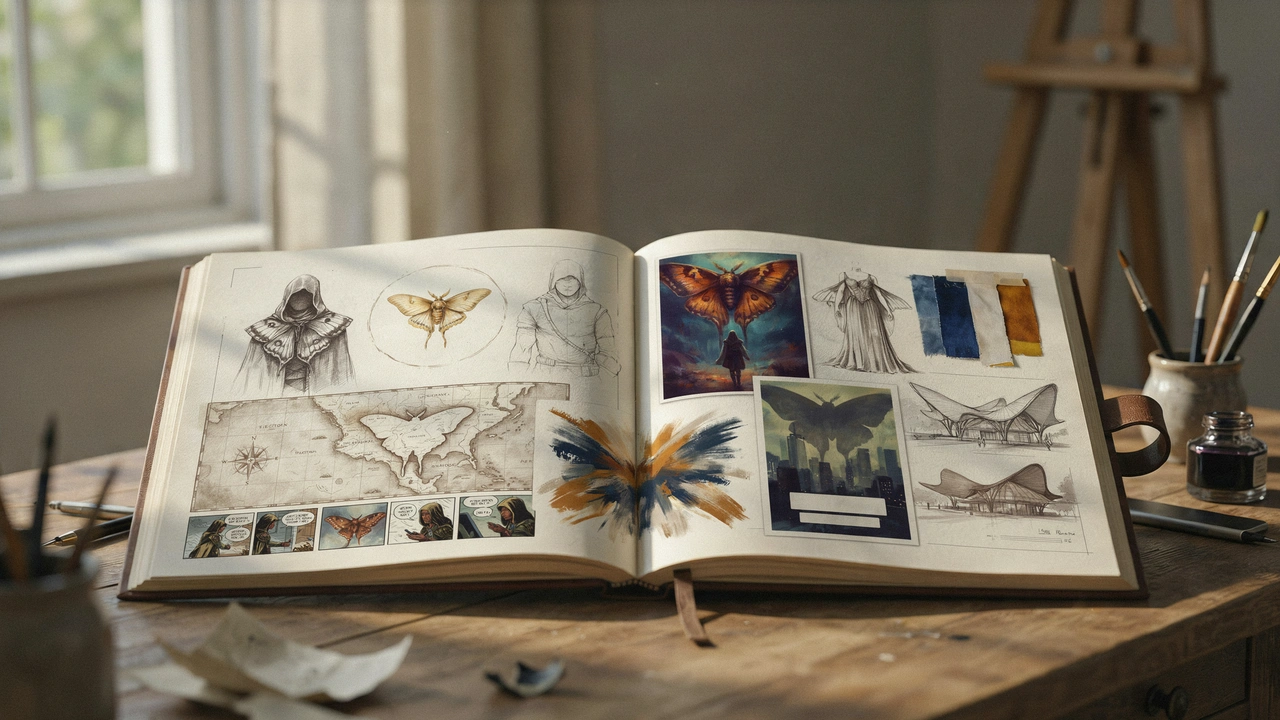
This is a specific continuation of the general Creator’s Guide.
This isn’t a guide to learning how to create art or instructions for publishing a Seed. For the submission process, see Create an Inspired Seed. Instead, it is a guide for generating art creation ideas from the content (Seeds) already on the site.
Artists have an extraordinary ability to make ideas visible.
Sometimes the inspiration is obvious. You read a story, picture one of its scenes, and immediately want to illustrate it. You see a photograph and imagine how you would paint it. A What If question creates an image in your mind before you’ve even finished reading it.
When that happens, follow it. There is nothing wrong with the obvious response when it genuinely inspires you.
But sometimes inspiration needs a little help.
A story doesn’t contain only the scenes described by its author. It contains people, places, objects, history, emotions, possibilities, and an entire world that may never appear on the page. A piece of music can suggest a landscape that has never existed. An article can become satire, symbolism, portraiture, or abstract art. Even another artist’s image can become the starting point for something completely different.
That’s what this guide is for.
The suggestions below aren’t assignments or rules, and you certainly don’t need to work through them as a list. They’re creative prompts intended to help you look at an existing Seed from different directions until something makes you want to pick up a pencil, brush, stylus, tablet, or whatever else you use to create.
Find a Seed that interests you, look at the suggestions for that Seed Type, and ask yourself:
What else could I make from this?
If the Parent Seed Is Fiction
Fiction gives artists an enormous amount of material because the finished story represents only a fraction of the world that exists in the reader’s imagination.
You could create:
- An illustration of a specific scene.
- A portrait of the protagonist.
- A portrait of a secondary character.
- A group portrait of the principal characters.
- A character as you imagined them rather than as explicitly described.
- A book cover.
- An alternate book cover in a completely different style or genre.
- A movie poster.
- A theatrical poster.
- A graphic novel or comic-book interpretation of a scene.
- A storyboard sequence.
- Concept art for an imagined film adaptation.
- Costume designs for the characters.
- Clothing, uniforms, jewelry, or other fashion from the story’s world.
- A map of the story’s world.
- A street map of a fictional city.
- A floor plan of an important building.
- An architectural rendering of a location.
- An interior design for a room described in the story.
- A landscape the characters might see.
- A location mentioned but never actually visited.
- An object or artifact important to the story.
- A technical drawing or blueprint of fictional technology.
- A vehicle from the story.
- A creature or species.
- A flag, crest, emblem, or symbol from the fictional world.
- Currency, stamps, tickets, identification cards, or other everyday objects from that world.
- A newspaper or magazine cover reporting an event from the story.
- A propaganda poster created by one of the story’s governments or organizations.
- An advertisement that might exist inside the fictional world.
- A travel poster inviting people to visit one of its locations.
- A historical painting depicting an event from the world’s past.
- A museum exhibit displaying artifacts from the story as though its events really happened.
- A portrait of what a character might look like twenty years later.
- An image of the world fifty, one hundred, or one thousand years after the story ends.
- An image showing what happened immediately before an important scene.
- An image showing what might happen immediately afterward.
- An imagined scene from a prequel.
- An imagined scene from a sequel.
- An alternate version of the story set in another historical period.
- The same world interpreted as utopian rather than dystopian, or vice versa.
- A symbolic image representing the story’s central conflict.
- An abstract work based entirely on the emotions the story created in you.
- An image inspired by one minor detail that everyone else might overlook.
You don’t have to illustrate what the writer already showed you.
You can create something the story merely made possible.
If the Parent Seed Is an Article
An article may initially seem less visual than fiction, but ideas, arguments, discoveries, and opinions can provide exceptionally rich artistic starting points.
You could create:
- An editorial illustration expressing the article’s central idea.
- A symbolic interpretation of its argument.
- A satirical cartoon.
- A political-style cartoon where appropriate.
- An infographic inspired by information in the article.
- A conceptual poster.
- A magazine cover based on its subject.
- An imagined book cover for a book exploring the same idea.
- A portrait of a person discussed in the article.
- An illustration of an event described by the author.
- A visual metaphor for the problem being discussed.
- A visual representation of the author’s proposed solution.
- A before-and-after interpretation.
- A utopian version of the future suggested by the article.
- A dystopian version of that same possibility.
- A fictional advertisement based on the article’s subject.
- A propaganda poster representing one side of the argument.
- A counter-poster representing another perspective.
- A diagram or illustrated explanation of a difficult concept.
- A historical-style illustration imagining how the subject might have been portrayed in another era.
- A speculative image showing what the idea could mean fifty years from now.
- An abstract work representing your emotional reaction to the article.
An article doesn’t have to tell you what something looks like. Sometimes the artistic challenge is deciding what an idea would look like if it could be seen.
If the Parent Seed Is Imagery
Being inspired by another artist does not mean copying their work. Ask what caught your attention and what completely different direction that element could take you.
You could create:
- Your interpretation of the same subject.
- The same concept in your own artistic style.
- A work inspired by the original color palette.
- A work inspired by its composition.
- A work inspired by its mood.
- A close-up of one small element.
- A wider scene showing what might exist beyond the original frame.
- The subject from another viewpoint.
- The scene at another time of day.
- The scene during another season.
- The same subject years earlier or later.
- A realistic interpretation of an abstract work.
- An abstract interpretation of a realistic work.
- A portrait inspired by a figure in the original.
- A landscape inspired by its atmosphere.
- A companion piece.
- An intentional visual contrast.
- A work imagining what happened immediately before the depicted moment.
- A work imagining what happens next.
- A poster inspired by the image.
- A book or album cover inspired by its mood.
- A sculpture or three-dimensional interpretation.
- A collage that explores one of its ideas.
- A completely different subject that creates the same emotional response.
The question isn’t necessarily, “How would I make this?”
Try asking, “What was it about this image that made me want to make anything at all?”
If the Parent Seed Is Photography
A photograph captures what existed in front of a camera. An artist is free to imagine everything outside it.
You could create:
- A painted or illustrated interpretation of the photograph.
- A portrait of someone pictured.
- A landscape based on the location.
- The scene from another viewpoint.
- What might exist beyond the edge of the photograph.
- The same location in another season.
- The same place decades in the past.
- The same place decades in the future.
- A fantasy version of the location.
- A science-fiction interpretation.
- A historical reinterpretation.
- An illustration based on one small detail.
- A travel poster.
- A postcard.
- A magazine cover.
- A movie poster inspired by the photograph’s mood.
- A fictional advertisement using the setting.
- An imagined building or environment inspired by its shapes.
- A color study based on its palette.
- An abstract work based on its light and shadow.
- A work attempting to recreate the emotion rather than the subject of the photograph.
If the Parent Seed Is Poetry
Poetry gives an artist something especially interesting: imagery created entirely through language, rhythm, metaphor, and emotion.
You could create:
- A literal interpretation of an image described in the poem.
- A symbolic interpretation.
- A portrait inspired by the narrator.
- An imagined setting.
- A book or poetry collection cover.
- An illustrated page.
- A series of images representing different verses.
- A visual interpretation of a metaphor.
- A work based on a single line or phrase.
- A color study based on the poem’s mood.
- An abstract emotional interpretation.
- A typographic artwork incorporating a short permitted excerpt.
- A surreal interpretation of the poem’s imagery.
- A scene representing what you believe happened before the poem.
- A scene representing what might happen afterward.
- An image deliberately capturing the feeling of the poem without depicting anything mentioned in it.
If the Parent Seed Is Audio
Close your eyes and listen before deciding what to make.
Music, spoken word, soundscapes, and other audio can inspire visual work without providing a single visual reference.
You could create:
- Album or single cover art.
- A concert poster.
- An imagined scene where the music might be playing.
- A landscape suggested by the sound.
- A portrait of an imagined character who belongs with the music.
- A visual representation of its rhythm.
- An abstract interpretation of its mood.
- A color palette translated into a finished artwork.
- A comic sequence inspired by the progression of the piece.
- A cinematic frame from the movie you imagine while listening.
- An imagined location where the audio originated.
- A visual interpretation of spoken-word imagery.
- A surreal representation of a particular sound.
- Artwork representing how the piece makes you feel rather than what you think it means.
If the Parent Seed Is Video
Video already provides images, which makes simply recreating a frame tempting. But it also gives you characters, environments, movement, emotion, storytelling, sound, and countless moments that were never shown.
You could create:
- A poster for the video.
- An alternate poster emphasizing a different idea.
- A character portrait.
- A portrait of a minor character.
- Concept art.
- A storyboard interpretation.
- A comic adaptation of a sequence.
- A scene that happens between two moments in the video.
- An imagined deleted scene.
- A prequel image.
- A sequel image.
- A map of the setting.
- A detailed rendering of a location.
- Costume or prop designs.
- An important object from the video.
- An image from another character’s point of view.
- A magazine cover about an event depicted in the video.
- An advertisement from inside its world.
- A completely different visual interpretation of its central idea.
- An abstract work based on the emotion created by the video.
If the Parent Seed Is a What If?
A What If Seed may be one of the most open-ended starting points an artist can find because it presents a possibility without deciding what that possibility should look like.
You could create:
- The first image that entered your mind when you read the question.
- A realistic depiction of the proposed world.
- An optimistic interpretation.
- A disturbing interpretation.
- A humorous interpretation.
- A scene from everyday life if the What If became reality.
- A portrait of someone living in that world.
- A city or landscape shaped by the premise.
- Architecture that might develop because of it.
- Clothing or fashion from that world.
- Technology created in response to the premise.
- A product advertisement from that future.
- A government propaganda poster.
- A protest poster opposing it.
- A magazine cover announcing the change.
- A newspaper front page depicting its consequences.
- A travel poster for the new world.
- A map showing how the world has changed.
- A scientific illustration.
- A museum exhibit looking back on the event generations later.
- A book cover for the story the question makes you imagine.
- A movie poster for a film that doesn’t exist.
- A character portrait of someone affected by the premise.
- A comic panel capturing one moment within that world.
- An abstract representation of the ethical question behind the premise.
- An image showing the best possible outcome.
- An image showing the worst possible outcome.
- An image showing the completely unexpected outcome.
A What If gives you the question.
You get to decide what the answer looks like.
If the Parent Seed Is Other
“Other” exists because creativity doesn’t always fit neatly into categories. That makes these Seeds particularly interesting starting points.
Begin by asking what attracted you to the Seed. Was it the subject, an emotion, a question, an object, a technique, a memory, an argument, or simply something you can’t quite explain?
Then try changing the question from “What can I make from this?” to:
“What part of this do I want to explore?”
Once you’ve identified that, many of the approaches throughout this guide can be applied regardless of the Parent Seed Type. Create a portrait, environment, map, poster, cover, artifact, alternate history, imagined future, abstract interpretation, or something that doesn’t yet have a name.
The categories help us organize creativity.
They don’t define its limits.
Use These Ideas as Starting Points
You don’t need to choose one of the suggestions in this guide exactly as written. Combine two. Change one. Reverse one. Take an idea intended for Fiction and try it with a piece of music. Use a suggestion from the Photography section on a poem.
Or read twenty suggestions, reject all of them, and create the twenty-first idea they caused you to think of.
That may be the best use of this guide.
The goal is simply to give you more places to begin.
Looking Forward
As the community grows, we hope to make creative exploration itself part of the experience.
Future versions may introduce Creative Accomplishments that recognize artists for trying different kinds of creative responses, such as creating a first character portrait, book cover, fictional map, abstract interpretation, or cross-discipline work. Other milestones may recognize sustained participation with badges celebrating accomplishments within particular creative disciplines.
These ideas are planned for future development and will continue evolving as we learn how creators actually use the community.
For now, you don’t need a badge to experiment.
Choose a Seed.
Look at it from a direction you haven’t tried before.
And make something only you would have thought to create.