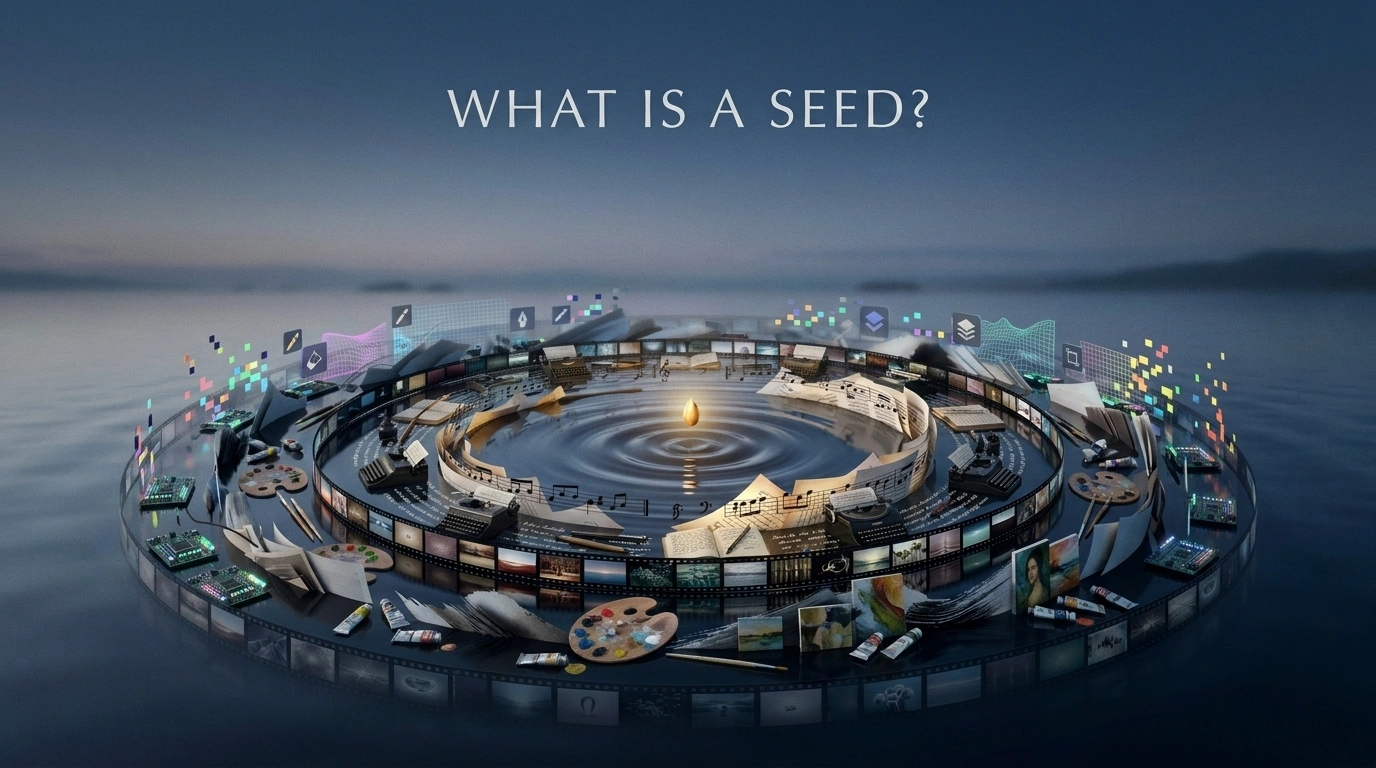
A Seed is a user-contributed creative work with two jobs: to express something worth sharing, and to inspire someone else to take that idea somewhere new.
It may communicate an idea, a question, a feeling, a possibility, a point of view, or an experience. The creator chooses the form that communicates it best: a story, factual article, opinion, painting, digital art, photograph, song, essay, video, poem, animation, or another kind of creative work.
But expression is only half of what makes it a Seed.
A Seed also carries something forward. It begins with inspiration from another Seed already published in this community, then becomes a new source of inspiration for whatever may come next. In that sense, every Seed occupies a unique place in the creative process. It is both a response to something that already exists and an invitation for someone else to respond in turn.
That simple exchange is how a single idea can become a creative genealogy.
A Seed Communicates Something
The first responsibility of a Seed is the same as that of any meaningful creative work: it should communicate something.
That does not mean it has to be profound, serious, polished to perfection, or easily summarized in a sentence. A humorous drawing can communicate something. So can an unsettling photograph, an instrumental composition, a speculative story, a personal essay, or a three-minute film.
What matters is that the work contains an idea, concept, feeling, question, observation, or perspective that another person can encounter and respond to.
A Seed should give the next creator something to work with.
Sometimes that “something” will be obvious. A story about an underwater civilization might inspire someone to illustrate the city. Another person might write about the political system that could develop there. A musician might imagine what the place sounds like.
Other connections may be far less predictable, and those are often the most interesting.
A Seed Begins With Another Seed
On this site, a Seed does not begin in isolation.
A creator first discovers an existing Seed that sparks something in them. Perhaps they see an unanswered question, disagree with an idea, become fascinated by a minor detail, imagine the story from another perspective, or simply experience a feeling they want to express in a different medium.
They then create something new because of that inspiration.
The new work does not need to resemble its parent. In fact, one of the most interesting things about creative evolution is how quickly an idea can change as it passes from one person to another and from one creative discipline to another.
The connection does, however, need to be genuine.
That is important because this is not simply a place to post unrelated creative work. The value of the community comes from being able to follow the connections and see how one creation led to the next.
The Inspiration Statement Preserves the Connection
Every Seed includes a required Inspiration Statement explaining how the parent Seed inspired the new work.
Sometimes a sentence or two will make the relationship perfectly clear. Other times, the connection may be more personal, abstract, or unexpected. In those cases, creators are encouraged to use the About This Seed section to explain more about what they saw in the parent Seed and how it influenced what they created.
This is not about forcing creativity into neat categories. It is about preserving a piece of information that normally disappears: why one creative work led to another.
Over time, those explanations help tell the larger story of the genealogy. They allow someone exploring a branch years later to understand not only what was created, but what one creator discovered in another person’s work that caused something new to exist.
Every Seed Can Start New Branches
A Seed has one parent, but it may eventually inspire many children.
Imagine a single story inspiring five completely different responses. One creator paints a scene from it. Another writes a fictional news report about its world. Someone else composes music inspired by its mood. A fourth creator challenges one of its assumptions in an essay, while a fifth writes a new story from the perspective of a minor character.
Each of those works becomes a Seed of its own.
Now each can inspire more.
This is where individual creativity begins to become something larger. No one person plans the genealogy. No one knows where it will lead. Each creator contributes one new interpretation, and the combined imagination of the community determines what grows from there.
That is the group genius at the heart of the idea.
A Seed Is Both a Continuation and a Beginning
This may be the most important thing to understand about a Seed.
When you create one, you are continuing a creative path that someone else began. Your work becomes part of that history.
At the same time, you are creating a new starting point.
Someone may respond to an idea you considered central to your work. Someone else may be inspired by a detail you barely noticed. A third person may transform your Seed into another medium and send the genealogy in a direction you never imagined.
There is no final generation.
A Seed published today may inspire something tomorrow, next year, or much later. As long as another creator can discover it and find something worth continuing, its creative possibilities remain open.
What Qualifies as a Seed?
The philosophy is open-ended, but the basic requirements are intentionally simple.
A Seed can only be created from another published Seed. For now, members cannot create new Original Seeds from the front end. Every member-created Seed begins with an existing Seed and becomes part of its genealogy.
A Seed has one parent. This keeps each line of inspiration clear and makes it possible to follow the genealogy from one generation to the next.
A Seed must be genuinely inspired by its parent. The new work may take the idea in a radically different direction, but there must be a meaningful connection. Submissions with no reasonable relationship to their parent may be removed so the genealogy remains useful rather than becoming a collection of unrelated self-promotion.
Every Seed requires an Inspiration Statement. If the relationship is not immediately obvious, creators are encouraged to explain it further in About This Seed.
A Seed should have the potential to inspire again. It does not need to predict what someone else might create. It simply needs to offer something another person might see, question, reinterpret, challenge, or carry forward.
That is the cycle: be inspired, create something new, then give someone else a reason to continue.
What Could Your Seed Become?
You may know exactly what inspired your creation.
What you cannot know is what your creation might inspire next.
That uncertainty is part of the point. A Seed enters the genealogy carrying the ideas of the work that came before it, your own interpretation of those ideas, and possibilities that will only become visible when another creator encounters what you made.
Your Seed may become the end of one branch. It may become the beginning of a hundred.
Either possibility starts the same way: someone discovers something here that makes them want to create.
Ready to continue a branch? Learn how to create an Inspired Seed and add your own idea to a creative genealogy whose next chapter has not been written yet.