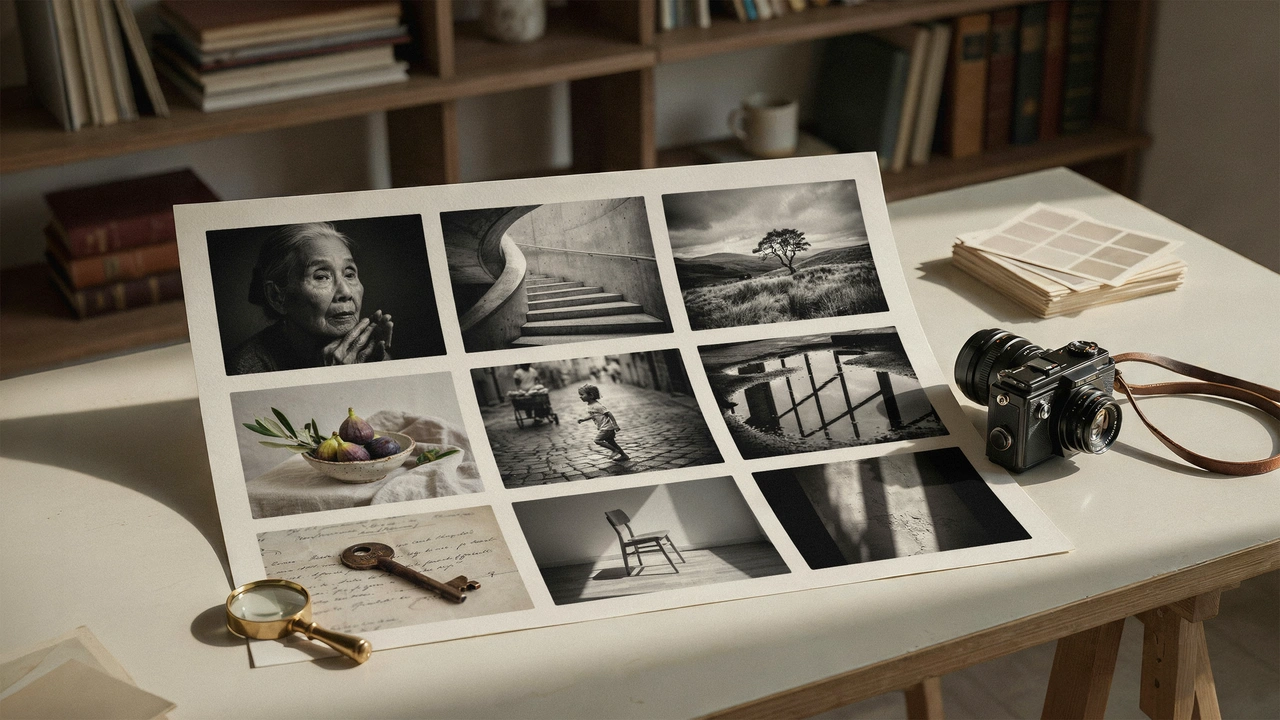
This is a specific continuation of the general Creator’s Guide.
Photography has a wonderful constraint that many other creative disciplines do not: sooner or later, you have to find something that can actually exist in front of your camera.
That does not limit what can inspire you. It simply changes the question. A science-fiction story may describe a city you cannot photograph, but perhaps you can find a modern building whose architecture captures its feeling. A poem about loneliness might lead you to an empty bus stop at night. A painting could inspire a portrait using similar lighting and composition. A What If? Seed might send you searching for an ordinary place that, photographed from the right angle, suddenly suggests an entirely different world.
This guide is designed to help you make those connections. It is not about cameras, lenses, exposure, editing, or how to submit your photographs to the site. For submission instructions, see Create an Inspired Seed.
Instead, use the ideas below as starting points for finding photographs you can realistically make from the Seeds you discover here. Some may require nothing more than noticing something differently on your next walk. Others might involve arranging a still life, working with a willing model, visiting a public location, waiting for the right weather, or creating a simple scene specifically for the photograph.
You do not need to recreate the Parent Seed. You need to discover what it makes you want to photograph.
If the Parent Seed Is Fiction
Stories provide photographers with characters, places, emotions, objects, relationships, conflicts, and atmosphere. You probably cannot photograph the fictional world exactly as its author imagined it, but you can find or create real-world equivalents that express something about it.
You could photograph:
- A real location that reminds you of an important setting.
- A landscape that captures the atmosphere of the story.
- Architecture that could plausibly belong in its world.
- An interior that resembles a room or environment described in the story.
- A willing model portraying your interpretation of a character.
- A character portrait using clothing, lighting, and setting to suggest personality.
- Two or more models recreating the emotional relationship between characters.
- A silhouette that suggests a character without attempting literal casting.
- A staged photograph inspired by an important scene.
- The moment immediately before or after a scene rather than the scene itself.
- A still life assembled from objects that represent the story.
- An ordinary object photographed as though it were an important artifact from the fictional world.
- A photograph suggesting something a character might see through their own eyes.
- A location that could represent the story if it took place in your own town.
- A modern location photographed to suggest a more futuristic world.
- An older building, vehicle, room, or object that reimagines the story in the past.
- Reflections, shadows, fog, rain, darkness, or unusual light that reproduce the story’s mood.
- A photograph representing the central conflict symbolically rather than literally.
- A series showing several real-world places that could belong to the story.
- A deliberately ambiguous image that makes viewers wonder what happened just outside the frame.
- A photograph of something barely mentioned in the story that captured your imagination.
- A conceptual self-portrait expressing how the story made you feel.
You are not trying to turn yourself into a movie production company. Work with what exists around you and ask which fragments of the fictional world you can make visible.
If the Parent Seed Is an Article
Articles can provide subjects, ideas, arguments, people, places, social issues, technologies, or everyday phenomena worth examining through a camera.
You could photograph:
- A real-world example of the subject being discussed.
- A location connected to the article’s theme.
- Everyday evidence of a larger issue described in the article.
- A portrait of someone whose work or life relates to the subject, with their cooperation.
- A photo essay exploring the topic in your own community.
- Contrasting images showing two sides of an issue.
- An object that symbolizes the article’s central argument.
- A carefully constructed still life representing the subject.
- Old and new objects together to explore technological or cultural change.
- Evidence of how a technology has entered ordinary life.
- Architecture or infrastructure connected to the subject.
- A detail most people pass every day without noticing.
- A photograph showing the human consequences of an otherwise abstract subject.
- A visual contradiction that challenges or complicates the article’s argument.
- A humorous or ironic real-world interpretation.
- A series documenting change over time when the subject allows it.
- A conceptual photograph expressing your personal response rather than documenting the subject literally.
Where people, private property, restricted locations, or sensitive situations are involved, work with appropriate permission and respect the people you’re photographing. A compelling idea rarely requires invading someone’s privacy to communicate it.
If the Parent Seed Is Imagery
Another visual work can be a particularly rich starting point because you can translate choices made by an artist into things you can find, arrange, light, and photograph in the physical world.
You could photograph:
- A real-world subject resembling something depicted in the artwork.
- A location with a similar composition.
- A scene using the original work’s dominant colors.
- A portrait inspired by its lighting.
- A still life based on its arrangement of shapes or objects.
- A real environment that produces a similar mood.
- A model posed to echo the composition without attempting to duplicate it.
- Clothing or objects inspired by the artwork’s textures.
- A photograph concentrating on one overlooked detail from the original.
- A real-world version of an abstract shape or pattern.
- Reflections or shadows that echo forms in the artwork.
- Natural textures resembling its brushwork or surface.
- A deliberately opposite interpretation, such as finding calm in response to chaotic artwork.
- A photograph that captures the same emotion using an entirely different subject.
- A small series showing where you found visual echoes of the artwork in everyday life.
The challenge can be especially interesting when the Parent Seed is highly imaginative. Instead of asking how to reproduce something impossible, ask what real thing shares one of its qualities.
If the Parent Seed Is Photography
Another photographer’s image can inspire you without becoming a photograph you try to duplicate.
You could explore:
- The same subject photographed in your own environment.
- A similar subject from a completely different perspective.
- A photograph using similar lighting.
- A composition inspired by the original.
- A different location with the same mood.
- The same type of location at another time of day.
- A similar scene in different weather.
- A photograph inspired by the original color palette.
- A monochrome response to a colorful Parent Seed, or the reverse.
- A close-up response to a wide landscape.
- A wide environmental response to an intimate detail.
- A portrait inspired by an environmental photograph.
- An environmental photograph inspired by a portrait.
- A still life using similar shapes or visual relationships.
- A photograph emphasizing what the Parent Seed leaves outside its frame.
- A series exploring the same general subject in your own community.
- A deliberately contrasting response: crowded versus empty, new versus old, natural versus artificial, movement versus stillness.
- Your interpretation of the emotion rather than the subject.
If the Parent Seed depicts a distinctive location you cannot reasonably visit, you do not need to. Ask what made the location interesting and search for that quality where you actually are.
If the Parent Seed Is Poetry
Poetry often gives photographers emotion and imagery without prescribing exactly what should appear in the frame.
You could photograph:
- A real object mentioned in the poem.
- A landscape suggested by its imagery.
- A location that captures its mood.
- A portrait representing its narrator or subject.
- A staged scene inspired by one moment in the poem.
- A still life built around one metaphor.
- An image based on a recurring color, object, or symbol.
- A photograph inspired by a single line.
- An empty space representing absence or loss.
- Movement representing energy, confusion, or change.
- Reflections representing memory or identity.
- Shadows representing something concealed or unresolved.
- Weather that reflects the emotional tone.
- A sequence of photographs corresponding to different sections of the poem.
- A completely nonliteral photograph that creates the same feeling in you.
Poetry is an excellent opportunity to stop asking, “What does this describe?” and instead ask, “What could I photograph that feels like this?”
If the Parent Seed Is Audio
Audio removes the visual reference entirely, which can make it especially useful when you want to break familiar photographic habits.
Listen first. Then notice what you begin to see.
You could photograph:
- The place the music makes you imagine.
- A real landscape that matches its mood.
- An urban environment that fits its rhythm.
- A portrait inspired by its emotional tone.
- A model moving in response to the music.
- Long-exposure movement inspired by its rhythm.
- Repeating patterns that visually echo a beat.
- Quiet minimalist scenes inspired by sparse audio.
- Busy street scenes inspired by energetic music.
- A still life using colors and textures suggested by the sound.
- A photograph of the environment where you would want to hear the piece.
- Musicians or instruments, when you have appropriate access, interpreted through the mood of the Parent Seed rather than simply documented.
- Light and shadow that reflect changes in intensity.
- A series progressing visually as the audio progresses emotionally.
- An abstract photographic study using reflections, motion, focus, or light to translate sound into imagery.
The photograph does not have to show music. It can show what the music caused you to notice.
If the Parent Seed Is Video
Video provides an abundance of visual material, but reproducing one of its frames is only the most obvious response.
You could photograph:
- A real location that evokes the video’s setting.
- A portrait inspired by one of its characters.
- A staged scene inspired by its central idea.
- A moment that might plausibly occur before or after something shown.
- An object representing an important part of the video.
- A still life assembled from visual motifs you noticed.
- A location with similar lighting or atmosphere.
- A photograph capturing the video’s mood without using any of its literal imagery.
- A documentary-style image exploring a real-world subject raised by the video.
- A small photo essay expanding on one of its themes.
- A behind-the-scenes-style interpretation of how an imagined world might look in ordinary life.
- A photograph from the perspective of someone the video never follows.
- A series translating motion into individual frozen moments.
- A deliberately quiet photograph inspired by a fast or chaotic video, or the reverse.
Look beyond what the camera in the Parent Seed already showed. Ask what another camera, in another place or pointed in another direction, might discover.
If the Parent Seed Is a What If?
What If? Seeds are especially useful for conceptual photography because you can search the real world for fragments of a possibility that does not fully exist.
You could photograph:
- A real location that already looks surprisingly close to the imagined world.
- An ordinary object framed so it appears futuristic, mysterious, or unfamiliar.
- A model representing someone living with the consequences of the premise.
- A staged everyday moment showing how life might change.
- Existing architecture that could plausibly belong in that future.
- Old technology photographed as though the premise happened in the past.
- Modern technology isolated from context so viewers see it differently.
- A still life containing objects someone in that imagined world might carry.
- A portrait showing an emotional consequence of the question.
- A location suggesting the optimistic outcome.
- Another suggesting the darker outcome.
- A series contrasting today’s world with visual hints of the imagined one.
- A conceptual photograph representing the ethical question rather than its literal scenario.
- Signs, reflections, screens, shadows, or environmental details that can suggest the premise without requiring elaborate sets or digital effects.
- A deliberately mundane image showing how something extraordinary might eventually become ordinary.
You do not have to photograph an impossible future. Sometimes the most convincing speculative photograph is something that already exists but suddenly means something different because of the question that led you to it.
If the Parent Seed Is Other
Start with what caught your attention.
If it was an object, find a real-world counterpart. If it was an emotion, search for a place, person, light, color, or moment that expresses it. If it was an idea, look for evidence of that idea in everyday life. If it was something stranger that you cannot easily describe, take your camera somewhere and deliberately look for visual echoes of it.
You might create a portrait, landscape, still life, street photograph, architectural study, conceptual image, abstract photograph, documentary image, self-portrait, or photo essay.
The Parent Seed gives you the connection.
Your camera decides where you find it.
Use These Ideas as Starting Points
Photography rewards exploration, so don’t treat this guide as a checklist. Take an idea from one section and apply it to another. Combine several prompts. Change the subject. Walk through a familiar neighborhood while deliberately looking for something a Seed has made you notice differently.
And don’t limit yourself to this guide.
The Artist’s Guide contains many additional ideas that photographers can adapt. You may not be able to photograph an imaginary city exactly as an illustrator can draw one, but an idea for a book cover, character study, abstract interpretation, fictional artifact, or visual symbol may lead you toward a photograph you can create. The difference between the disciplines can itself become a source of inspiration.
Sometimes you will go out specifically looking for a photograph.
Other times, a Seed simply gives you a reason to notice the photograph that was already waiting in front of you.
Looking Forward
As the community grows, we hope to recognize creators who challenge themselves to explore photography in different ways.
Future Creative Accomplishments might recognize milestones such as creating your first Seed-inspired portrait, conceptual photograph, still life, photo essay, cross-discipline interpretation, or photographic response to a Seed Type you haven’t explored before. Separate badges may recognize sustained contributions and milestones within Photography.
These features are planned for future development, and the possibilities will continue to evolve as photographers show us ways of responding to Seeds that we haven’t thought of yet.
For now, you don’t need an accomplishment to give yourself the challenge.
Choose a Seed that interests you. Take one idea from this guide that you wouldn’t normally try, grab your camera, and see what you can find.