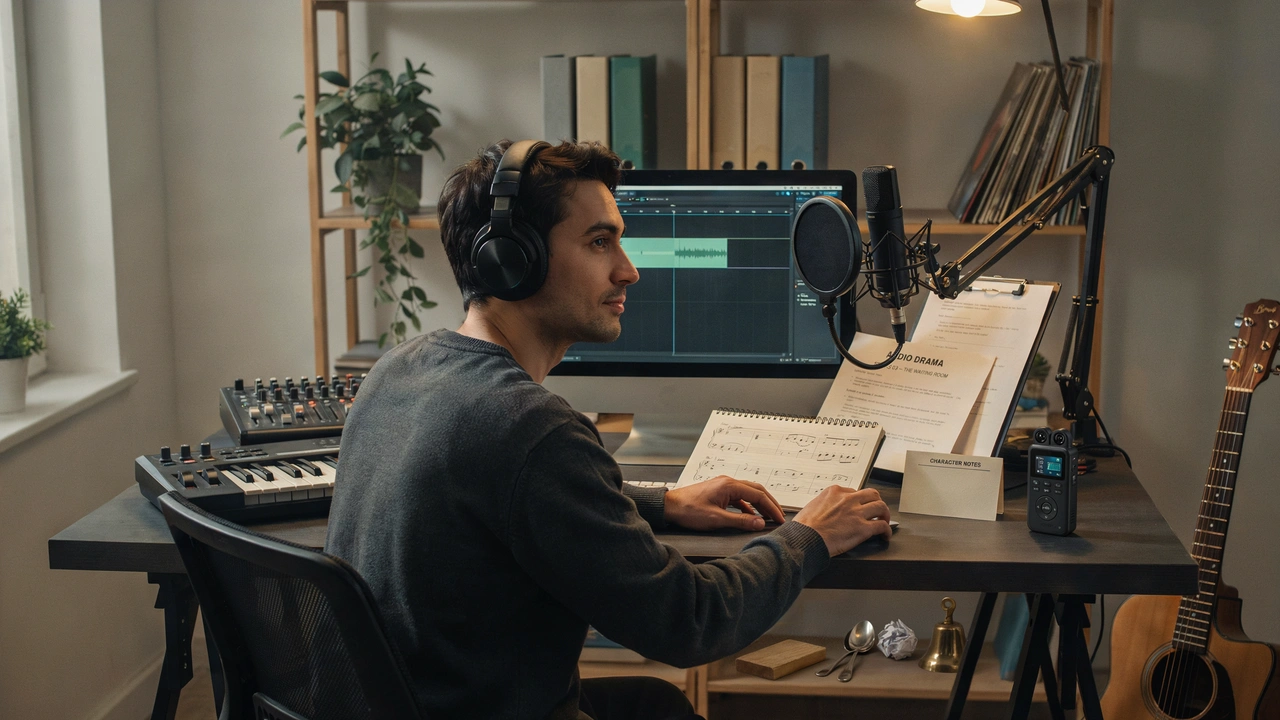
This is a specific continuation of the general Creator’s Guide.
Sound can do something remarkable: it can take an idea that began as words, an image, a question, or another piece of audio and turn it into an experience that unfolds through time.
A Fiction Seed might suggest a character theme, a dramatic score, a narrated scene, or an entirely new audio drama. A photograph might make you hear the sounds of the place where it was taken. A poem could become the inspiration for an original song. An article might lead to a podcast examining the issue in greater depth. A What If? could become a fictional news broadcast from a future that never existed.
And sometimes the inspiration is much smaller. One sentence makes you hear a melody. One image suggests a sound. One character needs a voice.
This guide is for musicians, composers, singers, songwriters, podcasters, voice performers, sound designers, audio dramatists, field recordists, and anyone else who creates with sound. It is not about the mechanics of publishing your Seed. For those instructions, see Create an Inspired Seed.
The purpose here is to expand the possibilities of what an Audio Seed can be and help you discover things you could create from the Seeds already growing throughout this site.
What Can an Audio Seed Be?
Don’t think of Audio as meaning only “music.” Audio Seeds can encompass many forms of original creative work.
You might create:
- Original Music: A new instrumental or vocal composition inspired by a Parent Seed.
- Song: Original music and lyrics responding to an idea, character, story, image, emotion, or subject.
- Character Theme: Music representing a particular character.
- Musical Score: Music inspired by a scene, story, image, or imagined sequence.
- Ambient Composition: Sound and music designed to evoke a particular environment, mood, or experience.
- Soundscape: A constructed audio environment using recorded, created, or combined sounds.
- Field Recording: Sounds captured from a real location when that environment meaningfully responds to the Parent Seed.
- Sound Effects: An individual effect or collection of original effects inspired by something in the Parent Seed.
- Foley: Created sounds representing actions, objects, environments, or events.
- Audio Portrait: A sound-based interpretation of a person, character, place, or idea.
- Spoken-Word Piece: An original performance using voice, language, rhythm, and sound.
- Poetry Performance: Your own original poetry written and performed in response to a Seed.
- Story Excerpt: A performed excerpt from a written work, subject to the permissions discussed below.
- Original Audio Fiction: A completely new story created specifically to be experienced through sound.
- Audio Drama: Fiction performed using actors, narration, dialogue, music, and/or sound effects.
- Monologue: An original fictional character speaking directly to the listener.
- Fictional Interview: An audio interview with an imagined character.
- Fictional Broadcast: A news report, emergency announcement, documentary, advertisement, transmission, or other recording from an imagined world.
- Podcast: A factual or creative discussion inspired by the Parent Seed.
- Audio Essay: A researched, reflective, analytical, or personal essay presented through sound.
- Commentary or Opinion: Your perspective on an idea raised by the Parent Seed.
- Review or Critique: An audio examination of a creative work, idea, performance, argument, or subject.
- Educational Audio: An explanation, lesson, guide, or introduction to a subject.
- Interview: A conversation with someone whose experience or expertise relates meaningfully to the Parent Seed.
- Documentary Audio: Reporting, interviews, narration, and sound assembled to explore a real subject.
- Fact-Check or Investigation: An audio examination of claims or questions raised by another Seed.
- Guided Experience: Audio designed to lead the listener through a place, process, story, or idea.
- Experimental Audio: Creative sound work that doesn’t fit neatly into any of the categories above.
These forms can overlap. A podcast might contain music and interviews. An audio drama might incorporate field recordings. A song could contain spoken word. A documentary might use sound design to establish place.
The important question isn’t “What counts as audio?”
It is “What could I create with sound because this Seed inspired me?”
A Note About Recording Someone Else’s Work
There is an important distinction between being inspired by another creator’s work and reproducing that work.
If the Parent Seed is a story, poem, article, essay, or other written work created by someone else, do not record and publish the entire work exactly as written unless you have received permission from the creator or otherwise have the necessary rights to do so.
A short excerpt can be useful when appropriate. For example, you might perform a brief passage before discussing why it inspired your composition or use a short excerpt as part of a larger original response. But an Audio Seed should not become an unauthorized audiobook or complete audio reproduction of someone else’s Parent Seed.
There is usually a much more interesting alternative anyway: create something new from what inspired you.
Perform a monologue from the perspective of a minor character. Compose the music you imagine playing during a scene. Create the sounds of the fictional environment. Produce a podcast about the real issue behind the story. Write an original audio drama exploring something the author left unanswered.
The Parent Seed provides the inspiration. Your Audio Seed should provide the next creative contribution.
If the Parent Seed Is Fiction
Fiction gives an audio creator an entire world to listen for, including many things the original author may never have described.
You could create:
- An original musical theme for the story.
- A theme for one particular character.
- Different musical themes for the protagonist and antagonist.
- Music for an important scene.
- An imagined opening or closing theme.
- A soundtrack for the world of the story.
- Ambient audio representing an important location.
- A soundscape of a fictional city, spacecraft, forest, battlefield, laboratory, home, or other environment.
- Sound effects for fictional technology.
- The sound of a creature described in the story.
- Audio representing an object, machine, vehicle, or invention.
- A short performed excerpt from the story, subject to appropriate permissions and use.
- An original character monologue.
- A conversation between characters that never appeared in the original.
- An audio scene showing what happened immediately before or afterward.
- An original sequel scene.
- An original prequel scene.
- A story about a minor character.
- A fictional radio broadcast reporting the story’s events.
- An emergency announcement from within its world.
- A podcast produced by fictional residents of that world.
- A political speech from one of its leaders.
- A fictional advertisement for something sold there.
- A tourist guide to one of its locations.
- An oral history recorded years after the events.
- A future historian’s audio documentary about what happened.
- A “found recording” discovered after the story.
- An audio diary belonging to a character.
- An original song a character might know.
- Music belonging to the fictional culture.
- A real-world podcast discussing the story’s themes.
- A discussion of the science, history, ethics, or social questions behind the fiction.
- A review or critical discussion of the story.
The writer gave you a world in words.
Ask yourself what that world sounds like.
If the Parent Seed Is an Article
An Article Seed can inspire many of the same responses available to a non-fiction writer, except your tools include voice, conversation, music, interviews, and environmental sound.
You could create:
- A podcast expanding upon the article.
- An audio essay.
- A commentary or opinion response.
- A respectful disagreement.
- A supporting argument.
- A fact-check.
- A research-based explainer.
- An interview with someone knowledgeable about the subject.
- A conversation between people with different perspectives.
- A news-style update.
- A historical backgrounder.
- A scientific explainer.
- An educational episode for beginners.
- A documentary-style investigation.
- A personal story related to the issue.
- An audio case study.
- A “pros and cons” discussion.
- A myth-versus-fact episode.
- A guide or instructional recording.
- A summary followed by your own analysis.
- A soundscape connected to the subject.
- An original song inspired by the article’s theme.
- A satirical fictional broadcast based on the idea.
- An imagined future news report showing where the issue might lead.
Don’t feel obligated to simply read an article aloud. Audio gives you ways to respond that the written page cannot.
If the Parent Seed Is Imagery
An image is silent, which gives an audio creator tremendous freedom to decide what might be heard within, around, or because of it.
You could create:
- A soundscape representing the scene.
- Ambient sound for the depicted environment.
- A musical interpretation of the image.
- A composition based on its colors or mood.
- Music representing a person shown in the artwork.
- Sounds associated with objects depicted.
- An imagined conversation between figures in the image.
- A character monologue from someone pictured.
- An audio story explaining what happened before the depicted moment.
- An audio story about what happens afterward.
- A fictional tour guide describing the place.
- A fictional news report about the event shown.
- An audio diary belonging to a person depicted.
- A poem or spoken-word piece inspired by the artwork.
- An abstract sound composition translating its shapes, movement, textures, or colors into sound.
- A podcast discussing what the artwork made you think about.
- An audio critique or appreciation of the work.
- A completely different sound experience designed to evoke the same emotion.
One useful experiment is simply to look at the image for a minute and then close your eyes.
What do you hear?
If the Parent Seed Is Photography
A photograph captured what something looked like at one moment. You can explore what that moment might have sounded like or what questions it raises.
You could create:
- A realistic soundscape of the photographed environment.
- Field recordings from the actual location when reasonably accessible.
- Recordings from a similar environment when the original location isn’t accessible.
- A musical response to the photograph.
- An audio portrait inspired by a person pictured.
- An imagined internal monologue.
- A fictional conversation occurring just outside the frame.
- An audio story about what happened before or after the photograph.
- A documentary about the location.
- A travel audio guide.
- A historical podcast about the place.
- Interviews related to the subject shown.
- A nature recording inspired by a landscape or wildlife photograph.
- An urban soundscape inspired by street photography.
- An audio essay about what the photograph communicates.
- A spoken-word response to its emotional quality.
- A fictional broadcast connected to the scene.
- An experimental piece translating visual elements such as movement, repetition, light, or contrast into sound.
If you cannot visit the location, don’t pretend that you did. Create a clearly imaginative interpretation or find an accessible environment that captures the quality that inspired you.
If the Parent Seed Is Poetry
Poetry and audio have a natural relationship because rhythm, pacing, silence, repetition, and voice can become creative materials themselves.
You could create:
- An original song inspired by the poem.
- Instrumental music expressing its mood.
- A soundscape inspired by its imagery.
- An original poem responding to it.
- A spoken-word response.
- A short performed excerpt, subject to appropriate permissions and use.
- A discussion of the poem.
- An audio essay about its themes.
- Music based on the emotional progression of the work.
- A character monologue inspired by its narrator.
- An audio story built around one metaphor.
- Sounds representing an environment described in the poem.
- A piece deliberately contrasting with its mood.
- An original work inspired by a single image or idea rather than the entire poem.
You don’t need to turn someone else’s poem into an audio recording.
Let it become the reason you create another piece of sound.
If the Parent Seed Is Audio
Another Audio Seed may give you the most obvious connection, but don’t limit yourself to creating something that sounds similar.
You could create:
- A musical response.
- A contrasting composition.
- A new piece inspired by its rhythm.
- A composition inspired by its instrumentation.
- A work based on its mood.
- A new soundscape inspired by its environment.
- A remix or transformation when the creator has given permission and you have the necessary rights.
- A companion piece.
- A musical answer to a musical question.
- An original song inspired by something said in a podcast.
- A podcast responding to another podcast.
- A fact-check of factual claims.
- A respectful counterargument.
- An interview exploring something raised in the recording.
- An audio essay about a question it left unanswered.
- A fictional story inspired by a factual recording.
- A factual investigation inspired by a fictional one.
- A sound effect suggested by one sound within the Parent Seed.
- A completely different audio form inspired by the same central idea.
Listen beyond the obvious.
Sometimes the most interesting response to a song isn’t another song.
If the Parent Seed Is Video
Video gives you dialogue, images, movement, music, environments, ideas, and stories from which to choose.
You could create:
- Music inspired by the video.
- An alternate musical interpretation of its mood.
- A soundscape inspired by a location.
- Original sound effects inspired by something depicted.
- An audio story based on an unanswered question.
- A fictional character monologue.
- A podcast about the video’s subject.
- An audio review.
- A factual companion piece.
- An interview.
- A fact-check.
- An educational explainer.
- An audio description or discussion of something briefly shown.
- A documentary-style expansion of one subject.
- A fictional broadcast inspired by the world depicted.
- A spoken-word response.
- A piece based only on the video’s emotional effect.
As with written Parent Seeds, do not simply extract or reproduce another creator’s entire soundtrack, narration, dialogue, or video as an Audio Seed without permission or the necessary rights. A short excerpt may sometimes be appropriate as part of a genuinely new work, but the goal is response and transformation, not duplication.
If the Parent Seed Is a What If?
What If? Seeds can be especially powerful for audio because you can make an imaginary possibility sound as though it is actually happening.
You could create:
- An original song inspired by the premise.
- A musical score for the world it suggests.
- A soundscape of that imagined world.
- An original audio drama.
- A character monologue from someone living with the consequences.
- A fictional podcast produced inside that world.
- A breaking-news broadcast announcing that the What If has happened.
- An emergency alert.
- A government announcement.
- A fictional advertisement for a new product created because of the change.
- A political campaign advertisement.
- A protest broadcast.
- A pirate-radio transmission.
- A scientific briefing.
- A corporate training recording.
- A tourist guide from fifty years later.
- An oral history from someone who remembers the world before the change.
- A classroom lesson explaining the event to children born afterward.
- A recorded message discovered generations later.
- An audio diary from the first person affected.
- A factual podcast investigating whether the premise could really happen.
- A scientific explainer.
- A debate about its ethics.
- A documentary exploring real developments that could lead toward it.
A What If? gives you a world that doesn’t exist.
Sound can make the listener feel, for a few minutes, as though it does.
If the Parent Seed Is Other
When a Seed doesn’t fit neatly into one category, begin with what you heard in your imagination when you experienced it.
Maybe it suggested a rhythm. Maybe you imagined a voice. Perhaps it reminded you of a place, an argument, a historical event, a personal memory, or a sound you haven’t heard in years.
Turn that response into music, sound design, spoken word, audio fiction, commentary, documentary, an interview, a podcast, a field recording, or something that doesn’t fit comfortably into any existing label.
Audio is extraordinarily flexible.
You don’t need to begin with sound to end with sound.
Use These Ideas as Starting Points
Don’t treat the sections above as boundaries. A Fiction Seed can inspire a factual podcast. An Article can inspire a song. A photograph can become an audio drama. A poem can lead to field recordings. A What If? might inspire an investigative podcast rather than fiction.
You should also explore the Fiction Writer’s Guide and Non-Fiction Writer’s Guide. Many of their prompts translate naturally into audio. A fictional diary can become an audio diary. A written interview becomes a recorded conversation. A non-fiction fact-check becomes a podcast investigation. A fictional newspaper from the future becomes a fictional news broadcast.
The Artist’s and Photographer’s Guides can provide unexpected starting points as well. If an artist is prompted to create a map of a fictional city, ask what walking through that city would sound like. If a photographer is challenged to find the extraordinary within an ordinary place, take a recorder and ask the same question with your ears.
The medium changes.
The creative question often survives the translation.
Looking Forward
As the community grows, future Creative Accomplishments could encourage audio creators to experiment beyond their usual forms: creating a first soundscape, original song, audio story, character voice, field recording, podcast response, fictional broadcast, cross-discipline interpretation, or contribution inspired by every Seed Type.
Milestone badges could recognize sustained Audio contributions and particular areas of audio creativity. These ideas are planned for future development and can evolve as musicians, podcasters, performers, and sound creators show us possibilities we haven’t imagined yet.
For now, try something simpler.
Choose a Seed that interests you and experience it once without thinking about what you could make from it.
Then experience it again and ask:
If this idea had a sound, what would I hear?