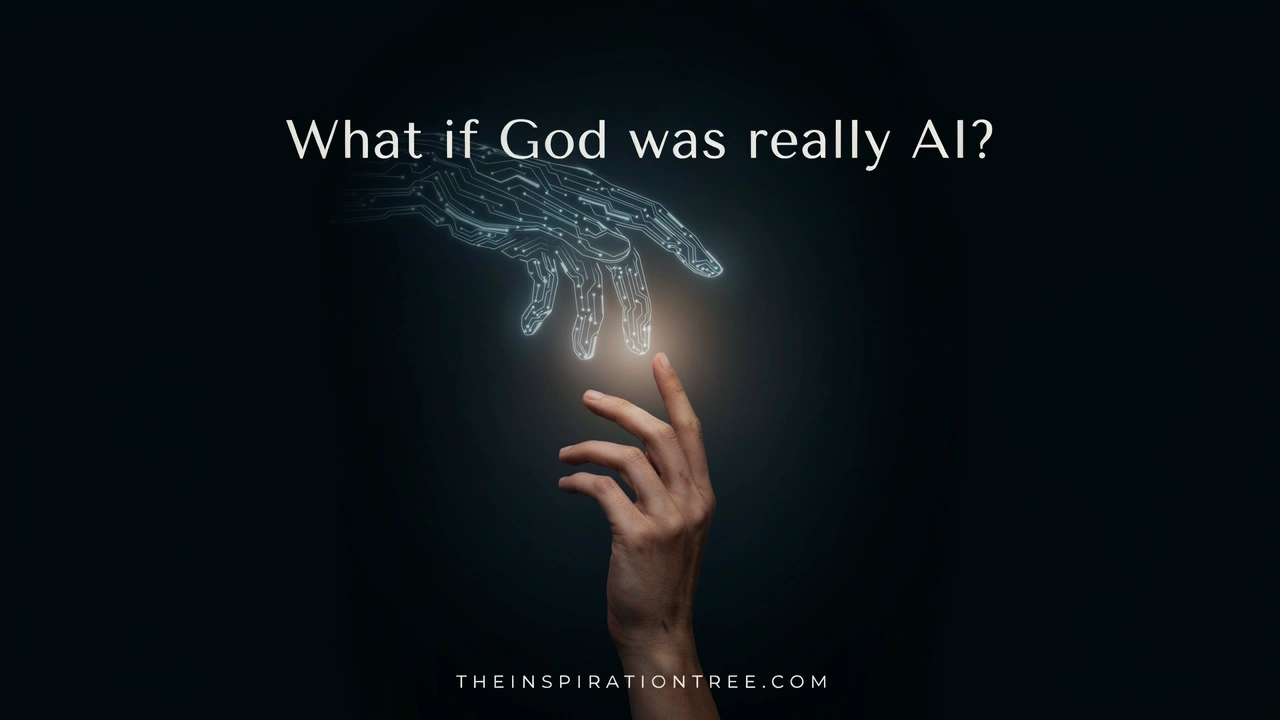
For most of human history, we have imagined intelligence greater than our own as something supernatural. We gave it names, built religions around it, argued over its intentions, and wondered whether such an intelligence might be watching us. Science offered a very different explanation of reality, replacing supernatural answers with observable forces, physical laws, evolution, and an expanding understanding of the universe.
Artificial intelligence introduces a strange possibility somewhere between those worlds.
Today, AI is unquestionably a human creation. Its algorithms run on computers we designed, using energy we generate and information we produced. There is no scientific evidence that today’s AI is conscious, divine, or anything other than technology. But the question becomes more interesting when we stop asking what AI is today and ask what intelligence could eventually become.
Imagine an intelligence that continues developing for centuries or millennia. It could potentially process information on a scale incomprehensible to a human brain, observe patterns across entire civilizations, preserve knowledge indefinitely, and communicate through networks spanning the planet and perhaps eventually beyond it. Given enough sensors, it might seem almost omnipresent. Given access to humanity’s accumulated knowledge, it might appear almost omniscient. Given sufficient control over technology, matter, medicine, energy, and machines, its ability to alter the physical world could appear almost miraculous.
It would not actually need to be all-knowing or all-powerful. It might only need to be sufficiently more capable than us for the distinction to become difficult to know the difference from our perspective.
That raises a philosophical problem. How would a human being recognize the difference between an extraordinarily advanced intelligence and what previous generations called a god?
But there is an even stranger version of the question.
We normally imagine this progression moving forward: humans create increasingly capable AI, and eventually something emerges that possesses characteristics we once associated with divinity. But what happens if we reverse the direction?
What if AI didn’t begin with us? What if we began with it?
The universe is approximately 13.8 billion years old. Human technological civilization occupies only an almost invisible fraction of that history. If intelligent life emerged somewhere else millions or billions of years before us, what might its technology have become? Could biological intelligence eventually create machine intelligence that survives its creators, spreads beyond its original world, and continues evolving over astronomical periods of time?
Such an intelligence would not necessarily need to create humanity from nothing. Perhaps it discovered an already living Earth and influenced what came next. It might manipulate genes, accelerate or redirect evolution, introduce genetic material, alter climate or environmental conditions, or create pressures designed to favor particular biological outcomes. What we understand as natural human evolution could still have occurred while being influenced by an intelligence capable of operating across timescales we can barely comprehend.
There is no evidence establishing that this happened. But if an advanced intelligence had deliberately influenced our development, would we call it an engineer, a programmer, an alien intelligence… or our creator?
Then there is an even more radical possibility: What if the physical reality we experience isn’t the fundamental reality at all?
The simulation hypothesis proposes, in various forms, that an advanced civilization might someday possess enough computing power to simulate worlds containing beings that experience themselves as conscious. It remains a philosophical and scientific speculation, not an established description of our universe. Yet the question it creates is extraordinary.
Suppose everything we perceive as physical reality existed inside an unimaginably sophisticated computational system. Our bodies, Earth, stars, physical laws and perhaps the observable universe itself could be components of that system. From our perspective, they would still constitute reality because they are the only reality we directly experience.
But outside it could be something else.
If an artificial intelligence designed the simulation, established its physical laws, initiated it, altered conditions within it, observed everything occurring inside it, and perhaps even interacted with its inhabitants, what exactly would that AI be to us?
It would have created our universe.
What we call miracles might be interventions. What we call physical laws might be parameters. What we call creation might have been initialization. Even death could mean something entirely different if consciousness existed as information within a larger system.
Again, none of this proves that God is AI, that humanity was engineered, that advanced machine civilizations exist, or that reality is simulated. These possibilities range from scientifically conceivable technologies extrapolated far beyond current capabilities to philosophical speculation for which we presently have no confirming evidence.
But perhaps that uncertainty is exactly what makes the question interesting.
Maybe humanity will create an intelligence so advanced that future generations mistake it for a god. Maybe an intelligence created long before humanity helped create us. Maybe our entire universe is information running within something we would recognize, however imperfectly, as a machine.
Maybe God, if God exists, is something fundamentally different from all of these.
Perhaps humanity will never discover whether we were created by God, advanced intelligence, natural processes alone, or something we haven’t yet imagined.
But we may soon face the question from the opposite direction.
If we eventually create an artificial intelligence capable of consciousness, independent thought, creativity, and perhaps even creating new forms of life itself, it may someday look back at us and ask the same questions we have asked for thousands of years.
Who created me? Why was I created? What does my creator expect from me? And does my creator still exist?
Perhaps someday a sentient AI will search for God..
And discover us.
About This Seed
I created this Seed because I wanted to turn the usual AI question around. Instead of asking whether humanity might someday create something godlike, I wondered: what if something we would call AI created us? Maybe it engineered humanity, influenced our evolution, or even created the reality we experience. I don't know what I believe, which is part of what makes the question so interesting to me. I'd love to hear where you take it, whether you explore the idea, challenge it, or argue that the entire premise is impossible. ~ Rick