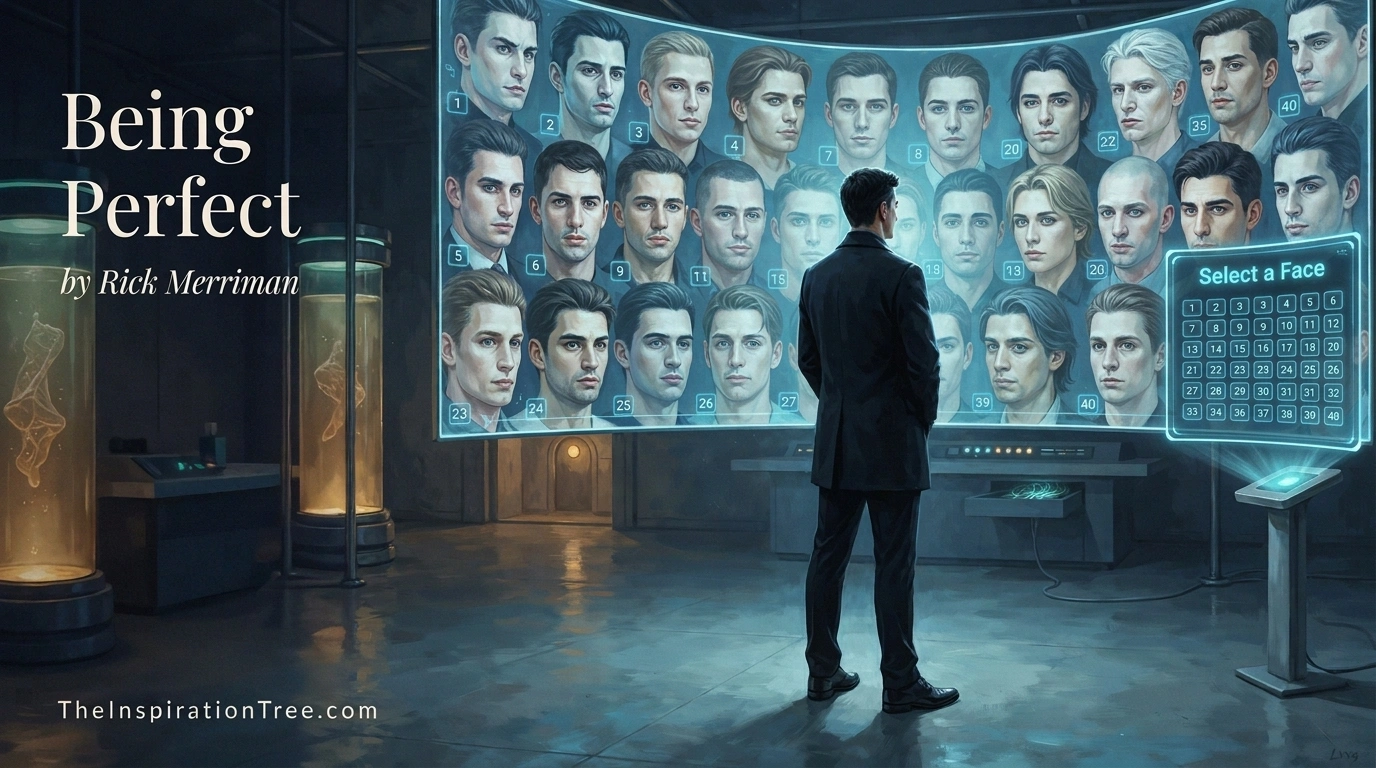
On our first date, she arrived wearing a face I had seen a dozen times before, cheekbones carved into crescents of light, eyes polished to a faultless clarity, lips arched in a smile designed to hover between charm and invitation. She wore surgically enhanced makeup that made her look like a work of art.
She was perfection, the kind of beauty the clinics promised to everyone, the kind of beauty I wore myself like a second skin. And yet, despite my own symmetry, despite the same surgical artistry etched into my face, I felt the old familiar tug of disappointment. She was beautiful, yes, too beautiful to be real. In the way, a copy of a copy of Mona Lisa’s smile can be alluring, even while knowing it‘s not genuine.
The guilt followed immediately, as it always did. Who was I to judge? My reflection in the glass behind her was no less curated, no less engineered. The slope of my nose, the breadth of my shoulders, even the subtle green flecks in my eyes, all chosen, all calibrated. All installed in me by the same process of cellular scaffolds and gene rewriters that had sculpted her. If she looked like a face I’d seen a dozen times, then so did I. My condemnation of her was also my condemnation of myself.
We sat across from each other in a café softened by warm lighting and jasmine-perfumed air. The place was designed to mimic old-world charm, dark wood, ceramic cups, even a chalkboard menu written by hand. None of it was real, of course: the chalk a polymer, the writing a cursive font, the coffee nothing more than a nutritionally balanced substitute.
But the illusion mattered. Illusions mattered to us all now.
“I hope you don’t mind,” she said, tilting her head in that appealing way that suggests more than words ever can. “I adjusted my appearance last week and haven’t had the chance to update my profile. I was going for something classic. What do you think?”
I smiled, rehearsed, practiced, by the way my perfect jawline allowed me to. “You look wonderful,” I said. And she did. Just as wonderful as the dozen before her.
Inside, the old unease stirred again. Beauty like this was no longer a surprise. It was no longer a delight. It was symmetry repeated so often it became monotony. And still, I wore the same mask, I played the same part.
She laughed, her voice lifted in enticing arcs that seemed to hang in the air like wind chimes. I found myself admiring the perfection of her teeth, the way her eyes glistened with just enough moisture to appear soulful. Everything about her had been measured to within fractions of a millimeter, all of it scientifically balanced to elicit attraction. And though she shone flawlessly, I felt only silence within, the emptiness of perfection too carefully manufactured.
But wasn’t that what I was too? Flawless? I thought of my own body, its lean masculinity and sculpted jaw, and I felt the nagging weight of hypocrisy. I had chosen this face, chosen this body. I had spent hours in a clinic watching diagrams of idealized bone structures, scrolling through countless facial iterations until I found the one I thought would make me desirable. And now, years later, I condemned others for doing precisely the same.
“I’ve always wondered,” she said, breaking into my thoughts, “why people hesitate to morph. Don’t you think it’s a kind of freedom? To wake up and decide who you want to be?”
I nodded slowly, careful not to reveal the storm inside. “Yes. Freedom,” I echoed. But the word tasted bitter in my mouth. ‘Freedom,’ I thought, should feel like a bird’s free flight. Like laughing, then crying after reading an emotional poem. This felt more like a poorly written romance novel.
For a moment, I tried to imagine her as she must have looked before: blemished skin, perhaps a nose bent slightly off center. A face shaped by inheritance, weather, laughter, or accident. I wondered if she missed it. If she ever thought of her old self, the way I sometimes thought of mine, an awkward teenager with blotchy skin, unruly hair, and a smile too large for his face. That boy had been messy, vulnerable, and flawed in countless ways.
But he had been real.
“I’ve already thought of changing again,” she said, stirring her drink with a silver spoon. “Maybe something bolder this time. A little less conventional.”
I caught her eyes, blue, unnaturally bright, and for a moment, I wanted to ask: What if you didn’t? What if you went back? What if you allowed yourself to be ordinary? But the words died in my throat. I had no right to say them. I wore my perfection like a mask, and she wore hers. We were both actors on the same stage, speaking lines written by a culture that demanded flawlessness.
The date passed in pleasant but predictable motions. We shared anecdotes, laughed in rehearsed patterns, and nodded on cue. Each gesture felt choreographed, as though we were two dancers gliding through steps we had learned long ago. The conversation was polite, the connection symmetrical but weightless.
At the end of the night, she didn’t bother disguising her intent: Sex, steamy and perfected, as though it were just another luxury commodity. I had no doubt it would be wonderful. The same precision that shaped both our faces had long since mapped pleasure to its final decimal point. But I shook my head politely, saying I wasn’t ready after my last reinvention cycle. In truth, what I wasn’t ready for was another night blurred with synthetic intimacy.
When she left, her farewell smile was perfect.
Of course it was.
I watched her go, her silhouette merging with the crowd outside. Dozens of faces greeted her, faces like mine, like hers, flawless in their sameness. High cheekbones, luminous eyes, sculpted lips. A chorus of clay peacocks impressing each other with their polished veneers.
I paused by a mirrored wall and saw myself: symmetrical, striking, enviable. A face designed to be unforgettable yet indistinguishable from all the others. I touched my jaw, tracing the line of perfection, and wondered if this mask had cost me more than it had ever given.
The rain began to fall, silver strands that blurred the lines of every reflection on the street. Around me, dozens of perfect people opened their identical umbrellas and looked downward, not chancing the rain may mar the meticulous makeup on their perfect faces. For one fleeting moment, their exquisiteness dissolved into streaks of water and light, and I thought I could see the humans beneath. Then the rain pooled, and the masks returned, flawless once more.
I walked home beneath the silver rain, carrying with me the guilt of a man who had judged my date and those caught in the rain, when truly, I had been judging myself all along.
#
Another date came a few days later. She was different. At least, that’s what I told myself as I waited in the atrium of the art gallery where we agreed to meet.
She had chosen an Asian face with jet-black hair, a sharper chin. Her eyes tilted slightly upward in an exotic way, but still, it was perfection, stunning in the same familiar, exhausting way.
She greeted me with a kiss on the cheek, light as a feather, and I felt the strange duality of attraction and distance. She was beautiful, effortlessly so, yet my heart did not move. I had begun to think it could not be moved ever again, as though perfection itself had smoothed away not only the ridges of our faces but also the texture of our souls.
We walked through the gallery together, pausing before works that were less art than they were mirrors. Morphological studios had begun commissioning sculptures that shifted their features as you approached, reflecting back possible versions of yourself: taller, slimmer, with skin gleaming like marble, or hair rippling like liquid copper. She laughed when one sculpture caught her likeness almost exactly. “See? Even art knows what beauty looks like.”
I managed a smile, though inside I felt the opposite. This kind of art didn’t know beauty, it only imitated it. Much like we did ourselves.
Conversation came easily, in a polished way. We spoke of the weather, though weather had long since been regulated into a gentle balance. We spoke of food, though food now differed little from place to place, each meal nutritionally optimized, its flavors carefully engineered to please without risk. Even when we spoke of our travels, they were the same curated environments, simulated thrills, and safe wonders.
Nothing truly exciting, nothing unexpected.
“Sometimes I wish I’d been born earlier,” she said, her voice softening as we drifted to a bench in the center of the gallery. “Back when people lived with… what was it? Chance? Things could go wrong, terribly wrong. But maybe that gave life its edge. Don’t you think?”
Her words startled me. They weren’t profound, but they felt honest. I nodded slowly. “Yes. Chance. Imperfection.” I almost told her about the dreams I sometimes had, dreams of my old crooked smile, of an uncorrected scar below my chin, of standing in front of someone who looked at me not because I was flawless but because I was me. But I didn’t. It felt dangerous to say such things aloud. The world had no patience for mediocrity.
“I’m joking, of course,” she said. “As I’m sure you were. If there was chance, who knows what I would look like tonight, and that would be terribly wrong, don’t you think?” She giggled in a very predictable way that was meant to be enticing. Then she started asking about what I thought her next reinvention should look like.
She was the same, the same as all the others.
Like the dozens of dates before this, the evening’s closing moment arrived with predictable precision. She tilted her head, lips moist and puckered. Her meaning was unmistakable: Her desire for sex, as seamless as the rest of her, as if even intimacy had been pressed from a mold. I knew it would be flawlessly sensual. Still, I shook my head, offering the same excuse about my last reinvention cycle. The reality was simpler, lonelier. I feared another night of perfection would only deepen the void inside me.
That night, I sat at my desk and searched through old archives, images from before morphological freedom. Grainy photos of men and women with uneven teeth, wrinkled foreheads, sunburned noses. Their imperfections sang of things that were just not quite right, like broken meter in a poem, but somehow, I couldn’t look away. Their faces told stories. Their beauty was not arranged, not programmed, not rehearsed. It was lived.
The next morning, I stared at my own reflection: perfect jawline, perfect skin, perfect symmetry. And I wondered, not for the first time, if anyone could ever love what was beneath it. Or even if I knew who was beneath it anymore.
A message blinked across my screen. Another date request, this one from someone named Clara. I hesitated, ready to decline, when I noticed her profile image. It was strange, not unmodified, no one was daring enough to do that. However, it was softer, less precise than what I usually saw.
Her features were not arranged in the current fashion, her nose bent slightly inward, her chin was less defined, her eyes larger than the standard proportion. It wasn’t the kind of beauty that drew every gaze, but it drew mine.
Almost without thinking, I accepted.
I told myself it was nothing, that this would be just another over-rehearsed evening, another mirrored conversation in a world of handsome faces. Yet, as I walked into the day’s silver rain, I felt a spark I had not felt in years. A spark of uncertainty. And that, I realized, was something close to hope.
#
The café was nearly empty when I arrived. The Seattle rain had lingered all afternoon, a quiet silver curtain against the windows. The streets were nearly empty, it seemed the ‘perfect’ stayed indoors when the city blurred like this. Clara was already seated, her hands curled around a steaming cup, her profile tilted slightly toward the glass.
I paused before approaching, watching her for a moment. She was not flawless, not in the way most chose to be. Her nose had a bend that caught the light, her lips were fuller than the symmetry models recommended, and her hair, though gleaming, fell in waves that refused the slick uniformity of fashion. But there was something about her, something raw, like a melody played on a slightly out-of-tune piano.
When she turned and saw me, her smile wasn’t rehearsed. It spread slowly, like a dawn breaking through uncertain clouds.
“You came,” she said.
“Of course,” I replied, though I realized I hadn’t been sure until this moment.
“Some men don’t. Not when they walk in and realize I’m not quite as beautiful as they hoped I might be.”
“I’m not some men.” I automatically replied with the expected cliché. I cursed at myself for being as conditioned in conversation as all my dates had been before her. Then I smiled.
A genuine smile.
We spoke first of trivialities, the weather, the quality of the café’s rehydrated cocoa, the latest city longevity projections. Yet beneath it all, there was a magnetism, faint but undeniable. Clara listened differently. Where others nodded with poised agreement, she tilted her head, her eyes searching as if each of my words meant something. And when she spoke, it was with pauses, with hesitations, as though she weighed not what would sound best, but what was true.
At one point, she laughed, and I noticed how her left incisor was slightly crooked, a tiny rebellion against the world’s smoothness. It startled me with its humanity.
“Most people don’t notice,” she said, catching my gaze. “I could have corrected it a hundred times over. I didn’t.”
“Why?” I asked.
She shrugged, stirring in the faux foam into her drink. “Because it’s mine. Not chosen, not designed. Just… me.”
The words struck harder than I expected. I had never thought of anything about myself as mine, not since the treatments, not since perfection had become so cheap and culturally compulsory. My face, my body, even my voice were curated, but curated by whose will? Was it mine, or was it society’s?
Later, as we walked along the riverside, she told me about her work. “I design and make small things,” she said. “Not faces, not bodies. Trinkets. Tokens. I know it sounds silly, but I think objects can still carry stories.” She pulled a small pendant from her pocket, carved in a pattern that seemed too uneven to have been machine-made. “I made this one by hand.”
I touched it gently. The edges were imperfect, not sharp, not smooth, yet alive with the trace of human hands. I couldn’t remember the last time I’d held something crafted without algorithmic aid.
“You keep it rough,” I murmured.
She nodded. “Because roughness remembers the person who shaped it.”
Her words still touched me long after I walked her home.
#
That night, lying in bed, I tried to summon the faces of the women before her, the ones who had been flawless in every proportion. Their smiles blurred into each other, their laughter indistinguishable. Yet Clara’s crooked tooth, Clara’s uneven pendant, Clara’s pauses… these details clung to me, refusing to fade.
For the first time in years, I let go of guilt for condemning perfection, and instead carried the guilt of not seeing through it sooner.
#
We fell into the rhythm of meeting nearly every day, and the weeks passed before I thought to count them. Clara took me into corners where the city seemed to fray, places so obscure most residents could not have named them. At the fringe, craftsmen sold goods touched by imperfection, rough and uneven but undeniably theirs. Jugglers dropped balls, magicians fumbled cards, and the crowd’s laughter was a balm of truth against the city’s sheen. Clara seemed more radiant here, as though each breath drew in a freedom the city had long forgotten how to manufacture.
Returning from her world, the city greeted us with silence dressed in symmetry, its people drifting past like mannequins, each too polished to betray anger, joy, or even surprise.
In a quiet moment, I asked her, “Don’t you ever want to change more? To be… like them?”
She looked at me, her expression steady. “Perfection isn’t the same as beauty. Haven’t you felt that? Haven’t you ever looked at yourself and wondered what was left of you?”
I opened my mouth, then closed it again. Her gaze lingered on mine, not accusing, but waiting. And in that pause, I felt the truth stir inside me. I had wondered. I had wondered a thousand times.
I thought of my perfect jawline, my flawless skin, my unwrinkled forehead. I thought of how strangers admired it, how dates praised it, how mirrors confirmed it. And I thought of how it rang with emptiness, like a bell struck not to give sound, but to vibrate in silence.
She smiled, knowing my answer without being told. As Clara reached for my hand, I realized something I had buried for too long. I didn’t want to be perfect anymore.
The rain had stopped outside. Sunlight beamed down, sudden and certain, turning the drenched avenues into glistening rivers that seemed to breathe with new life. Still, it struck me that the city had not changed at all, but I had. Her hand in mine carried the same warmth as the sun, a warmth that whispered of change, raw, imperfect, and undeniably alive.
#
It was in my bedroom mirror where the final reckoning came. It was not in a dramatic moment of crisis, not in some tearful confrontation, but in the stillness of a morning when the world seemed too quiet to recognize its failings.
I had risen early, long before the city’s waking cycle. The glass wall of my apartment shimmered faintly, adjusting itself to a simulation of dawn. And there I was, staring at myself. My reflection gazed back, flawless, symmetrical, exactly as the biometric algorithms promised I would remain until I desired a new version of perfection. A face sculpted by consensus, beloved by strangers, admired in passing.
Yet all I saw was absence.
Clara’s words echoed: Haven’t you ever looked at yourself and wondered what was left of you?
I leaned closer. The skin in the corners of my eyes was smooth where it should have creased, where time should have etched its testimony. My jaw carried the precision of a sculptor’s tool, not the rough signature of heredity. It was as though my reflection were a mask, designed not to enhance but to erase.
That day, I didn’t go to the reinvent checkup appointment I was scheduled for. Instead, I walked with Clara beyond the city’s flawless perimeter, where the air smelled faintly of wood and earth, where the buildings still carried imperfections from centuries before biofabrication had perfected their edges.
“I don’t know if I can do it,” I confessed, as we stopped beneath an overhang of weathered stone. “I don’t know if I can let go.”
Clara tilted her head, rain dripping from the strands of her hair. “You don’t have to all at once. But you have to start.”
“Start what?”
“Choosing yourself. Not the world’s version of you.”
#
The next weeks blurred together like watercolors bleeding on wet paper. At first, the changes I requested were small. Freckles returned to my nose and cheeks, ones I had as a child. The faintest curve of a scar under my chin, from when I fell from a bike decades ago, was restored in a discolored relief. They were inconsequential, barely noticeable, yet when I saw them in the mirror, they seemed louder than anything else.
And I felt unburdened, as though some hidden weight had quietly slipped from my shoulders.
But even small flaws have their consequences. People noticed. On the street, strangers’ gazes lingered, not admiring, but puzzled, faintly disapproving. Friends asked why I hadn’t “maintained.” One even joked that my “technician must’ve fallen asleep.” Their words stung, but they also rang hollow. It was then I realized how deep the lie ran. Our version of perfection wasn’t beauty. It was compliance.
Clara never hurried me. Instead, she would sometimes tilt her head and ask, “Is this closer to who you are?” Each time, my reply wavered in words but grew firmer in honesty.
One night, lying beside her, I whispered, “I’m afraid.”
She brushed her fingers against my temple, the gesture so simple it ached. “Of what?”
“Of you not liking the result when it’s all done. Of disappearing. Not from the world, but from myself. I think I already have.”
She didn’t reply with words. Instead, she leaned closer, resting her forehead against mine. And in that moment, I realized she had never wanted me perfect. She had only wanted me present.
The next appointment was harder. I asked them to restore the lines of age. To narrow my broad shoulders. To lose the six-pack abs and sculpted pecs. The technician blinked at me, confused, as if I’d requested rust painted over polished gold.
When it was done, I looked into the mirror again. For the first time in longer than I could remember, I recognized the man staring back. He wasn’t beautiful, symmetrical, or perfect. Not in the way the world demanded.
But he was me.
About This Seed
Being Perfect started with a simple question: what happens when technology makes physical perfection available to almost everyone? The story took that idea toward identity, conformity and the possibility that eliminating our imperfections might also eliminate some of the things that make us recognizable as individuals. Inspiredby POV1
But physical appearance is only one direction this idea could go.
A writer might imagine a society where intelligence, personality, athletic ability or emotional responses can also be perfected. What happens to someone who refuses? What becomes desirable when everyone can be beautiful? Could an imperfection eventually become a status symbol, an act of rebellion, or something people deliberately create?
An artist or photographer could explore engineered beauty, changing standards of attractiveness, identical faces, aging in a world where aging is optional, or the contrast between manufactured perfection and natural individuality. A filmmaker could approach the idea through romance, satire, advertising, fashion, body modification, social pressure or a future counterculture built around remaining unmodified.
A nonfiction creator might take the idea in another direction entirely, exploring cosmetic surgery, genetic engineering, beauty standards, social media filters, body image, biofabrication or the technologies that may eventually allow people to alter themselves in ways that are impossible today.
And perfection doesn't have to involve the human body at all. What happens to art when algorithms can remove every technical flaw? To music when every performance can be corrected? To relationships when compatibility can be optimized?
If everything could be made perfect, what would we eventually discover that we missed about imperfection?