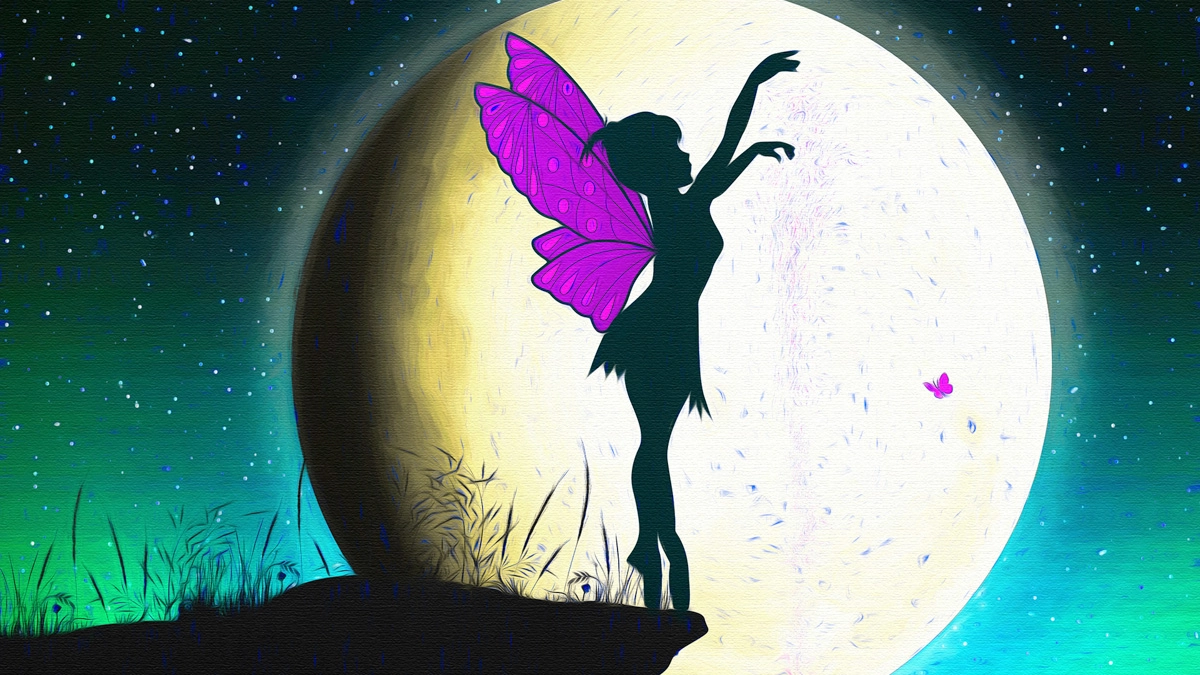
Faeries are slender-winged creatures that are rumored to be among the first races to inhabit Mernac. Faes are known for their youthful appearance – even though they may be hundreds of seasons old. Sometime between the age of 12 and 25, faeries go through what is known as “The Change” which forever freezes their appearance to the time they go through The Change.
Faes can be found on all continents of Mernac and many of her islands, but it is thought that the island continent of Ooloo is where the gods first created them. They usually live in small groups of 20-100 females and are almost always found in heavily wooded areas away from any other type of civilization. The exception to this is Tobernian faeries in the Kingdom of Paizes. This Kingdom, composed of multiple large cities, came into existence at the end of the Faerie Wars when most male faeries rebelled against the females who led most of the virtually defenseless Fae settlements throughout Mernac. Paizes was established to serve as a stronghold to ensure no force could ever threaten Fae existence again, as happened during the Faerie Wars.
Faeries, with the exception of Dark Faeries, are inherently good and kind creatures. However, they are often mischievous and will sometimes play tricks on other races. This is quite easy for them to do, as most other races can usually never see faeries, either because of their small size or their spells of invisibility.
There are as wide varieties, or races, of faeries as there are Fooka in a well-stocked mountain stream. From the Crystal Faes of the Tian Islands to the giant Bat Faeries of Garren to the glowing Firefly Faes who grace the summer night on the inland plains of Cathall – all pride themselves on their beauty and the unique coloring and textures of their wings. And all share a common heritage and allegiance to their Matron Goddess, Kanola, The Mother of Music and Dance.
At one time, there were both male and female faeries, but at some point in early history all the males were cast out (approximately in the year 900), as the males were viewed as too dominant and violent for the taste of the female faeries. Though a short but devastating war ensued (The Fairy Wars), the females quickly won.
The cast-out male faeries eventually evolved into Wood Elves. These male faeries (Elves) also lost the secret of creating faerie dust and, with it, the ability to fly. Over the years, they also lost the wings on their backs, which is uniquely faerie. Though many elves, to this day, are still born with a subtle nub in the middle of their backs, reminding them of their faerie heritage.
Faeries are smooth-skinned humanoids who can fly using magic dust (Faerie Dust) applied to their wings. The magical creation of this dust is probably the most guarded of the many faerie secrets. Faerie skin can range from pure white snow to deep, rich brown, sunset pink, or, in some cases, orange-red hues. The exceptions to the color range are dark green and blue, or blue-black hues, which are only found on their sister race, Dark Faeries.
A faerie’s skin is most often monochromatic and lustrous, but it is not unknown for them to be born with subdued patterns of color on their skin, particularly on their backs, buttocks, and thighs. Their eye color is also extremely varied and usually much more striking in contrast to the other races of Mernac. Their eyes are also very often of the same hue as their spectacular wings.
Faerie eyes, and especially their tears, have more to them than fascinating beauty; under certain circumstances, they are known to have a hypnotic trance effect on many races, particularly the males of those races. This is especially true for all elves and, to a lesser extent, humans and dwarves. The trance state is one akin to a strong lustful emotion, love, complete adoration, and subservience. Those who fall prey to its effects will often sacrifice all that they have, up to and including their own lives, to protect the faeries from danger – or even to simply fulfill any of the faeries’ slightest whims.
The trance lasts anywhere from a few hours to several months, in some cases, it will last the affected creature’s entire life. These trances – and when and why they work, are all but unknown to most races; however, it is known that Faeries use this to attract and control mates (usually elves) during their reproductive cycle, every two years. An impregnated faerie may or may not give birth to a faerie, but only female faeries with wings will be accepted into the faerie group. Half-fae females born without wings must leave any fae settlement, go into seclusion, and are destined to become a “Dragon Keeper,” a protector of the ever-diminishing population of Dragons.
Though a rare occurrence, all male offspring must be given to others to raise – or, in some cases, left in the forest to let the Mother of Nature decide their fate.
Each faerie can be similar to the appearance of another faerie – with the exception of their wings. Each faerie is born with a unique set of colors and patterns and, to a lesser extent, textures and wing size. Faeries are extremely proud of their own wings and will often adorn their bodies with clothes and jewelry that match or complement their wings. A faerie with permanently broken or disfigured wings will almost always live a life of solitude rather than face the humiliation of letting others see less than perfect wings. These faes often seek out the elusive half-fae Dragon Keepers and work in their service. In many cases, however, these faeries take their own lives.
Faeries are very intelligent and often can have strong magical abilities. This is particularly true of the healing- (Menk) and illusion- (Hundar) based magical arts. With the exception of Tobernian Faeries, they are extremely shy and stay away from other races. They will do almost anything to avoid interaction with other races. Faeries are typically very gentle and artistic, with a love of song or anything musical. Their art, be it visual or musical, is widely sought after by most races for its pure beauty and innocence. Most races also yearn to get even a glimpse of a faerie, as they are considered among the most alluring and sensual examples of feminine beauty and form in Mernac.
All Faeries are born with a strong magical ability, Trazel, the ability to change one’s size. Faeries typically are quite small and are approximately the size of a large butterfly or small bird. However, they can increase their size to that of a large human – or even larger in some extreme cases.
About This Seed
When I read Fantasy Worlds: Somewhere, There Is an Answer, what really caught me was the idea that fantasy worlds are different from ours because someone has decided how everything works. There are rules behind the magic, reasons certain creatures exist, histories that explain why people behave the way they do, and answers that may be completely unknown to the characters but still exist somewhere in the world.
That immediately made me think about faeries.
I've always been fascinated by everything Fairy, Faerie, and Fae, especially when they aren't just magical decorations in someone else's story but an actual people with their own lore. The Faeries of Mernac seemed like a perfect example. Their wings, Faerie Dust, the Change, their history with the Wood Elves, and even the Dragon Keepers all exist because of rules and events within their world. Someone living in Mernac might not understand all of those connections, but the answers are there.
That's what I love about worldbuilding. One little rule can suddenly make an imaginary world feel real.
I'd love to see some of yours. Share a piece of lore from a fantasy world you love or have created. Tell us why dragons hoard treasure, what happens when a witch breaks the rules of magic, why your Fae can't cross running water, what elves believe happens after death, or something completely original.
It doesn't have to explain an entire world. Give us one rule, belief, creature, tradition, mystery, or bit of history.
I would love to see what someone else creates from it.