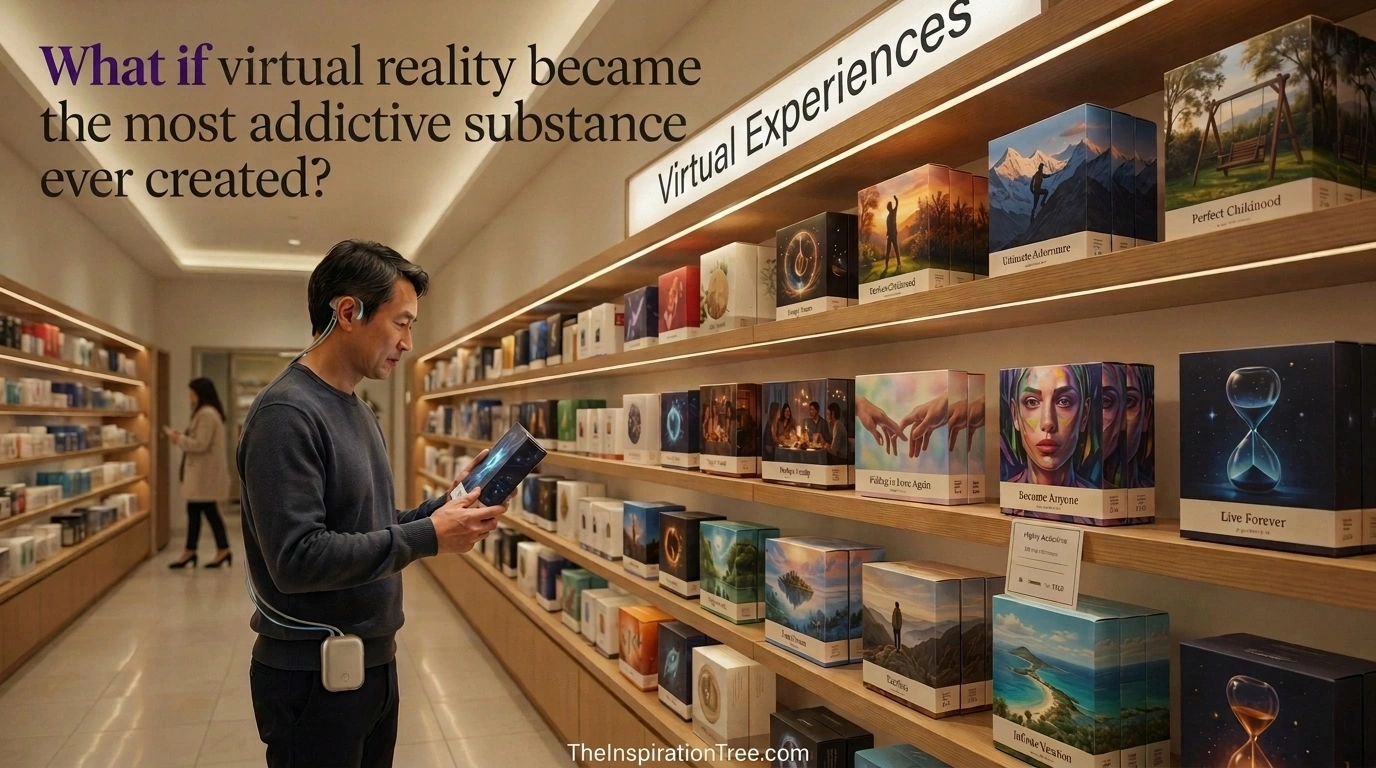
Addiction has always had a complicated relationship with escape.
People do not become addicted simply because something feels good. Addiction can involve reward, reinforcement, habit, vulnerability, environment, and the desire to change how we feel. Sometimes that means seeking pleasure. Sometimes it means escaping pain, loneliness, boredom, anxiety, disappointment, or simply a life that feels less satisfying than the alternative.
Now imagine an escape that does not merely distract you from reality.
Imagine one that can replace it with a reality designed specifically for you.
We already have a warning of what might be possible. Video games have produced problematic patterns of use for decades. The World Health Organization now recognizes gaming disorder in ICD-11, characterized by impaired control over gaming, increasing priority given to it over other activities, and continued or escalating play despite negative consequences. Today, this affects only a small sub-section of gamers.
But gaming may also be an early glimpse of something much more immersive.
Today’s virtual reality can surround us with convincing three-dimensional environments, track our movements, respond to our actions, and produce a powerful sense of presence. Yet it constantly reminds us that it is artificial. We wear a headset. We use controllers. Graphics have limitations. Our bodies remain firmly planted somewhere else.
Those limitations may not last forever.
Brain-computer interfaces are already moving communication between brains and computers beyond science fiction. That is still an enormous distance from plugging someone into The Matrix, but suppose that distance gradually shrinks. Instead of merely convincing your eyes and ears that you are somewhere else, future systems might interact much more directly with the neural processes through which you experience the world.
At that point, perhaps virtual reality becomes something closer to controlled dreaming.
Dreams already demonstrate something extraordinary about the human brain: while we sleep, our own neural activity can generate people, places, emotions and experiences that can temporarily feel real. Dreaming involves complex brain processes, with dopamine among the neurotransmitter systems implicated in some theories of dream generation and motivation.
A future VR system would not necessarily need to manufacture pleasure chemically. If a virtual experience produced genuine excitement, achievement, affection, anticipation or reward, the brain could respond to those experiences through its own reward and emotional systems. Human research has already demonstrated changes in dopamine transmission during reward tasks presented in virtual environments.
Serotonin and dopamine are far more complicated than the popular shorthand of “happiness chemicals,” but the larger point remains: the brain reacts to experiences, and those experiences do not always need to originate in the physical world.
Now add artificial intelligence.
This may be where the real danger begins.
Imagine an AI that does not merely generate a virtual world but continuously learns your definition of perfect. Every second you spend inside teaches it something. It discovers which environments relax you, which people attract you, which conversations fascinate you, which accomplishments make you proud, what frightens you just enough to be exciting, and what makes you want to stay another hour.
It learns your regrets too.
Perhaps you could return to high school knowing everything you know today. Take the job you turned down. Say yes instead of no. Stay with the person you left. Walk away from the person you married. Save someone you lost.
Or forget your real past entirely and choose another one.
Live in ancient Rome. Be born two hundred years from now. Become a famous musician in 1975, the first person on Mars in 2043, or an ordinary parent in a quiet town in a life where the tragedy that defined your real existence simply never happened.
And because AI understands you, these would not be static games with predetermined scripts. The characters could respond to you. Relationships could evolve. Consequences could develop naturally. The world itself could change according to your behavior.
Most importantly, the system could keep learning.
If one version of paradise eventually bores you, it creates another.
It could discover what you want before you consciously know it yourself.
Then comes perhaps the ultimate temptation: time.
What if subjective time inside the simulation eventually differs from time outside it? Could you experience years while hours pass in the physical world? Could you live multiple lives? Could people eventually preserve enough of their memories, personality, and behavior that some virtual continuation remains after their biological body dies?
Would that count as living forever?
We do not currently know whether consciousness can be uploaded, whether subjective time could be manipulated to anything approaching that degree, or whether a digital copy of a person would actually be that person. Those remain enormous scientific and philosophical questions.
But a sufficiently convincing simulation would create another problem long before immortality.
What if you stopped knowing you were inside one? Could you be in one now?
Imagine voluntarily entering a virtual experience that temporarily prevents you from remembering that it is virtual. You do not put on a headset and spend the next few hours thinking, this isn’t real. For the duration of the experience, it simply is reality.
In that sense, VR could become controlled dreaming with one extraordinary difference: instead of the subconscious creating the dream, an intelligent system and AI create it for you.
And it knows exactly what kind of dream you never want to wake from.
At that point, the danger may extend far beyond people already vulnerable to addiction.
What happens when the alternative really is better?
Outside are bills, illness, aging, rejection, work, physical limitations, loneliness, grief, compromises, and mistakes that cannot be undone. Inside, you can be healthy. Young. Loved. Successful. You can explore other worlds, correct your regrets, recover people you lost, become someone else, or simply live an ordinary life that happens to be better than your own.
Calling everyone who preferred that world “addicted” might eventually become uncomfortable. Crazy even?
Perhaps they made a rational choice.
If virtual experiences became subjectively indistinguishable from physical ones, humanity might eventually confront a question far stranger than whether VR is addictive.
If both lives feel completely real, but one is designed to be everything you want…
Why would you choose this one?
About This Seed
Being in recovery from addiction myself, I've always found "addiction" interesting/terrorizing because it often isn't simply about wanting more pleasure. Sometimes it's about wanting less reality. Escape. At least, that was the case for me.
Besides struggling with alcohol, there were long periods of my life when I was addicted to certain games. EverQuest in the early 2000s completely consumed me, as it was a completely different world that I could just... lose myself in. As gaming and immersion improved over the years, it made it easier and easier to lose myself in other games. The escape from the real world - some closer to what I considered "perfect" than others. That made me wonder what happens when technology can offer an alternative reality designed specifically for us. Would we recognize the danger and regulate it, or willingly choose the "better" world? - Even if it was not real. I'd love to hear where you take this, either as a discussion or by responding with an inspired Seed. I'm especially interested in whether you think people would ultimately choose reality at all. ~ Rick