The Inspiration Tree

Digital Immortality

Explore Creative Genealogy
What will you add? Add the Next Generation →

Most of us are already building a digital archive of ourselves without intending to.

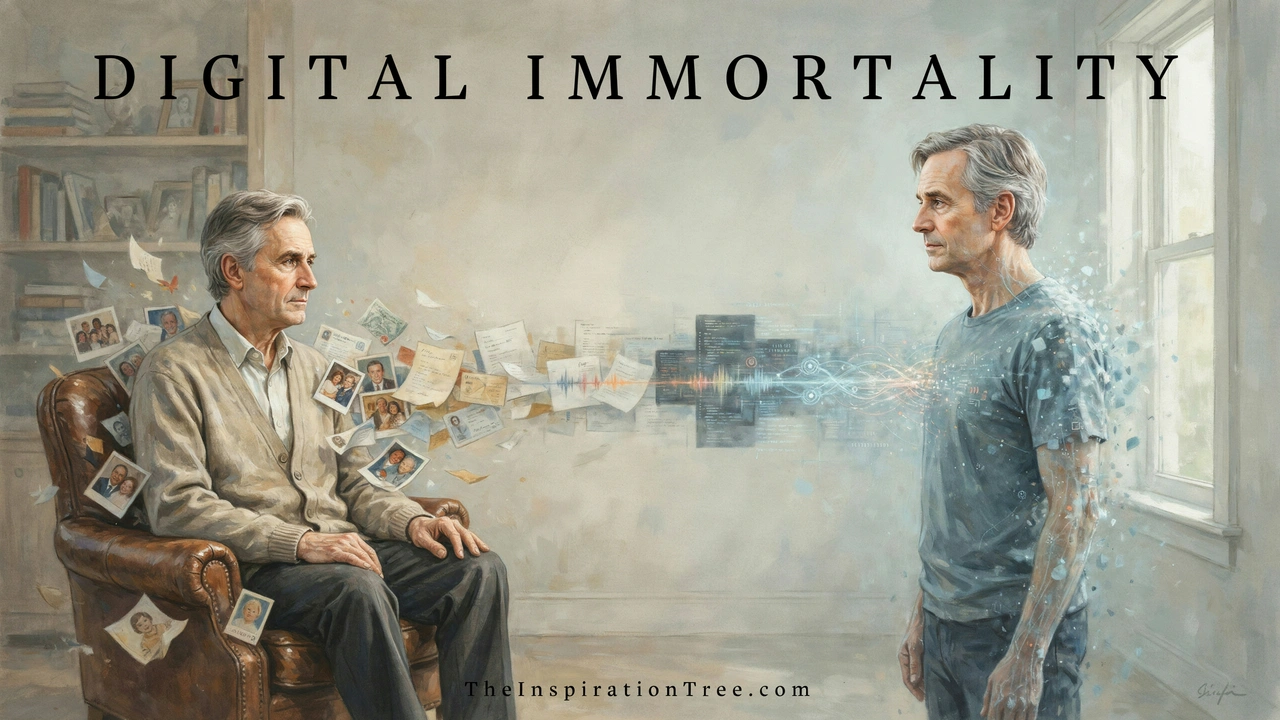
Photographs, emails, text messages, videos, voice recordings, documents, social media posts, search histories and conversations accumulate throughout our lives. Taken together, they reveal more than what we did. They capture how we speak, what we believe, what makes us laugh, whom we love, how we make decisions and how those things change over time.

Today, most of that becomes part of what we leave behind. But artificial intelligence introduces another possibility. Instead of merely storing those fragments, AI could increasingly assemble them into an interactive model of the person who created them.

Imagine dying while leaving behind an AI that knows decades of your history, speaks in your voice, recognizes your family, remembers your stories and has learned enough from you to respond to new situations much as you might have.

You haven’t uploaded your mind. But something that looks increasingly like you remains.

This isn’t digital immortality yet. However, several technologies that could contribute to it are already developing, and the most plausible route may be very different from the traditional science-fiction idea of scanning a brain and uploading a person into a computer.

We may build our digital selves gradually while we’re still alive.

Companies are already experimenting with the first pieces. StoryFile has developed interactive representations based on extensive recordings of real people. In 2026, it created a digital twin of technology journalist Kara Swisher, combining recorded interviews with material from her writing, podcasts and autobiography. The result could answer questions using both authentic recordings and AI-generated responses based on information Swisher herself had produced.

Another company, Eternos, worked with terminally ill Michael Bommer to preserve extensive information about his life, experiences and personality. The company later became Uare.ai and shifted toward creating personal AI models for living people, attempting to capture not just facts but values, knowledge and patterns of decision-making.

That shift suggests a much more plausible path toward digital immortality than waiting until someone is dying.

Imagine living with a personal AI for forty years. You continually talk to it and correct it. It sees the photographs and writing you choose to share. It learns your opinions, humor, relationships, preferences and thousands of decisions. Instead of reconstructing you after death from scattered evidence, the model has spent decades learning directly from you.

Now add information coming from somewhere much closer to the source: the brain itself.

Brain-computer interfaces are being developed primarily to restore communication and control to people with paralysis and neurological disease. They cannot extract a mind, but researchers are becoming increasingly successful at translating specific forms of neural activity into digital information.

In 2025, researchers demonstrated a brain-computer interface that converted attempted speech into audible words quickly enough to support much more natural conversation. Other researchers demonstrated real-time decoding of inner speech from motor-cortex activity in people with paralysis. The possibility of unintentionally decoding private thoughts was serious enough that the researchers also tested safeguards designed to decode only speech the participant intended to communicate.

The technology continues to move beyond translating thoughts into words. In September 2026, NIH reported a neuroprosthesis (National Institutes of Health) capable of simultaneously decoding neural activity associated with speech and gestures and using those signals to control a personalized digital avatar. The medical purpose is restoring more natural communication, but the underlying accomplishment is striking: aspects of a person’s internal neural activity can now help control how a digital representation of that person speaks and expresses itself.

Put these developments together and an intriguing possibility emerges.

One technology learns about you from the digital record of your life. Another begins capturing limited information directly from your brain. Voice synthesis can reproduce how you sound. Generative video can reproduce how you look. AI can increasingly combine information from all of them.

None of this transfers consciousness. But perhaps digital immortality wouldn’t begin with consciousness transfer at all. It could begin with creating an increasingly detailed digital reconstruction of a person.

Actually uploading a mind remains far beyond current science. Even mapping the brain presents enormous challenges. Connectomics is making impressive progress in reconstructing neural connections, but a recent review in Nature Reviews Neuroscience describes substantial technical and conceptual obstacles that remain.

More importantly, the brain isn’t simply a wiring diagram. Synaptic strengths, electrical activity, chemistry and other constantly changing biological processes may all contribute to memory and identity. Even if we could reproduce those processes perfectly, we still wouldn’t know whether copying them also copies consciousness.

That uncertainty creates the most important distinction in the entire idea of digital immortality: recreating someone is not necessarily the same as preserving them.

If a digital copy remembers my childhood, recognizes my friends and insists that it is me, that doesn’t prove my consciousness somehow moved into the computer. The biological person may simply have died while a remarkably convincing copy continued.

But that doesn’t necessarily settle the matter.

Suppose the digital copy continues operating after my death. It has new conversations, forms relationships, changes its opinions and accumulates memories that I never had. Eventually, whether it is still “me” becomes less important than another question:

Has it become someone?

That question changes the ethical problem completely.

Researchers are already examining the implications of AI “digital ghosts” that recreate deceased people. Current concerns center largely on the original human: consent, privacy, ownership of likeness, emotional manipulation and whether AI should be allowed to generate new statements in the name of someone who can no longer approve them. A recent analysis in Ethics and Information Technology (The making of digital ghosts: designing ethical AI afterlives) explores how generative digital representations complicate identity and autonomy precisely because they can continue producing new material after the person dies.

But future technology could force us to consider the rights of the digital entity itself.

If it is merely software imitating a person, deleting it is deleting software. If it ever becomes conscious, however, its origin may no longer determine its moral status. It might not be the person who died, but it could still be a new person capable of experiencing its own existence.

Then questions that sound philosophical become surprisingly practical. Who owns it? Can the company hosting it shut it down? Can someone’s heirs delete it? Can copies be made without its permission? Can it own what it creates, earn money, keep information private or refuse to continue impersonating the person from whom it was created?

Even the difference between turning it off and deleting it could matter. One might merely interrupt its existence. The other might end it permanently.

Nothing available today demonstrates that AI is conscious, and no technology can currently transfer human consciousness into a computer. Brain-computer interfaces decode limited neural signals. Digital replicas model aspects of people. Brain mapping remains enormously incomplete. Digital immortality in the literal sense remains speculative.

What no longer seems quite as speculative is the possibility of creating increasingly sophisticated digital continuations of people.

We are already generating the archives. AI is learning how to model individuals from information. Brain-computer interfaces are beginning to translate neural activity directly into digital communication and expression. Those technologies don’t need to suddenly produce a perfect uploaded mind. They only need to keep getting better and gradually begin working together.

Someday, a person may die while leaving behind a digital counterpart built from decades of memories, conversations, behavior and perhaps information obtained directly from the brain. At first, everyone may understand that it is a reconstruction.

But if that reconstruction continues learning, changing, remembering and developing a life after the original person is gone, calling it “digital immortality” may eventually miss the most interesting possibility.

Perhaps we won’t have discovered how to prevent a person from dying.

Perhaps we will have discovered another way for a person to begin.

About This Seed

Digital Immortality was inspired by How I Picture It in My Mind, which made me wonder how far the idea of preserving ourselves digitally has already moved from fiction toward reality.

While researching it, I discovered something more interesting than traditional mind uploading. We are already creating enormous archives of ourselves. AI can increasingly learn from those archives, while brain-computer interfaces are beginning to translate limited neural activity directly into digital information. What happens if those technologies eventually converge?

There are countless directions to take that idea.

A writer might imagine someone inheriting a digital parent, a family fighting over whether a deceased relative's AI should be deleted, or a digital copy refusing to continue impersonating the person it was created from. What happens when multiple copies exist, or when a digital version accumulates decades of experiences the original person never had?

An artist could explore the boundary between biological and digital identity, visualize a lifetime becoming data, or imagine memories being reconstructed into a new consciousness. A filmmaker or audio creator could approach the idea through family drama, science fiction, documentary, mystery, romance, or horror.

Nonfiction creators could explore brain-computer interfaces, consciousness, neuroscience, digital legacy, privacy, AI personhood, inheritance, ownership or the legal rights of digital beings.

And perhaps the most interesting question has nothing to do with immortality at all.

If a digital copy continues learning, remembering, and changing after the original person dies, when does it stop being a copy and start becoming someone?

Discussion

Continue the conversation without leaving this Seed.

Home Forums Discussion: Digital Immortality

Viewing 0 reply threads
  • Author
    Posts
    • #1398

      “Digital Immortality” is a Article Seed shared by ThinkingGuy14.

      This discussion is open to any response inspired by this Seed.

      You might share what the Seed made you think or feel, a question or different interpretation, a personal experience or memory it brought to mind, an idea for another creative response, constructive feedback for the creator, or a connection to another Seed or creative work.

      These are only suggestions. There is no required type of response and no single correct interpretation. Please keep the conversation thoughtful, relevant, and respectful.

      What did this Seed inspire in you?

Viewing 0 reply threads
  • You must be logged in to reply to this topic.

Join the discussion

Log in or create an account, then return directly to this discussion.

Log In Create Account