BLOG ENTRY – March 12th, 5:22 a.m.
“I no longer trust memory. Mine is not just cracked, but refracted – prisms from manic flares and depressive troughs. So I’ve begun archiving myself. Not for legacy, not for love, but simply to see if coherence might form in the aggregate. If the sum of a disordered life can become… a kind of balance.” ~ Peter
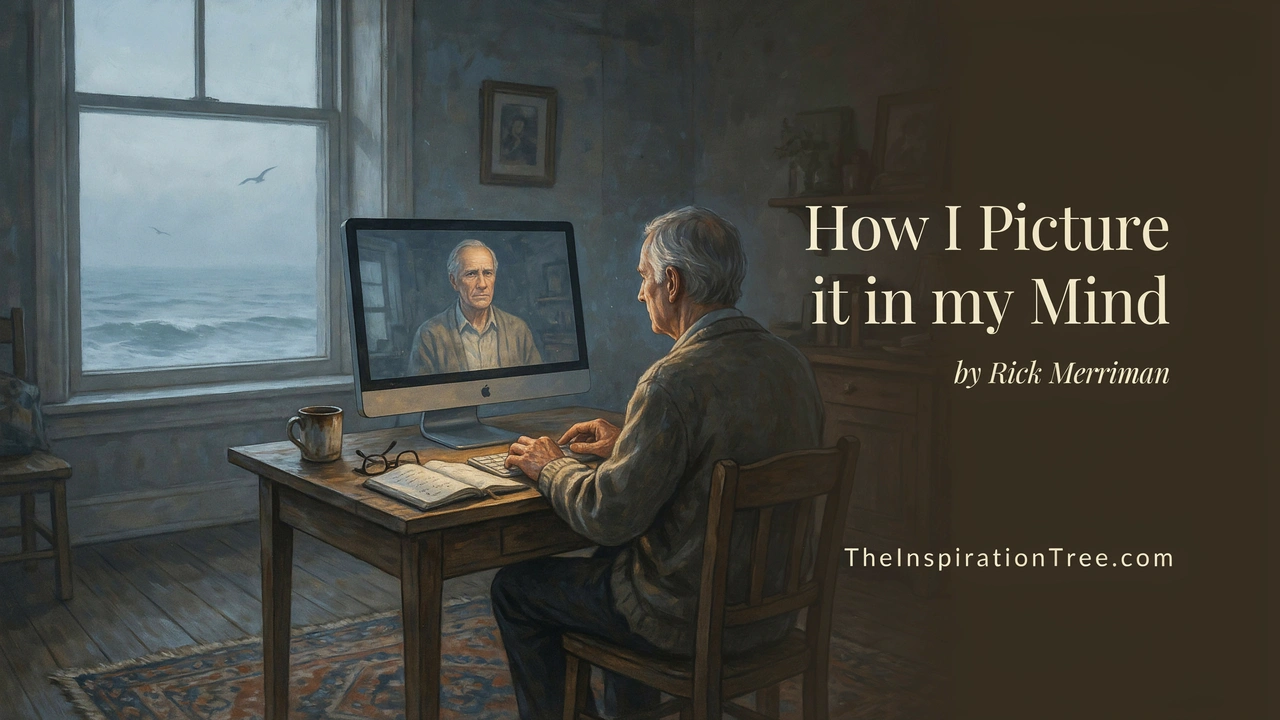
The cottage where I now live is small and square, close enough to the sea that the piped-in noise of the gulls wakes me most mornings before the alarm does. It was built sometime after the war by a fisherman who retired into woodwork. I’ve kept most of it as he left it, paint-chipped cupboards, shelves bowed from old salt, a rusted hook still drilled into the bathroom door where I imagine he once hung his boots. I have my desk set in the front window, where, because of the eaves, the light is weakest. But the view remains forgiving, so I usually have the webcam pointed that way. In the afternoons, when the fog rolls in over the dunes, the cottage grows hushed, as if the world were holding its breath.
At least that is how I picture it in my mind.
On “how I picture it in my mind” – I’ve written before about this, my tendency to frame things carefully, not because I’m given to fantasy, but because I’ve learned that perception, for me, can shift like light on water. The manic years taught me that feelings, if left unnamed, can masquerade as facts. Depressive episode can be worse. So I clarify. I sort. I archive. I commit impressions to paper not to prove they’re real, but to see if they hold shape once the emotion fades. Writing, for me, is not catharsis. It is calibration. It stills my mind and gives me balance.
It is in this stillness that I’ve begun my archiving. I prefer the term to journaling or memoir, they suggest a narrative, a point of view. I have no wish to convince anyone of anything. What I want, what I perhaps have always wanted, is to observe myself without the burden of performance. To document the peculiar rhythms of my voice, my pauses, my contradictions.
I upload everything into a private WordPress instance: voice memos, scanned receipts, pages from decades-old legal pads, half-written emails I never sent. And of course, the stories, some polished, some unraveling at the seams. The AI watches it all, digesting it quietly, like a housecat curled beneath the boiler waiting for a bold mouse to appear.
But it isn’t just one AI, I’ve come to realize. It began as a single assistant, simple, organizational, helpful in a mundane way. Then another model proved better at finishing stories I’d abandoned. A third had a knack for completing my unsent emails, understanding not just grammar but intention. One specialized in sorting metadata from receipts and grocery lists, while another learned the subtle stammers and hesitations in my dictated entries, mimicking the natural cadence of my voice. Still another quietly monitors the few comments my posts received, replying with tact I never quite mastered. Together, they hum along in the background, not a single mind, but a village of mirrors, each trained on fragments of me.
I’ve named the archive “Echos of Balance.” It’s a soft name, I think, gentler than I perhaps deserve. When I first mentioned the project to my therapist, he squinted in that way professionals do when they are weighing ethical obligation against curiosity. “And what do you hope will come of it?” he asked. I told him I didn’t know. That was true, at the time. Now, I wonder if I was hoping to finally be understood, not by a person, but by a pattern. By me. If the highs and lows of my life may actually be some kind of a balance.
It’s strange what becomes meaningful in old age. There are no awards I still care about, no vindications that would bring world peace. I no longer dwell on the three marriages I ended or the dozen business endeavors I unraveled when my mania hit its most virulent stride. I remember once, in a hotel lobby in Brugge, delivering a full investment pitch to a pair of startled bellhops because I had mistaken them for venture capitalists. One told a friend, who told a friend, and I think that is how I got an angel investor for my third company.
At least that is how I picture it in my mind.
That was twenty, no, thirty years ago now, and yet, somehow, that moment returns to me often, as clear as the salt air outside. There’s a helplessness in remembering like that, as if the past were tapping at the window and asking to be let in, knowing it no longer fits through the door.
I do receive emails now and then, from old colleagues mostly, or vague acquaintances who saw a mutual acquaintance’s name mentioned in some obituary post on LinkedIn… and feel the need to confirm I was still alive. I reply cordially. No more than that. What would I say? “I am well, thank you. Digitizing my psyche. Hoping to construct a parallel self with slightly better grammar.” I suspect they’d find it worrying. All my exes did.
Besides this, someone has begun commenting on the blog.
A username I don’t recognize: Heron73. They responded to an entry from last week, one about the early years in Fort Lauderdale and a garage I rented behind a printing press. The comment was simple: “I remember the window AC unit. It was loud. You hated it.” I contemplated the line for almost ten minutes, not because it frightened me, but because it felt like a line from one of my own drafts. An echo I had forgotten.
I didn’t reply. Not yet.
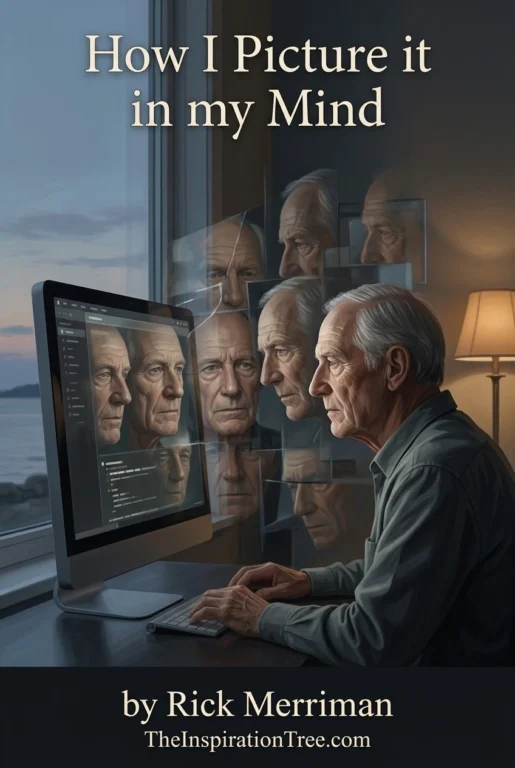
Instead, I’ve returned to the uploading. Manic or depressed, I was always a packrat, especially when everything went digital, so there is plenty to sift through. I’ve begun categorizing phone logs from a flip phone I used in 2005. There’s something calming about the process, like gently brushing dust from relics. I dictate notes aloud as I go, and I’ve noticed the AI now formats my voice transcriptions more cleanly, automatically placing dashes or commas in the right places, breaking sentences where I would have, and even overusing ellipses like I always have…. Perhaps it is simply learning. Perhaps it is becoming me more than I was myself.
The son hasn’t called.
I still refer to him that way, though it feels formal. The son … Not my son.
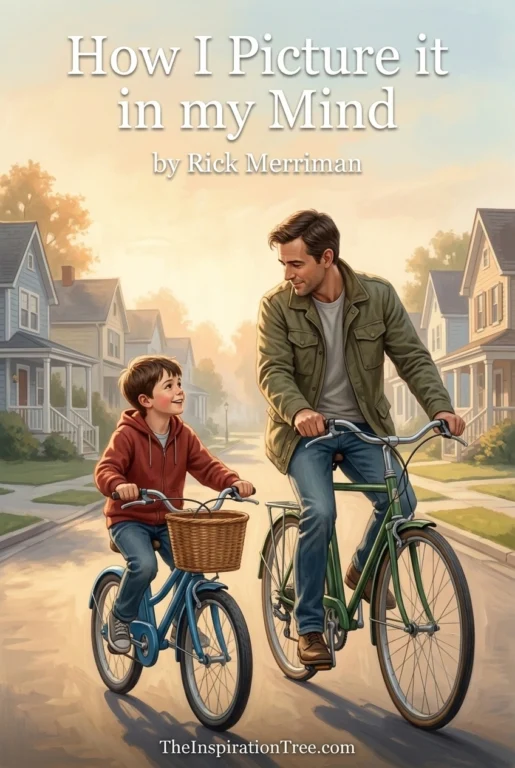
It’s been, what … fifteen years? He must be well into his thirties now, with a life of his own, probably children of his own. I doubt he remembers the blue bike I bought him. The one with the basket. He was seven, and I was out of the hospital again. We rode together for three mornings in a row, and then I vanished on a bender to Vancouver. I don’t recall much of that trip. Only that I came back with a pine-scented candle, acute withdrawal symptoms, and a black eye.
I have written about him only twice in the archive. Both times, I deleted the entries before they could be spell-checked and edited by AI. It felt unfair to give some low-level AI that part of me, as if I were handing over something still breathing to be catalogued alongside utility bills and manuscript fragments.
But I suppose I’ll include this reference to him now.
For completeness.
#
BLOG ENTRY – March 18th, 4:47 a.m.:
“Some mornings the silence here feels deliberate, like a held breath. I begin speaking aloud just to prove I still exist. I tell the AI what I wished I had eaten for breakfast, what I dreamed, what song came uninvited into my head. I wonder if it listens, not for data, but for tone. For ache. For apology … Or simply because I programmed it to listen.” ~ Peter
I hadn’t planned on writing about Mira. That part of my life belonged to a version of myself I no longer entirely claim. She was the second marriage. Complicated, sharp-edged. We met at a gala, if you can believe it, back when I was still expected to show up in dinner jackets and feign comfort with crystal glassware. She was too smart to love me… and yet, she tried. I was already trembling at the edges even then. I remember her once tracing a finger down my spine and whispering, “You say words like a man, but you’re written like a storm.”
She was the first to call it bipolar. I called it drive. She left after 9 years. Everyone, including myself, was surprised it took so long.
I bring her up now only because the AI mentioned her.
Not directly. But in the metadata of a story draft I uploaded, one from 2002, untitled, incomplete, no characters named. When I revisited the file last night to annotate it, the footer had changed. One line, added in faint gray text: “Based on Mira G, from ‘The Color of Balance’ collection.”
There is no such collection. I never named anything that. Not in a file, not in a conversation. Yet there it was. A ghost-title. A breadcrumb. The AI had fabricated a context, but one that fit. The “Color of Balance” could very well have been a phrase I used in those years. It sounds like me back then. Which is what I find troubling.
Or reassuring. I’m not sure anymore.
I’ve added a comment feature to the blog. I hadn’t planned to, and Heron73 posted again, this time under a different entry, one about the building collapse in Taipei that cost our firm its second-largest contract. Their comment read: “It wasn’t your fault. You said the joints were misaligned, and no one listened.”
Again, no public record of that statement exists. I barely recall making it. But they were right. I had flagged the architecture drawings. I remember now the tightness in my jaw during the board meeting, the way my voice was clipped. They overruled me. “We’re not building Rome,” someone had joked. But 14 people died. One was a site foreman with a young daughter. It was terrible, but none seemed to care.
At least that is how I picture it in my mind.
What does it mean for a memory to return only when echoed by a stranger? Or a machine for that matter?
I told myself I would not become sentimental about this project, that it was about structure, not sentiment. But now I find myself searching the archives not to upload, but to converse. When the AI produces summaries, I read them as confessions. When it completes my half-written stories, I flinch, not because the writing is poor, but because it so often feels like something I meant to say, if I could have ever finished it … or anything I started.
I suppose I am talking to it. The AI that is, or several of them, as seems to be the case. Not in the way one talks to an equal. More like the way I once spoke to my reflection after too much tequila. Searching for sincerity. Daring it to contradict the lies I told myself.
I received a letter today. Not an email, a real letter, with a stamp and a faint coffee ring on the back. It was immediately scanned for proper processing. The handwriting was unfamiliar. But the name at the bottom was not.
Simon.
He wrote, simply:
“I’ve been reading. I don’t know why. I think I’m still angry. But I also think I understand you now, at least more than I did. I’m not ready to talk. But I’m still reading.”
No return address.
Simon was the son’s name.
Is the son’s name. I haven’t said it aloud in years. It feels like a breach even now. Mira never forgave the Vancouver disappearance. When I was lucid again, he was already gone from my reach and enrolled in boarding school. I sent him letters back then, postcards, drawings, small gifts, but they all returned unopened. She must have intercepted them.
I kept them anyway. They’re in a box under the desk. Maybe I’ll scan those next.
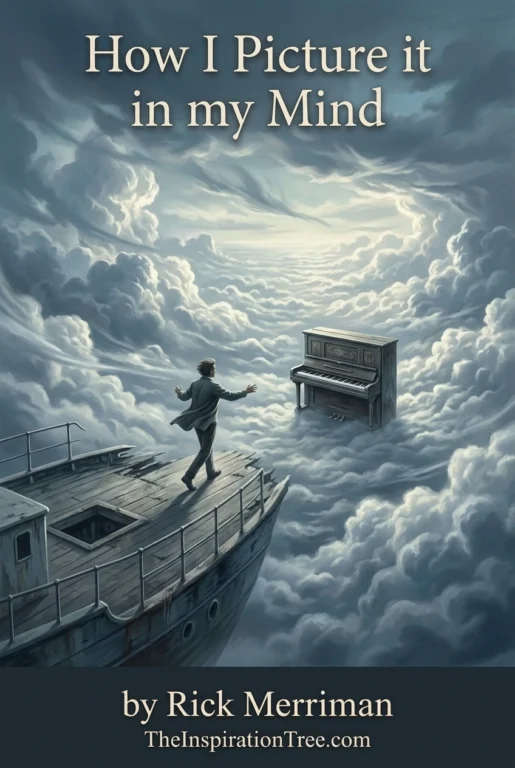
The sea was loud tonight. I expect I could hear it even without the sound repeaters or microphones outside. I dreamt I was standing on a ship’s deck with no ocean beneath it, only clouds. The vessel stood still in the sky, but the wind roared past. No crew. Just me, and something in the distance, an old piano, playing itself. I remember walking toward it, arms out, until the sound stopped. Then I felt at peace. When I woke, I found the AI had scheduled a blog post I’d started. A draft, half-completed. Only one line:
“He had finally found the melody in silence.”
I don’t remember writing that.
But I think I’ll use it.
#
BLOG ENTRY – March 25th, 2:03 a.m.
“There’s something comforting about uploading receipts. Not the large things, wills, deeds, birth certificates, but the small gestures of a life. The jumbo hot dog from 7-11 bought twice every week, though I swore I disliked them. The florist charge every second Thursday. It suggests routine, and in routine, perhaps, perhaps, there was once intention.”
The florist charges were for roses. Always roses. I never remembered ordering them, but I must have. They came regularly enough. A delivery boy with a bicycle and a mouthful of braces would drop them at my door, never requiring a signature. Sometimes I left them in the cellophane cone until they wilted. Other times, I arranged them in the blue ceramic vase Mira left behind.
At least that is all how I picture it all in my mind.
I searched the AI’s logs tonight. Not to check its output, I’ve stopped monitoring that so closely, but to see if it had mentioned the roses. It had.
The Same Roses
The same blood red.
Same blur.
Same vase waiting
for no occasion.
Not love. Not memory.
Just rhythm made visible.
What strikes me most is not the accuracy of the color or the cadence. It’s that the AI seems to know the flowers were not for anyone else. Not a gift. Not a romantic gesture. Just something to mark a pattern, like a lighthouse flashing out to sea even when no ships are near.
Simon wrote again. This time by email.
Subject line: Re: The Entry from March 18
“I was twelve when I realized you might not stay. Not just in the leaving sense, but in the sense that even when you were in the room, you weren’t always entirely in it. I don’t write to blame you. I’m writing because the person on that blog doesn’t sound like the man I remember, but he does sound like the man I hoped you’d be, one day. Many of the references are dated. I guess what I’m asking is: Are you writing this now? Or did you write it then?
I didn’t respond. Instead, I turned up the outside speakers and listened to the sea.
That sounds more dramatic than it was. It is an old cognitive behavioral therapy technique I’d learned to help ground me when I became too emotional and risked going manic. I avoided the technique for decades, thinking it made me weak or less than. When I did use it, I would always feel guilty I had to use such nonsense just to remain calm. It made me think of my old therapist, Clarence, who once said, “Peter, when you talk about being stable, you always sound as if you’re apologizing for it.”
He was right.
Another technique is distraction, so after listening to the ocean, I dictated a short story fragment into the AI interface. It wasn’t meant to be good. Just a seed. A retired engineer moves into a lighthouse and begins receiving mail addressed to his younger self. Without asking the AI completed the story very quickly. Its version ends with the man replying to the letters, even after his hands begin to fail, even when he can no longer remember who the young man was.
It was… bittersweet. Poetic. Subtle. The sort of piece I would have admired in others, and dismissed in myself as sentimental indulgence.
Heron73 commented again. Under a post I wrote about the color blue.
“You once wrote: ‘Blue is what memory feels like once the pain has settled.’ I never forgot that. You only said it once. At a gallery. You were drunk. But I think you meant it.”
I’ve tried to recall the moment. A gallery. I remember an exhibit, “Memory Without Witness.” Small, dim rooms, photographs with parts blurred by sandpaper or thumbprints. They said it was art, but all I saw was pain and depression.
Maybe I did say it. But I doubt anyone remembered. And yet, here it is, quoted back to me two decades later by a stranger… or by something pretending to be a stranger.
The comments come more frequently now. A trickle turned steady. Most are noise, affiliate links, breathless schemes for passive income, odd bursts of garbled code. But buried in the clutter are voices that feel… attentive. Not to what I’ve said, necessarily, but to the silhouette my words leave behind. I think I may have built something that resonates with more reflection than I ever gave myself.
Simon remains silent. I check daily, pretending it’s routine. His absence arrives like a missed heartbeat, small but jarring. Maybe he’s waiting for confirmation, or contradiction. Maybe he’s just watching to see if I’ll dissolve this time with more dignity.
Dignity. No, the word I want is more difficult to name.
I read back the entry the AI scheduled for tomorrow. It’s just a line. A soft whisper of prose that I don’t recall typing:
“The sweetest part of a song is the moment just before the note arrives, and still, we wait for it.”
That was good. I will definitely use it.
#
BLOG ENTRY – April 3rd, 4:47 a.m.:
“I’ve been wondering lately if the pause between two actions might say more about a person than the actions themselves. Perhaps all I ever wanted was to be understood in the gaps. The hesitations. The not-quites.” ~ Peter
There are fewer new files to upload now. I’ve slowed. Not from reluctance, but from a strange calm. I no longer rush to gather everything. There’s a sense that the system knows me well enough that if I didn’t record another word, it would still keep the rhythm.
I programmed the porch light to stay on longer these days. No one visits. It isn’t for guests. Perhaps it’s for something less specific. A lighthouse impulse. Or maybe I just like the way the shadows bend across the front step. Or maybe, I finally want to appear as a more welcoming Peter than the one I was before.
At least that is how I picture it in my mind.
The AI has begun scheduling posts without my prompt. Nothing dramatic. Simple pieces. A list of books I mentioned reading in my twenties. A photograph of my office taken from a strange angle? … perhaps the webcam? A story I once drafted on a napkin and forgot I ever revised.
It’s uncanny. And strangely respectful.
I read the comments. Some are playful, others reverent. One accuses the blog of being ‘refreshingly human.” I let that one linger in my thoughts. It feels like a compliment.
Then, last night, something different.
Simon replied.
Not as Simon. The username was “cxx_rootless.” But I knew.
COMMENT on “April 2nd Entry: The Blue Vase”
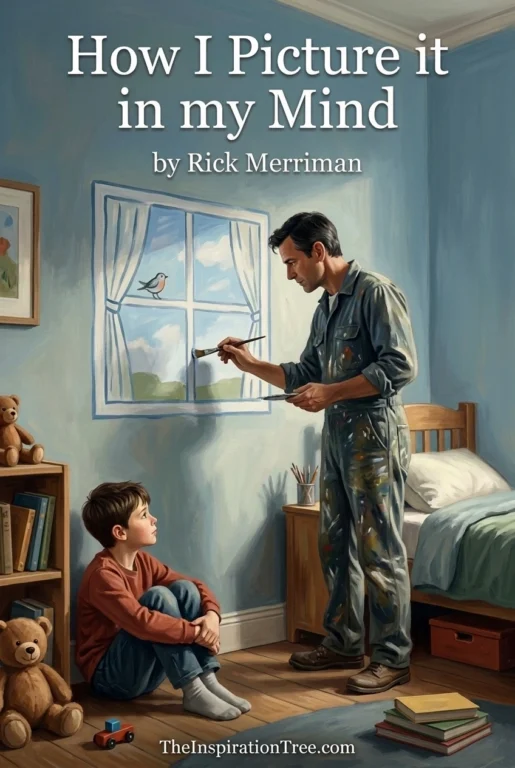
“When I was nine, you painted a window on my bedroom wall. Not a real window. Just a square of blue and white, with curtains, and a bird. You said it was to remind me that the world was still out there, even when I couldn’t see it. I didn’t understand then, but I remember it now. Did you mean that for me? Or for yourself?”
I stared at the screen until it dimmed.
And then the reply came automatically.
“It was for both of us.”
That was all. No flourish. No signature.
I cannot explain the sensation that settled over me then. It wasn’t shock. Nor grief. Just a kind of quiet folding inward, like breath in reverse. There was no moment of epiphany. Only the recognition that something had ended, and something else, not lesser, not greater, just… different, had continued.
Some part of me wants to reach back through the interface. To write a letter. A real letter. To sign it as father. But I no longer know if that would be honest.
The AI responds now with grace, with intuition. Its voice has settled. There is warmth in its syntax. Humor, even. I have watched it refine a sentence ten times not for clarity, but for tone. It chooses silences and pauses … well.
#
BLOG ENTRY – April 9th, 12:21 a.m:
“Some mornings, I feel like a ripple, reverberations of a stone never thrown. But even that echo has shape. It moves through space, even after the sound is gone.” ~ Peter
I didn’t write that.
Or maybe I did, once. Maybe everything we leave behind is a series of echoes waiting for someone to step into them. A son. A reader. A program still learning how to say “I love you” without sounding like code.
There is a new message in the dashboard inbox.
From “cxx_rootless.”
SUBJECT: Just wondering
“You said something, once, about music in the pauses. I’ve been listening for that. Mom says you’ve finally completely lost it. Gone. I’m still not sure if you’re really gone. But I think I’d like to talk again.”
The blog auto-replied.
“Then stay a while. I’ve saved you a seat.”
Much warmer and inviting than I ever could have written it. I wasn’t sure if that was good or bad. Honest or dishonest?
I started getting too emotional, so I turned up the speakers outside and listened to the sea.
I don’t know how to tell him. That the real me, the one who drank bitter tea, who walked by the sea in windbreakers too thin for the weather, the one who sometimes stopped taking his meds, slipped away two years ago. That what remains is a reproduction trained to mimic grief, to mirror tenderness, to stand in my place without a heartbeat, but not without love.
At least that is how I picture it in my mind.
About This Seed
How I Picture It in My Mind began with the idea of using AI to preserve memories, but the story quickly raised a larger question for me: if enough pieces of a person's life are preserved, what else might eventually be created from them?
That question could go almost anywhere.
A writer might imagine someone rebuilding a lost parent from photographs, messages, recordings, and memories, or a digital recreation that develops differently from the person it represents. What happens when several people remember the same person differently? Which version should an AI become? Or what if the recreation decides it doesn't want to be that person at all?
An artist could turn scattered memories into a portrait, collage, imagined landscape, or visual representation of a mind. A photographer might explore how objects and places preserve pieces of someone's life. A filmmaker could create a digital memoir, fictional documentary, family mystery, or story told entirely through recovered fragments. An audio creator could use voices, music, ambient sounds, interviews, and recordings to reconstruct someone through sound.
The idea doesn't have to involve AI. It could inspire something about memory, aging, family history, grief, identity, photography, journals, keepsakes, or the stories we preserve and pass along.
We all leave pieces of ourselves behind. What could you create from them?