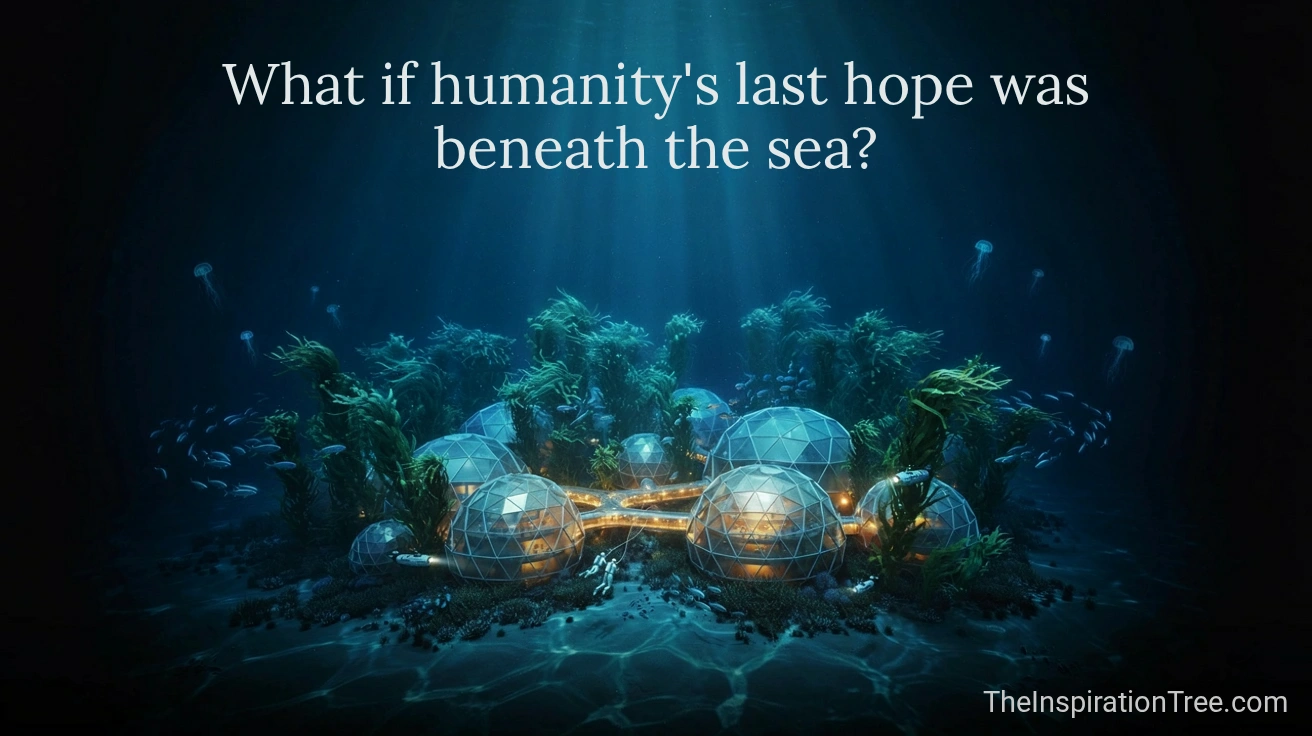
For generations, when humanity imagined outgrowing Earth, we looked up.
We imagined colonies on the Moon, cities on Mars, enormous space stations, and eventually settlements around distant stars. Space became synonymous with humanity’s next frontier.
But what if we’re looking in the wrong direction?
More than 70 percent of Earth’s surface is covered by ocean. Beneath it lies an enormous three-dimensional environment that humanity has barely begun to inhabit. Perhaps our next great expansion won’t require traveling millions of miles through space.
Perhaps it will require traveling a few hundred feet down.
And eventually, finding somewhere else to live will become less a question of if than when.
Climate change is already altering the geography on which civilization was built. As Earth warms, melting land ice adds water to the oceans while warming seawater expands. NASA’s latest measurements show global mean sea level has risen about four inches since 1993, and the annual rate of rise has more than doubled over roughly three decades. This is only one factor in the effects of the Earth warming; there is evidence that the increase in inland flooding and other unusual weather phenomena may be directly tied to it.
That doesn’t mean the continents are about to disappear beneath the waves. But rising seas increasingly threaten coastal communities and infrastructure, while humanity simultaneously faces pollution, habitat destruction, pressure on freshwater and agricultural land, growing energy demands, and continued consumption of finite resources.
Even if global population eventually stabilizes, billions of people will continue demanding more housing, food, technology, energy, and material resources. We cannot expand cities, industry, agriculture, mines, data centers, roads, and infrastructure indefinitely without changing the environment around us.
There is an obvious irony in one possible solution.
What if the oceans threatening some of our existing cities eventually become the place where we build new ones?
The idea isn’t entirely science fiction. Humans have already lived beneath the ocean.
NOAA’s Aquarius Reef Base, located about 60 feet underwater in the Florida Keys, has supported scientists living and working underwater around the clock. Its habitat provides roughly 400 square feet of living and laboratory space for six people, while a surface buoy supplies power, compressed air, and communications. Saturation-diving techniques have allowed aquanauts to remain there for extended missions rather than resurfacing after every dive.
Aquarius is a research laboratory, not a city. But it proves something important.
We already know how to keep humans alive beneath the sea.
The challenge would be transforming a small habitat dependent upon the surface into something vastly larger and increasingly self-sufficient.
Imagine clusters of pressure-resistant habitats built along relatively shallow continental shelves. Residential domes connect to laboratories, workshops, schools, medical facilities, recreation areas, farms, and manufacturing modules. Instead of trying to make one enormous structure capable of surviving every possible failure, cities could grow modularly. A damaged section could be isolated without sacrificing the entire colony.
Then comes the most fundamental question: How would everyone stay alive?
Oxygen could initially be generated much as it is in other sealed environments, using electricity to split water into hydrogen (energy generation) and oxygen (needed to live), supplemented by stored reserves and surface systems. But a mature underwater community might add biology to the equation. Large illuminated tanks containing algae or other photosynthetic organisms could help recycle carbon dioxide while producing oxygen.
Kelp and seaweed could become even more valuable outside the habitat. Instead of traditional farmland, enormous underwater farms might produce food while requiring no freshwater irrigation or conventional agricultural land.
Food production could extend beyond plants. Fish, shellfish, crustaceans, algae, and other marine organisms might be raised in carefully managed aquaculture systems. Hydroponic or aeroponic farms inside the habitat could produce vegetables and fruits. Eventually, cultivated meat or other future food technologies might reduce the amount of physical farming space required.
An underwater city would therefore not necessarily need truckloads of groceries arriving from shore every morning.
It could gradually become an ecosystem designed to support itself.
Power presents similar possibilities. Surface solar arrays and offshore wind farms could send electricity downward. With Tide turbines, ocean currents, tides, and waves could potentially contribute energy where geography makes them practical. Geothermal energy might be available in selected locations. And a sufficiently large permanent settlement might ultimately rely on compact nuclear reactors for dependable baseload power.
Water, strangely enough, would be both everywhere and unavailable. Seawater would need deep-sea desalination for drinking and agriculture, but unlike a settlement on Mars, the raw material would surround the city.
Waste could become another resource. Water would be recycled. Organic waste could be processed into nutrients or fertilizer. Materials that are expensive to import would create enormous incentives for repair, recycling, and reuse.
The goal would not merely be an underwater building.
It would be a closed or nearly closed human ecosystem.
That still leaves formidable problems.
Water pressure increases rapidly with depth. Saltwater corrodes equipment. Structures must withstand currents, storms, earthquakes, leaks, and failures that could become catastrophic. A colony would require multiple independent systems for oxygen, power, communications, food, and emergency shelter.
And we would have to avoid destroying the very environment into which we were expanding. Moving underwater because we damaged the surface, only to pollute and industrialize the ocean floor, would repeat the problem rather than solve it.
Perhaps the hardest challenge would be human.
We evolved beneath an open sky. What happens psychologically when children grow up without one?
Residents might spend months without feeling rain, walking through a forest, or seeing a natural horizon. Every trip outside would require equipment. Every wall would separate ordinary human life from an environment capable of killing an unprotected person within minutes.
For some, watching whales glide beyond an observation window might feel like paradise.
For others, that same window might eventually feel like prison glass.
Future settlements would probably need parks, artificial sunlight, plants, large communal areas, private spaces, and perhaps immersive virtual environments designed specifically to counter confinement and isolation.
Yet all of those difficulties are trivial compared to the problems we would face colonizing Mars or other potential settlements in the cosmos.
Mars is tens of millions of miles away even at its closest approaches. It offers no breathable atmosphere, severe cold, substantial radiation exposure, reduced gravity, and no possibility of rapid rescue from Earth.
An underwater colony would also exist in a hostile environment, but home would still be directly above it.
Replacement equipment might arrive in hours or days. Residents could communicate with the surface essentially in real time. Medical evacuation might actually be possible. The colony could expand using technologies descended from submarines, offshore platforms, aquaculture, life-support systems, marine robotics, renewable energy, and habitats we have already begun building.
Perhaps humanity will eventually reach Mars and the stars.
But long before we can make another planet feel like Earth, necessity may force us to become much better at using the planet we already have.
If rising seas consume valuable coastal land, resources become increasingly strained, environmental pressures intensify, rampant pollution does not stop, and humanity continues searching for room to grow, perhaps our first great colonies beyond the familiar human world won’t be millions of miles away.
They may be only a few hundred feet from home.
And when we finally need somewhere new to live, humanity’s last unexplored frontier may have been beneath us all along.
About This Seed
Being more of a "beach" person than a " the mountains " person, I've always found it interesting that when we talk about humanity needing somewhere new to live, or what our backup plan is if we continue to kill our environment, we almost immediately start talking about Mars or other planets. But most of our own planet is ocean. Could living beneath it actually be the more practical next step? I'd love to hear what you think, including what underwater life might look like, what could go wrong, and whether we should even be considering it.