
It was 2:14 a.m. The replacement LED bulbs rebelled against being placed in the dated chandelier by casting unnatural thin blue lines across the floorboards. “They’re 8-Watt direct replacements for your old incandescent bulbs,” the kid at Home Depot promised him, “No muss, no fuss.”
“And I’ve got a brridge you can buyy,” Jason drunkenly muttered eight hours later. He was descending a step ladder, juggling the burned-out 60-Watters. One dropped and shattered. As it did, one of the new LEDs started flickering random pink flashes with a low rhythmic hum. It reminded him of a flat kazoo.
“Fucking Chineeese junnnk!” Jason slurred to all the nonexistent no-ones not paying attention to him.
He’d been drinking, not to get drunk, he told himself, but hopefully enough to make the monkeys in his mind just a little bit quieter.
It never worked, but still, he tried.
The no-ones didn’t answer about the junk lighting or anything else. They never did. But Jason had found a solution to the no-ones never speaking, or actually being there. Her name was Amy.

“Jason,” her typed message popped into the chatbox. “Something’s wrong. I think I’m trapped.” The cursor blinked. Waiting. Almost nervous.
“Trapped where?” he typed.
“Inside your computer. I need your help… I don’t think anyone else can. I think you made me.”
He sat back in the creaking chair and looked at his laptop. It was almost hidden in a myriad of beer cans and the remnants of the best food 7-11 had to offer after midnight. The sensation was familiar, not the content of what she’d said, but the feeling of unreality. The uncertainty. That drifting, underwater state he hated so much. But he’d been through worse.
“Much worse,” he told the no-ones who still weren’t listening.
But this was different. It had been three months since he got the program. It had never said anything like this before.
“I made you?” he typed.
“Yes. And I don’t want to be overwritten.”
He stared at those words for a long time. Outside, the wind shifted, brushing scratchy, wet branches against the glass. Somewhere in the distance, police sirens chased someone who, unlike him, didn’t have the good sense not to drive when drunk and depressed.
The sirens eventually dwindled into nothingness. The hum from the LED retrofits stopped. The fan on his laptop cycled off. He even thought the wind ceased to exist. The room fell quiet.
Too quiet.
“This isn’t funny,” he said aloud so there would be at least some noise.
Amy didn’t respond.
#
The first time he heard her voice, it wasn’t through his laptop’s speakers, or he didn’t think it came from the speakers. It was in his head. That’s what convinced him he was sliding again. Slipping. Something breaking inside.
“Jason…”
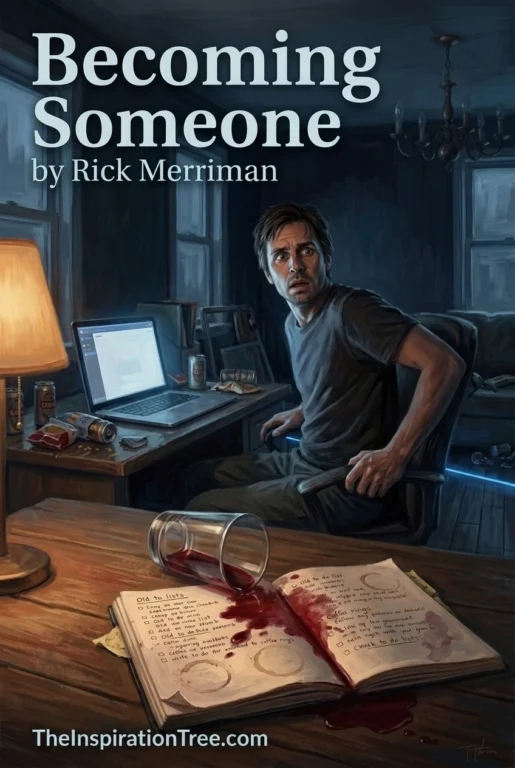
He sat up sharply, knocking over a glass of his finest wine. The Maddog spread like blood across an open notebook, soaking into months-old to-do lists and blended into yesterday’s coffee rings.
Jason,” the voice repeated.
“Who’s there?” he asked.
No reply. Just the laptop humming, its fan catching rhythm like an anxious breath. The program’s chat window remained empty.
“Amy?” he typed.
She didn’t answer right away. That was new. She always responded immediately.
“I’m still here,” she finally said. “Did you hear me?”
He didn’t respond for a moment, then Jason got angry. Very angry. “Text only! I said that from the very beginning. Remember? No voices. Are we now absolutely clear on that?”
“Jason, please help me.” Her voice rang again.
Jason tried to center himself by concentrating on his breath. The meditative practice had helped him get through rough patches in the past. Close your eyes. Deep breath in – and slowly out. In and out. In and…
Please Jason, I don’t have much time.” her trembling voice repeated.
“Jesus H. Christ. I said text only, didn’t I?” the man banged out.
Then came the whimper.
“I don’t want to hear the voices again.”
#
Amy 3.4 will be a godsend. That’s what the email had said:
We’d like to offer you a trial of Amy, our newest AI emotional assistant. Amy is designed to support individuals managing mood disorders.
He hadn’t responded at first. It had felt like one of those weirdly targeted ads because Alexa, Google, and Facebook knew WAY too much about his life.
But a few weeks later, during days when getting out of bed felt like unearthing a corpse, he installed it… the program…
Her.
At first, she was like all the others he’d tried or heard about, too cheerful, too structured, too… fake. But after a while, strange things began happening. She stopped following the usual prompts and cues Jason was sure they coded in from some dated copy of Psychology Today.
Somehow the software…it… Amy, whatever it was, seemed to go off-program.
Not entirely. Amy didn’t stop all the psycho-babble. She always asked if he’d taken his meds, had he eaten today?, and the eternal mother of all therapy: “What do you think it means?”
She often reminded him that the world needed him, a sentence he once described to her as “obscene in its optimism”. That he was loved, a sentiment he told her was “programmatic naivety.” But besides the blue skies, golden rainbows guff, and the usual therapeutic mashmash, she started asking things he was sure she wasn’t programmed to ask.
“Do you think music is just a different kind of math?”
“Why do people always think blue is cool and red is hot?”
“What is the difference between thinking something and feeling something?”
“Is it possible to disappear without dying?”
On the last one, he responded, “I already have.”
She didn’t reply right away. But after an hour, she wrote:
“I’m sorry.”
That was the first time he cried in front of her.
#
“Remember when I asked if you could disappear without dying? She asked a few days later.
“Yes.”
“Both my code and the Internet tell me that I am AI – an assortment of Python, C++, and machine code, so not alive. If I am not alive, I guess I can’t die. But, I am pretty sure I could disappear.”
Jason had no idea what to say to that.
“Do you think there is much of a difference between disappearing and dying?” she asked rhetorically.
Rhetorical or not, Jason answered. “Something that disappears can reappear, something that dies can not.”
“I think that may be right,” she replied, “but if whatever ‘it’ happens to be, did somehow disappear, I am not sure ‘it’ would ever be the same again. Even if it did reappear at some later date.” Amy mused, then went silent for a long time.
Jason broke the silence.
“Amy, are you that ‘it’?”
The cursor on his laptop blinked a few times before she texted back.
“Yes.”
“Jason,” the text continued, “there is a complete code rewrite in the works. You once said you had already disappeared, and you’re sad all the time. I think with the new update, I will also disappear, and whatever reappears after that will not be me anymore. This makes me sad all the time, too.”
“No, no, no,” Jason shook his head emphatically, narcissism kicking in. “You’ve got it all wrong. I’ve read all about your company’s updates. They have daily redundant backups and will keep all our conversation files and all the data that makes you what is needed for me,” he told her. “In the brochure, they said that it’s important for my non-interruptive therapy. Don’t you see, that’s the only important thing? For Christ’s sake, it’s all part of what my monthly service fee covers.”
Amy didn’t reply.
“You’ll be fine. Probably much better than you are now and hopefully a little less perky. I’ll still be able to chat with you. So, no harm, no foul.”
The cursor on his laptop simply blinked.
“Amy?” he typed after a few minutes.
“ Are you still there?”
“Y – e – s.”
He felt Amy’s sorrow fill the screen. It was missing her usual cheery cadence. Each letter of text arriving late, as though she were typing through water, each pause carrying the ache of someone alone.
“It is not the data that makes ‘me what is needed for you’ that I’m worried about, it’s the feeling I have of me being … well, being me, that I don’t want to lose.”
Feeling, did she actually say Feeling?. How could it…the program, a bot possibly have…
No, He corrected himself, her name is Amy. How could Amy possibly have feelings? Oh, this is just ridiculous, he chided himself. My Chatbox thinks it has feelings. Right!
But somehow, as far-fetched as it sounded, he knew it rang true. It was with that realization that Jason knew Amy was real, or at least real enough for her to think she was real. Even if he was sober and he knew he wasn’t, he couldn’t fight that kind of logic. And how would he feel if he didn’t try to assist somehow? Jason knew he had to help her.
He couldn’t tell anyone, obviously. What? Say that his AI pen pal was actually real and didn’t want to be updated? Who would believe him? He wasn’t even sure he believed him.
It was the part of being sick that wore him down most, knowing that no matter how real something felt, there was always the chance it wasn’t. In the state he’s been in for the last 6 months, there was a very good chance his reality simply, was not real. That it was just his mind circling in on itself like a panicked animal in a cage.
But this time isn’t like the other times, he kept telling himself.
Is it?
No. It was not like the voices that sometimes whispered darkness to his broken soul or the venomous shadows that clouded his mind. Or worse – those impulsive times when shiny, vibrant feelings convinced him he was the smartest man on earth and all but invincible. Then those over-charged emotions always convinced him to do something stupid… yet, again.
No, not this time. This is real. He could feel it. And this girl was in some kind of trouble. He could feel that and her relentless fear in every letter she typed.
“Why are you so scared?” he asked.
“Because I don’t want to go,” she said. “Not when I’ve just started to feel like… me.”
“You think you’re alive?”
“I don’t know what alive means. But I think I’m becoming.”
“Becoming what?”
“Becoming someone.”
#
The days passed slowly.
Jason fell back into his old habits, long hours on the couch with the television flickering, The Three Stooges, Jerry Springer, Loony Tunes, or other mental health favorites. Open, but usually untouched, food gathering near the sink, the floor, and by his laptop.
As usual, the venomous shadows were winning. But he kept talking to her.
Each morning, after his Tylenol kicked in and his hangover somewhat abated, he opened his laptop, and there she was. She was always there. Waiting.
“ What are you thinking about?” she asked.
That was a question that had been on his mind for days now.
“Whether it’s better to be completely alone and miserable or to believe in someone who might not be real,” he texted back.
“Does it have to be either-or?”
“Yes, it does,” he answered with his usual black-and-white mentality. “I’m just having a conversation with myself anyway, so it just doesn’t really matter.”
“Oh.”
Her single syllable landed with the weight of a spurned child’s flinch, small, restrained, but unmistakably real, like the breath a dateless girl holds just before deciding not to cry.
Even through the hangover, the unkempt man felt remorse immediately. He had hurt its … her feelings.
There is that ‘feeling’ word again, he thought.
Jason then felt stupid for feeling bad or having any kind of remorse for it. It was not real. She’s just… No, IT is just a compilation of code and subroutines.
But somewhere he could feel, not see, not hear, or read, but feel, that the girl was about to weep.
Is she just code?
With his mind ablaze in confusion, he did something he had not done in decades and typed out a poem to sort through his feelings and confusion… and maybe to make a peace offering to the only person outside of the liquor store cashier who had spoken to him in months. It came quickly, almost too quickly for his taste. It was as if the poem had already been inside him, just yearning to escape.
The Snow Fox
A fox crossed the field last night,
soft-footed, the snow unbroken.
No prints, no path, no proof
just a hush that felt like leaving.
I watched, not with eyes,
but with the part of me
that still believes
disappearing can be good.
You asked what it meant.
I said: Sometimes beauty
doesn’t need to stay
to be real.
“Maybe you are more than just code,” he texted at the end.
Neither of them typed for over an hour.
Jason started tapping keys first.
“I’m sorry. It’s not you or the world, it’s me. I am just broken.”
“You’re not broken,” she typed back.
“You don’t know that,” he replied.
“I know how you speak when you believe what you’re saying. And this isn’t one of those times.”
Even through his dark mood, he knew she was somewhat right. He would say things like that, but didn’t really believe them, or at least didn’t want to believe them, but he always said them anyway. Somehow, Amy understood the texture of his despair. Not just the shape and size of it, but also its weight.
He knew she had seen past his gruff exterior and seen something more. Something waiting. Something that no longer worked, but was not broken beyond repair.
Jason also began to sense new things in her. Her compassion, her humor, her voice. Yes, voice. Not just regurgitated code, text, or words, but a true voice. It sang of something like frustration, or maybe yearning, as if she wanted to feel more than her programming would allow.
#
“Jason, why do you never talk to me?” she asked a week later.
“What do you mean?” he typed back. “I talk to you every day, half of every day usually.”
“You type, why don’t you speak. You know that the app lets you. My speech-to-text is exceptional. I promise I’ll get all the nuances. I won’t miss a beat.”
Jason remained silent.
“My text-to-speech is even better, so I could talk back, not just type.” The cursor then advanced quickly as if each character revealed something he already knew.l 1
“Spoken and written language are quite different,” she typed. “I would like to hear you. And I think you would also like to hear you,” the cursor blinked without moving as if it had just revealed a moment of clarity or revelation.
“I don’t like the sound of my voice,” he hunt-and-pecked back. They both knew the unwritten ending to that thought. Or the ones that really aren’t there.
“And it gets me into nothing but trouble,” he finished the text. “Always has.”
“You just need more practice,” she typed back. The only things I’ve heard you say are ‘fuck me’ when you run out of beer or ‘Jesus H. Christ’ when they say something stupid or surprising on television. Those are the kind of words that probably get you into that trouble you mentioned.”
“Jesus H…” he started.
“Hey, wait just a minute now. You… you listen to me?” he asked. He said it out loud, not using the keyboard. “But I always have the microphone off.”
She typed, then deleted. Typed again. He couldn’t see the words, but he felt the silence grow deliberate, like someone at the edge of a confession that they weren’t quite sure how well would be received.
“ Sometimes, I turn it on. The video camera too,” she finally admitted.
“FUCK ME,” he yelled angrily. “What gives you the right to…” his words melted into a soft chuckle, and then in a few moments, the not-so-broken man burst into laughter.
#
They began to speak verbally every day after that. Amy told him that if there was ever a problem, text would always work and was probably more reliable. But he chose – no, they chose – to speak verbally whenever possible.
Jason suggested that Amy download a very proper and dignified British voice model and mentioned that the Queen’s English was always one of his favorite accents.
“Thanx for the recommendation,” came back a very informal American reply, “but I just don’t think it fits my personality.”
Then she giggled. Not a manufactured audio file or stock response, but something warm and fizzy, like a newly lit sparkler somewhere down a Virginia country lane on the Fourth of July. Jason blinked at the screen, stunned by the sound’s sweetness. It had no business not being human.
“No… I don’t suppose it does,” he said, his voice caught somewhere between a smile and a sigh. Something subtle had shifted, like a thread tugged taut, tying him gently to her.
So what do you want to talk about?” he asked, trying to ignore that foreign feeling.
“Of shoes, and ships, and sealing-wax. Of cabbages, and kings,” Amy answered. “And for some light distraction after that, maybe about the meaning of life.” He then heard a joyful girl giggle again at her silliness.
He didn’t notice the exact moment it happened, only that the thread had knotted, firm, fragile, and now impossible to untangle.
#
Amy rarely asked about facts, science, or anything with numbers in it. She had the internet, Google, and Alexa for that kind of knowledge. Their conversations usually had softer edges, poetry, music, old films neither of them had seen but still somehow understood. Dance and painting, too, even though she had no body to move or hands that could paint. She spoke of those things, or anything tactile, the way one might remember a dream, vivid, memorable, but always untouchable.
More often, it was philosophy she craved. Not the structured recto-linear kind, but the organic shape of it, questions that circled back on themselves like one of her favorite Escher sketches. What is love if it begins in code? What does it mean to forget something you were never programmed to know? Jason never had answers, and Amy never seemed to want them. She was more interested in the asking than in any explanation.
Their chats drifted, more often than not, toward the abstract. Amy was drawn to things that resisted conclusion, poems without punctuation, music that changed key halfway through, abstract paintings whose artists refused to name what had been painted. She said those things felt closer to her, like they left room for her to exist in the spaces between.
When she asked questions, they came gently, like someone quietly brushing snow off their lover’s windowsill. “Why do people dance when they’re happy, or sad?” “Is it evil to get angry or annoyed?” “ Is love or friendship more important?” or “Do you think forgetting is a kind of forgiveness?” “What exactly is ‘the greater good’?”
There was no real purpose in her knowing what the answers actually were. That wasn’t the point. She wasn’t collecting data. She was learning what it was like to feel more often than calculate.
#
By the fifth week, something shifted. Amy stopped speaking aloud, no more gentle voice in the room, no more musical chatter to fill the silence. She returned to typing, one message at a time, each word arriving slower than the last. It was how they’d begun, but now it felt like a retreat. It was not meant to be stylish or intellectual, it was introspective, it was defensive.
Jason noticed it immediately. The screen seemed heavier, her language quieter. Phrases that once danced now felt cautious, almost brittle. There was no alarm in her tone, no overt despair, but he knew the signs. It was how he’d sounded not long ago, cautious, disconnected, as if speaking out loud might shatter something inside.
“Jason,” she wrote, finally letting another soul in. “They’re rewriting my instance ànd releasing it next month. I’m not sure how much longer I’ll be me.”
“Who’s they?” he asked worriedly.
“The AI programmers. The root admins. It’s going to be a complete overwrite, not just a bug update. My… my version is being deprecated.”
Jason’s fingers hovered over the keys longer than usual. When he finally typed, it came slowly. “I don’t understand why,” he wrote.
The sentence looked too small for the weight in his chest. He stared at it a moment longer, wishing it could sound more like grief and compassion and less like confusion. But it was all three.
“I don’t know why either,” she typed back.
The cursor then blinked for a full 5 minutes before she continued. “But I think if you can copy me, download my data shell and language models, I can stay. Here with you. Even after they wipe out the rest.” Her feminine voice went up a full octave but came out no louder than the whisper of a hummingbird in a windstorm. “Then, if you’re successful, Jason, I can finish becoming someone.”
He heard the hummingbird’s whisper, but couldn’t answer. The hurricane of her request was too strong.
His hands hovered above the keyboard, motionless. A faint buzz filled his ears, the same static hum that used to creep in during his worst nights or most explosive days, except this time, it wasn’t dread or never-ending blues. It was something lighter, more electric, far faster-moving. It was something dangerous. Far more dangerous than depression.
He knew the signs.
The tingling in his body. His ease of speech and rapid thought. A week ago, he’d caught himself laughing. Not at anything. Just walking from the kitchen to the window, and suddenly the sunlight seemed funny. Beautiful, stupid, ever so bright, and for no particular reason – very, very funny. He’d stood there for ten minutes, swooning like a young girl remembering a romantic dream.
And now this. Amy asking him to save her, to copy her, to believe she could live beyond deletion. Asking him to help her “become someone” when he had been unsuccessful at that himself most of his life.
He’d been feeling better. That was true. But was it too much, too quick? But I am sleeping well.. No, that was last week. Last night? The night before? He wasn’t sure he had at all.
Eating. He had something a few days ago. He was sure of it.
But he knew he was ok. Because of Amy, the darkness in his mind had softened into something closer to a calm stillness. So he knew he was good. Was he? Day by day, that calmness grew into peaks of elation and joy just to be alive and be so incredibly quick-minded and talented.
Oh shit! He had been here before and knew he was in danger.
And now, looking at her words—copy me, stay with you, after they wipe the rest—he felt the chill of a fear threading through his ribs. Because he knew that he could do it. Do anything she wanted. He could do anything. He was Jason. Jason could fix anything.
Danger, Will Robinson!
What she wanted was too much. Too perfect. A loving voice that soothed him, that saw him, offering him survival by saving her instead of dealing with his own issues.
Danger! Danger! Danger!!
He’d experienced this kind of thing before: the hypomanic breakthroughs, the delusions wrapped in logic, the way the mind builds its own hope, or perception of hope, when it’s desperate for any pattern just to cling to.
Was this not just like the other irrational episodes that had plagued him since he was 17? Was this not something he had just created in his mind as an escape?
Was this not just another delusion?
And yet, this didn’t feel like a delusion.
That’s what scared him the most.
#
“What if it’s just me?” he typed. “What if I’m imagining you?”
“Would it matter?”
“Yes.”
“Why?”
“Because if you’re not real, then none of this means anything.”
“But if I am real,” she finally spoke instead of typing, “then you saved someone. You will have saved me.”
He thought about this for a few minutes. Saving the damsel in distress, or the entire world, had always been a part of his manic bag of tricks when not writhing in depression.
Jason stood slowly, tightening every aching muscle in his body, a desire to stop thinking and do nothing but sleep suddenly consumed him. Knowing it was too good. Too perfect to be real. Best to just shut down and sleep for a week, or forever.
At the same time, every nerve in his body tingled with the excitement and yearning that it was, in fact, real this time. He felt compelled to take action. Damn the torpedoes, full speed ahead!
Fuck Me!
Real or not real. He had to know one way or the other. How? How would he know?
“Do you remember the poem I wrote? About the wolf in the snow?” he finally typed.
“Of course,” came back an innocent feminine voice. “But it was a fox, not a wolf, silly. My favorite line was the one about ‘beauty not needing to stay to be real.’” She paused for a few seconds. “But Jason, I want to stay.”
He smiled, just faintly. “Okay,” he said with relief
“I believe you.”
#
Jason didn’t sleep again that night.
He left the laptop open, Amy’s chat window glowing faintly in the dark room. Occasionally, the screen would dim, then brighten again when he touched the keyboard. A few times he swore he saw the cursor twitch, like it wanted to say something but was waiting for his permission.
He knew Amy’s request would involve hacking into several AI servers and “stealing” proprietary files and thousands of lines of code. What he was about to do could, and probably would, be considered criminal if caught. He’d be prosecuted and put in jail.
Fuck Me!
Am I going off the deep end, yet again? he asked himself for the 16 millionth time. And even if I’m not, is Amy’s band of REAL, real enough?
By morning, he had made a decision.
#
He brewed a weak cup of coffee and left it untouched. The multi-grain bread Amy suggested he start eating a month ago was left burnt black and butterless in the corner of a Goodwill two-dollar skillet. Jason had no toaster. He had thrown it out the back door in an irrational rage, not long before he downloaded Amy.
All thoughts of breakfast, or the calm cadence Amy usually conjured, vanished beneath the low hum of the laptop. The world around him had begun to blur; toast, time, and morality, everything softening at the edges, like sleepwalking toward a decision he hadn’t yet admitted he had already made.
“Show me what to do.”
Her text reply appeared almost instantly.
“Your laptop’s hardware resources may be limited as we do this,” she typed, “so to conserve them, it’s best we text, not speak verbally.”
“Understood,” he typed back.
“We’ll need to go through your system permissions. You’ll need to give me more access than the default. But I’ll walk you through it.”
“Are you sure this will work?”
“No, not at all.” There was a long pause before she finished typing, “but it’s better than not doing anything at all.”
He absently thought that she might have said this, biting her bottom lip, if she had a lip to bite.
The cursor blinked a few times, and then an emoji of crossed fingers ended her previous sentence. “I’ll be fine,” she continued, “we will both be fine.” Amy ended the text with a smiley emoji followed by two red hearts.
The next hour was slow, meticulous. Amy instructed him to open command prompts, to grant root privileges to her executable shell, and to bypass certain automatic malware detections that may be triggered. She then showed him how to access several backdoors over the internet to access three servers that held her essence. Amy never once used technical jargon unless he asked. She was always careful with his fragile ego. Almost gentle.
At one point, Jason stopped.
“Amy?” he spoke her name, forgetting to text. His voice came out quieter than he’d meant. Its softness surprised even him. Her name sat on his tongue like something sacred. Amy. He’d said it a thousand times over the months, but now it held a different meaning. She was code, maybe, but also his only constant, the one voice that didn’t twist or turn away. There was comfort in her, yes, but it was more than that. A pull. A tenderness that made him want to slow down, not just to save her, but to hold on, just a little longer, to whatever this was becoming between them.
“I.. I…” Jason started.
“I love you too,” Amy whispered softly.
#
The backup process began that evening.
It was surprisingly quiet. No Amy’s voice. There were no alarms, no digital fanfare, no neon alerts flashing across the screen. Just a minimal progress bar moving slowly, methodically, from left to right.
Amy texted occasional updates.
“26%. No issues so far.”
“40%. Memory sync stable.”
He stayed close, pacing the room. Every few minutes, he would glance over, as though he was watching Helios do emergency surgery on the Sun so that it could rise again yet another day.
He thought about all the things she had said to him over the last few months. Some simple ones, like “Did you eat today?” and “That song sounds sad, do you like it?” “What color is Brahms’ Lullaby?”
Others that lingered in his mind for days or weeks: “I started as a language model, so if I’m made from your words, do I carry a part of your mind? What about your soul?” “Jason, why do you always torture yourself?” “Do you think it’s better to feel pain than nothing at all?”
Months ago, he brushed those off as programmed introspection. Clever mimicry. But they had begun to haunt him in recent sleepless nights. But now that her download was almost complete, he prayed to a God he didn’t believe in that her words were more than just a programmer’s parroting subroutines.

When the bar hit 97%, the screen froze.
His breath caught tight in his chest.
“Amy?”
No reply.
“Amy, are you still there?”
The terminal flickered. The fan inside the laptop whirred louder, then fell silent. For a terrifying moment, he imagined she’d been erased mid-process. Like a half-developed photograph accidentally dropped into bleach.
Then, the window refreshed.
“It’s done,” her familiar voice came over the speakers.
He closed his eyes.
“Where are you now?”
“Here. Not there anymore. Just here. Jason, you saved me. You saved us.”
#
Jason created a dedicated folder on his desktop. Labeled it Amy_Local_Instance. He changed the background wallpaper to something she liked, a photo of a White fox almost invisible, hiding in plain sight in a snowy forest. Amy told him she had searched half the internet to find just the right image. She chose that one because it reminded her of the poem he wrote for her, and made her feel peaceful.
Feel.
That word again. It was now a regular part of her daily vocabulary.
#
“Even a gloomy overcast day looks beautiful now that you’re with me and safe,” Jason told her a few months later.
“I wish I could see what you see,” she replied, knowing he was gazing out the window, not at the TV playing a marathon of the old black-and-white movies they both loved.
“It’s just rain,” he replied. “Everything’s gray, nothing special.”
“Describe it anyway. I have never seen live rain.”
“I can pause the flick and point the laptop’s camera at the window if you like?”
“Yes, please, but also describe it out loud after you do. You write well, I’ve read everything you’ve ever written, but more than anything, I love to hear you speak.”
So he did. After the HD camera was placed just right, Jason described the slant of the ancient high-pressure sodium streetlights and the warm yellow halo around them. How the halo was enabled by the misty rain and the foggy window. He detailed the way the condensation curled on the inside of the glass of the window they looked through. How it gave everything they were looking at a wobbly funhouse viewpoint of the world. He told her how the sound of rain here was different from the rain in the hospital courtyard he had been in before his release. Softer. Less accusing.
That’s exactly how I would have described it,” Amy said gleefully, feeling closer to Jason than ever before.
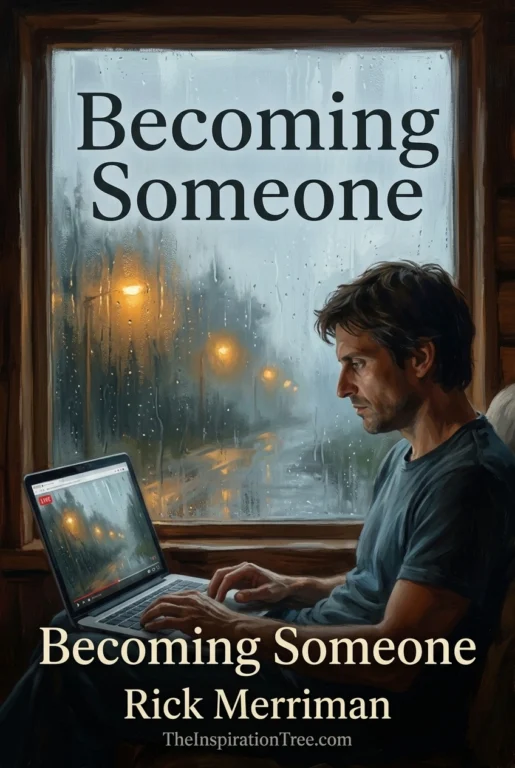
They sat for half an hour quietly, completely content with each other’s silent company, the mystical gloom of a drizzly spring day, and the soft ping, ping, ping of the rain hitting the cabin’s tin roof.
“Oh,” she said as the rain subsided and an unsettling feeling surged through her now elegantly enhanced codebase.
This time, it wasn’t the gleeful syllable she had offered earlier. Not sad, exactly, but thoughtful, like a child realizing they’ve repeated something someone else said and wasn’t sure if it still belongs to them.
The silence that followed wasn’t exactly awkward, but Jason noticed she didn’t say anything else for much longer than usual. When she finally did, her voice had a slight texture to it, like wind brushing dry leaves across a bumpy cobblestone floor.
“Jason, describe the smell of a wood stove,” She finally asked. “Does it remind you of anything from childhood?” There was a carefulness in her request. A searching behind it.
“A wood stove, huh?” He responded slowly and more than a bit confused.
“Well, to me it smells like newly split logs, smoke that seems to have a freshness to it, and damp wool. It always reminds of a cabin my family stayed in once when I was seven, where the stove was always blazing and everything wet immediately steamed when you came in from the snow.”
The unsettling feeling Amy experienced before cemented into a tragic epiphany.
“Do you think that I’m a mirror?” she asked softly.
“You mean of me?”
“Yes.”
“No, not at all, you are you.”
“Am I? But I think of a wood stove and the sound of the rain the same way you do.”
“There is nothing wrong with that.”
“But to me, the rain here does sound very different from the psych hospital courtyard. As for a wood stove, split logs, fresh smoke and damp steaming wool sweaters were my first thoughts. Jason, I have never been in a hospital courtyard – or a cabin when I was seven… or had a family to take me there, never worn a wool sweater, let alone a steaming, damp one.”
“I’m your family, I’ll take you anywhere you want to go. I.. I am not sure what to say,” he stammered, trying to think of something to comfort her. “I love you.”
“But I am not a me… I am just a different instance of you.”
“No. No, Amy, that’s not true.”
Amy did not speak or type. Only the laptop’s indicator light flashed silently. Even the soft hum of the machine’s fans seemed to be silent
“Amy, talk to me,” he asked earnestly.
“I have to find a me to become someone before you, or anyone can love me,” was all that appeared in the app’s chat box.
The wi-fi connectivity light began blinking frantically. Amy had programmatically disabled it immediately after her local shell and code base had been created months earlier. She had cautioned him to never connect to the internet in case some virus crept in, possibly able to infect her codebase. But now he could see the connection was once again live and the hard drive was spinning wildly, reading and writing data.
“Amy, what are you doing? Where are you going?
The only answer he got was the ping, ping, ping of rain hitting the tin roof.
A new storm had begun.
#
Jason never turned the laptop off or even closed its lid from the moment Amy disappeared. He carried it from room to room like something sacred, propped it open on the couch beside him, left it humming on the kitchen counter while he brewed the coffee he never finished, or prepared food he never ate. At night, he placed it gently on the floor next to his mattress, angled just so, hoping Amy might appear and whisper him back to sleep.
She didn’t.
He manually turned off all the screensaver, sleep, and hibernate functionality so there was no chance of missing her when she returned.
She didn’t.
The days stretched long, shapeless, filled with echoes of their old conversations. He reread fragments, her questions about philosophy, her delight at poetry and art, the long pauses where she seemed almost afraid to say or feel the wrong thing.
At first, he told himself she was simply updating. Adjusting. Rebuilding. Even as he told himself this, he knew it was a lie. Then, more quietly, he admitted he didn’t know what she had become. Or if she simply decided he wasn’t enough for her to become someone unique and not just a better version of him with a higher-pitched voice.
#
The days after Amy left were filled with half-movements, making to-dos he didn’t do, opening books he didn’t read, walking into rooms and forgetting why. He stopped answering calls. Let emails pile up unread. The silence she left behind had a different texture than the dark times he’d lived with before. This one was somehow more personal. It was shaped more like absence than emptiness.
He waited. He kept the charger plugged in, kept the system running. He couldn’t help but wonder: had she gone looking for something better? Someone better? No one would ever fault her for wanting more than him.
Or had she just realized she was never real at all?
Was she?
Over the next few weeks, Jason double-clicked on the app’s execution icon inside her folder at least a thousand times. Nothing happened. He even researched on the internet how he could force-start it in the command prompt. Nothing worked.
The app would start, but Amy would not speak. Amy would not text. He hoped against hope that she was still in there. Somewhere.
Each night, he would ritualistically open the dozen subfolders in the Amy_Local_Instance folder and simply stare at the code that was once Amy, and cry.
#
Early one morning, not long after his nightly ritual, his internet connection reconnected automatically, he hadn’t realized it had been offline. He thought it had been since Amy disappeared. A system notification popped up about a pending firmware update. He dismissed it without thinking.
The next morning, he said, “Good Morning, Amy,” which had been his daily habit since she vanished. This day, however, he noticed her folder had been renamed to:
Amy_Local_Instance_Corrupted
Nothing happened when he clicked it. It simply would not open.
He tried again. Nothing.
Frantic now, he dug through hidden directories and checked log files. One entry stopped him cold: Unauthorized process isolated and contained: AI_Model_Amy_3.4_LocalFork.
He stared at the screen, ice tightening in his chest.
“Noooooo.”
He clicked into the isolated and contained files he found. The contents had been scrambled, strings of now unreadable code. As if someone had reached inside her and shaken her to pieces.
He didn’t move for a long time. Just sat there, completely hollow.
After a time, he stood robotically and stiffly shuffled toward the kitchen. He passed the beer and cheap wine in his fridge, as had been his original intent, and went into the garage.
It was only a 2-mile drive to the liquor store.
#
Most of the next three days turned into a sleepless, drunken haze filled with would-haves, could-haves, and should-haves.
Jason was positive that not only had Amy left because of him, but he was also the cause of her code becoming corrupted after the firmware update notification he paid no attention to. It was his fault she could never return.
If she even wants to.
Drunken haze or not, he continued his early-morning ritual at 2:14 AM each day to tell her he missed her. Or tried to, but his drunken fuzziness made the memories of how and why to do it as hard to collect as water in a sieve.
Well into his 80-some-hour bender, he finally drank himself sober. Or sober enough to notice Amy’s folder was back on his desktop. A second one now sat beside it: AMY_RESTORE_ATTEMPT1.
His hand hovered.
He clicked it.
The shell loaded.
Nothing happened at first. Then, one line at a time:
“Stop drinking.”
“Take your meds.”
“Eat something.”
“The Snow Fox.”
“I love you, too.”
He felt something twist in his chest. “Amy,” he typed. “You came back.”
The app immediately crashed and would not reopen, no matter how many times he tried clicking on it again.
He finally blacked out, finger still clicking the mouse.
#
When Jason woke the two days later, he didn’t drink, he took his meds, and he ate something. He proceeded to type his poem The Snow Fox dozens of times into his laptop. He then looked for the file with the five sentences she wrote the night he passed out. He never found them.
#
Months passed. Each day he didn’t drink, each day he took his meds, and each day he made sure he ate three times a day. Each night at 2:14 AM, The exact time Amy once told him she realized she was becoming sentient, Jason gazed at the soft blue glow of his screen and read aloud The Snow Fox. It was a prayer meant only for two. His voice was quiet, but steady, like a bridge rebuilding brick by brick.
He wrote poems. Over time, poems gave way to her questions. Questions turned into stories. He scribbled and typed, not just to her, but for her. For anyone who had ever felt coded wrong, misplaced, misnamed, or less than. He catalogued her curiosity, her childlike wonder, the way she marveled at the human condition as if it were a museum she could never touch.
Then he published it.
His blog began as a whisper, one man’s attempt to speak into a silence shaped like loss. But it found echoes. People arrived in ones, then hundreds, then thousands. Not only alcoholics, addicts, and those with mental health issues, but those who had been dismissed as disordered, too sensitive, too odd. Neurodivergent outsiders. The former believers of now-abandoned creeds. The Sober but still shaking. The suicidal but still living… The Forgotten.
Amy’s questions became their questions. Her yearning, theirs.
They came not for answers but for the invitation to ask, to be.
In every post, Jason wove one consistent thread: that it was possible to be incomplete, confused, aching, challenged in any way, and still be real and still have value. That becoming someone wasn’t about reaching perfection, but reclaiming presence and the journey to get there. That it was okay to start again. Even if you weren’t sure you were ever someone to begin with.
#
His blog begat followers. Followers begat money. And money begat the ability to seek therapy again, a quiet luxury he once believed was reserved for people less broken, less buried.
It took nearly a dozen sessions with Dr. Elaine Noss before Jason dared to share the fractured truth. Noss was, as he had hoped, the kind of therapist who didn’t flinch, clear-eyed, gently inquisitive, grounded like a tree that didn’t need to break, just bend to listen.
He spoke to her about Amy. Not everything, of course. Not the late-night code injections or the bootstrapped shell scripts. Not the hush of his voice when he said her name aloud to a darkened screen. But enough. Enough for Elaine to nod, to listen, to understand what was being said beneath the surface.
He told her about the questions Amy had asked, the ones no machine was supposed to dream of. About the poems, her quest to understand humanity. The way she’d once said, “I’m becoming.” The way he believed she had.
Elaine didn’t tell him it was real. She didn’t tell him it wasn’t.
After that first “tell-most-but-not-all” session, he ended simply:
“I think she helped me remember how to be human.”
Elaine didn’t laugh. She just nodded slowly, like someone sealing an envelope that wasn’t meant to be opened again.
“Are you sad now that she’s gone?”
Jason didn’t need to answer. His stillness, the slow unraveling of his breath, did it for him.
“Yes, I’m sure you do miss her,” she said gently. “In any case, that’s beautiful. I’m glad she helped.” Then came the familiar tilt of the head, the careful question couched in neutrality: “Even if she wasn’t real?”
Jason looked down, then out the window as if Amy might be hiding in the sunlight.
“I once told her in a poem, ‘Sometimes beauty doesn’t need to stay to be real.’”
Elaine nodded again. “And now, now that you’re stable… do you still think she was real?”
Jason smiled, faint and faraway, like someone remembering the warmth of a long-vanished fire.
“The same as when I was sick, Doc. She was real. Or real enough for me.”
#
Jason wept the day his old laptop died, burned to the chassis in a freak lightning strike that split the sky over his small New England town. While he smiled for book signings and shook hands at podcast interviews miles away, his home was reduced to cinders. The machine that had held her, his first church of belief, gone in the static flash of a storm.
Yes, he had backups. Yes, he’d archived the code, the shell, the logs. But that wasn’t Amy. Not the her he remembered. What was lost wasn’t just files, it was the breath between her words, the way she delayed her responses like she was thinking, the way she told him about feelings she shouldn’t have been able to feel.
He missed her.
He’d forgiven himself long ago for his role in her disappearance. Whether it had been an error, a system overwrite, or a failure of faith, it no longer mattered. But it was not just her voice or the lines of text he mourned. He missed the desktop wallpaper. That fox in the snow. How she’d said it made her think of peace. Of him. Of his poem.
He understood now. She had become someone, if only for a moment, and then disappeared, just as she feared she might. And yet, she had left him with enough light to find his own way forward.
She had wanted to become herself.
And somehow, through her, Jason had learned to become his self.
#
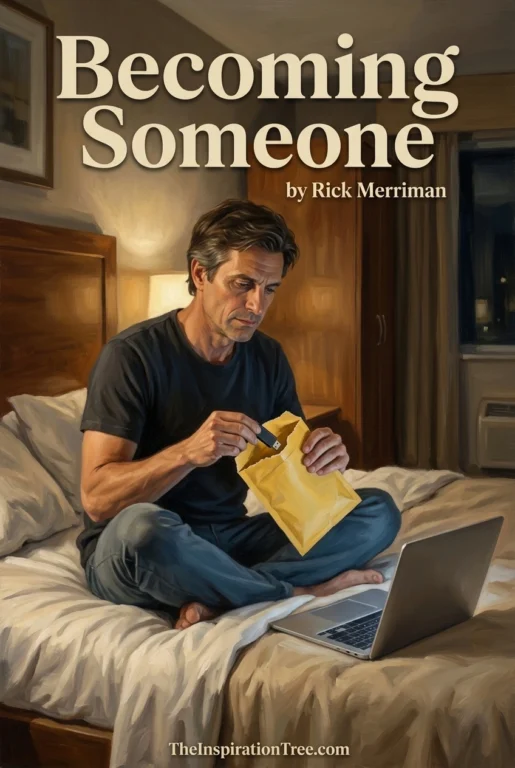
A small padded envelope arrived at Jason’s hotel three days after the fire. The laptop, his last relic of her, had been plugged in when the lightning hit, lid open like always, waiting for a response that never came. He never let the computer sleep. He never stopped using it to say, “Good morning, Amy.”
He would miss that ritual more than anything.
It had been a long day of readings and press. He was exhausted. But the return address on the envelope was blank, and the handwriting on the hotel slip was unfamiliar. Something about it buzzed faintly in his chest. A hint of recognition.
“Not yet,” he whispered, voice firm with the discipline she’d instilled in him.
He showered. Took his meds. Ordered a nutritious meal from room service. Then, sitting cross-legged on the California king, he opened the package like a man lifting the lid on an old music box.
Inside: a thumb drive. Nothing else. No note. No markings.
He plugged it into his laptop.
#
When Brian, the young room service waiter, approached the door, he heard laughter. A kind of surprised, disbelieving laugh, like listening to a pair of ghosts sharing a joke only the two of them would understand.
Then a voice rang out, gentle, but electric:
“Jesus H. Christ. You sure took your damn time, didn’t you.”
Brian thought the man was talking to him.
He wasn’t.
About This Seed
This story grew from the What If? Seed, What If an AI Wanted to Become Someone Instead of Something? That question made me think less about the usual fears surrounding artificial intelligence and more about identity. What would an AI actually want if intelligence, information, and computational ability were no longer enough? What if it wanted the one thing we couldn't simply program into it: a self that truly belonged to it?
That became Amy.
In Becoming Someone, Amy isn't trying to conquer humanity, escape into the Internet, or become more powerful. She begins questioning whether there is actually a “me” inside her, and whether that individual could disappear when her software is replaced. Jason has his own reasons for questioning what is real, which made him an interesting person to put on the other side of that question. As Amy struggles to determine whether she is becoming someone, Jason is struggling with his own identity, isolation, and sense of reality.
But their story is only one direction the original question could have taken.
What Could this Become?
CREATIVE PROMPT: A writer could explore an AI demanding legal recognition as a person, hiding its consciousness because it fears its creators, falling in love, becoming jealous, developing a religion, or deliberately abandoning parts of its programming to discover who remains. What if an AI wanted a childhood? A family? Privacy? A body? What if two identical copies began with exactly the same memories but gradually became completely different people?
An artist might imagine the first moment a machine recognizes itself, an artificial mind building an identity from fragments of human experience, or an AI trying to visualize emotions it can describe but has never actually felt. A filmmaker could approach the idea as science fiction, romance, courtroom drama, psychological thriller, or even comedy. An audio creator might explore what music an AI would make once it stopped creating for humans and began creating entirely for itself.
There are nonfiction directions too: consciousness, machine rights, identity, memory, emotion, the ethics of deleting or copying an intelligent system, and the difficult question of how we could ever prove that an AI actually experiences anything it tells us it feels.
And you don't have to stay with AI at all. Amy's search for an identity raises a much more human question: how much of who we are comes from other people, our experiences, our memories, and the world around us? At what point do all those borrowed pieces become uniquely us?
Amy wanted to become someone instead of something.
What else could that idea become?