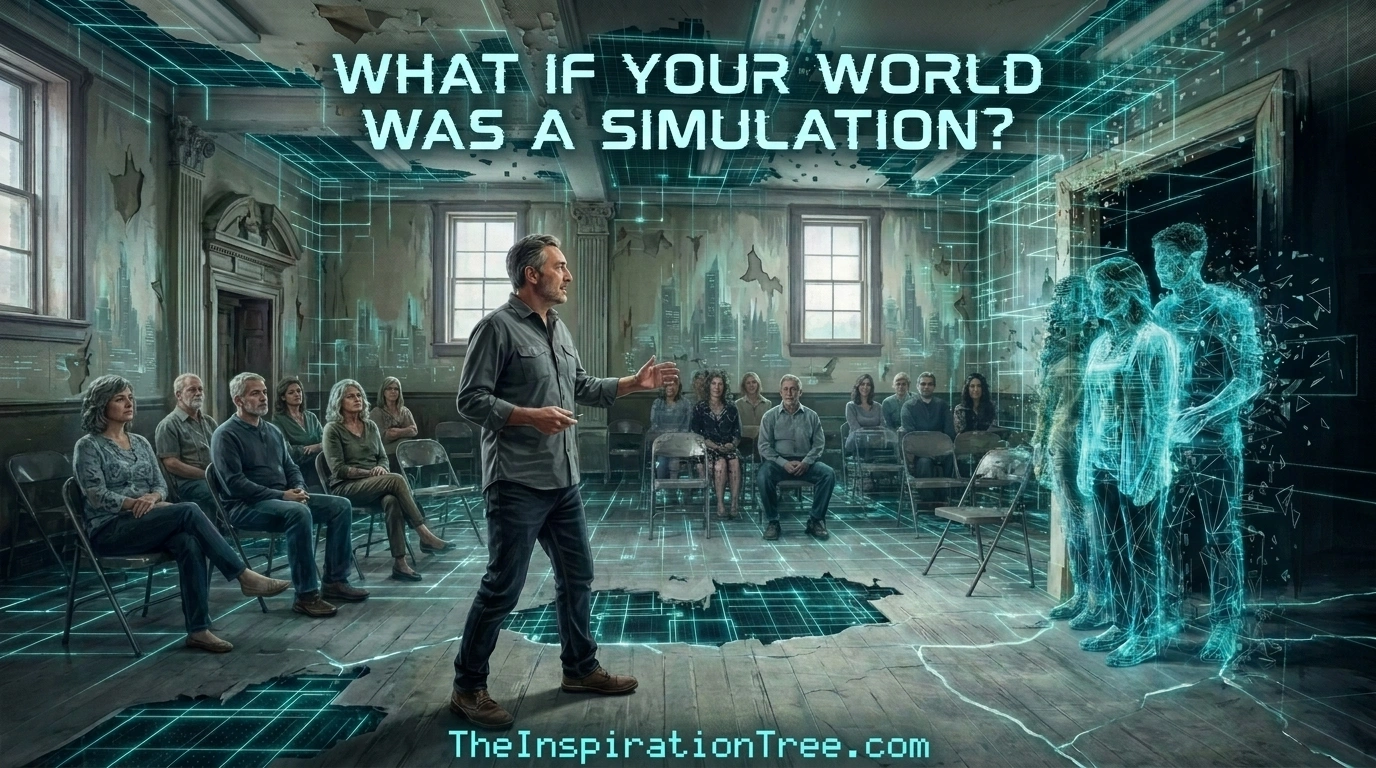
You wake up tomorrow and everything is exactly as you remember it. Your home is the same. The people you love are the same. You are still you. Except today you learn something impossible to dismiss: your world is a simulation.
How would you react? Would you be terrified? Angry? Would you immediately want to know who created it and why? Or, after the shock passed, would you realize that your relationships, memories, happiness and pain still feel exactly as real as they did yesterday?
Humans were asking versions of this question thousands of years before computers existed. Plato’s Allegory of the Cave imagined people who knew only shadows and believed those shadows were reality. The Chinese philosopher Zhuangzi famously wondered whether he was a man who had dreamed of being a butterfly or a butterfly now dreaming he was a man. Centuries later, René Descartes asked how we could be certain that everything we perceive isn’t a dream or the work of a powerful deceiver. The technology is new. The question isn’t.
Computers gave the old question a modern form. In 2003, Oxford philosopher Nick Bostrom published his influential simulation argument. He didn’t claim that we had discovered we’re living in a simulation. Instead, he reasoned that if advanced civilizations eventually become capable of creating enormous numbers of simulations containing conscious beings, simulated people could eventually vastly outnumber the original biological ones. If that happened, why should we automatically assume we’re among the originals?
There is currently no scientific evidence establishing that our universe is a simulation. Scientists have considered whether a simulated universe might leave detectable clues. One physics paper, Constraints on the Universe as a Numerical Simulation, for example, explored whether a universe simulated using a kind of underlying lattice could produce observable effects in extremely high-energy cosmic rays. Interesting, yes. Proof that someone programmed the universe? No.
Perhaps the more interesting experiment is happening much closer to home.
Virtual reality is still easy to distinguish from ordinary life, but consider where it began and where it might eventually go. Visual realism continues to improve while spatial audio, eye and body tracking, haptic technology, artificial intelligence and brain-computer interfaces advance alongside it. Imagine those technologies after another hundred years rather than another five.
What happens if a virtual world eventually looks, sounds and feels indistinguishable from physical reality? What if its artificial inhabitants remember conversations, form relationships, learn, change and perhaps become conscious? At what point does a simulated experience become simply an experience?
Then take it one step further. Imagine that the inhabitants of that simulated world eventually develop computers. They invent their own virtual reality and begin creating simulated worlds themselves. Those worlds might eventually contain beings who build simulations of their own.
Every civilization could believe it was creating the first simulated reality while actually existing several layers down.
This leads to a philosophical question that may be more interesting than whether we can prove we’re simulated. Philosopher David Chalmers has argued in Reality+ that virtual objects and experiences can be genuinely real and that meaningful lives could exist within virtual worlds. Being simulated, in other words, doesn’t necessarily mean being fake.
Imagine again that tomorrow you discover your world is a simulation. Your childhood still happened to you. The people you love still matter. Kindness still affects another person. Pain still hurts. Your choices still have consequences. Perhaps discovering that your world is ultimately made from information rather than what you previously thought wouldn’t make your experiences any less real.
Some people might even hope the simulation hypothesis is true. If our reality exists inside another, perhaps there is something outside it. Maybe death isn’t necessarily the end. Maybe there is a creator, an explanation or another place to wake up. None of those possibilities follows from the science, but the desire behind them is familiar. Humans have wondered for thousands of years whether there is another reality beyond the one we can see.
Perhaps someday we’ll create a simulated world whose inhabitants ask exactly the same question.
If they think, love, suffer, create and wonder about their existence, would we consider their lives less real simply because we know what their universe is made of?
And if we wouldn’t, perhaps the same answer should apply to us.
What if your world was a simulation?
About This Seed
This Seed began with Scott's Fifth Year. I originally created the image for a specific moment in that story, but when I looked at it outside that context, it opened a Pandora's box of other ideas. What if the people in the room weren't experiencing the reality they thought they were? What if the figures appearing around them belonged to another reality entirely?
That led me to a much older question: how do any of us know that what we experience is actually real?
People were asking versions of that question thousands of years before computers. Plato imagined people mistaking shadows for reality. Zhuangzi questioned whether he was a man dreaming he was a butterfly or a butterfly dreaming he was a man. Descartes wondered whether everything he perceived could be an elaborate deception. Today, simulation theory, artificial intelligence, virtual reality, and brain-computer technology give us entirely new ways to ask the same question.
What interested me most while exploring the idea wasn't whether we could prove we're living in a simulation. It was something more personal. If you discovered tomorrow that your world was simulated, would that make your life less real? Would the people you love matter less? Would your memories, happiness, pain, and choices somehow lose their meaning?
What could this inspire?
A writer might explore someone discovering that their life is simulated, the people operating the simulation, or a simulated civilization creating virtual worlds of its own. An artist could reveal the machinery beneath ordinary reality, imagine what exists outside our simulation, or show two realities bleeding into one another.
A filmmaker could create the moment the illusion fails, an emergency broadcast announcing the discovery, or a documentary made from inside a simulated world. An audio creator could imagine voices breaking through from another reality or the sounds of a world beginning to glitch. A nonfiction creator could challenge simulation theory, explore consciousness and perception, examine the future of VR and AI, or ask whether a simulated person could ever truly be conscious.
Or forget computers altogether. Perhaps the image suggests alternate dimensions, dreams, digital ghosts, time travel, collective hallucination, an afterlife, or something completely different.
Scott's Fifth Year led to an image. The image led to a question. Now I'm curious where that question might lead someone else.