And Then There Was Light
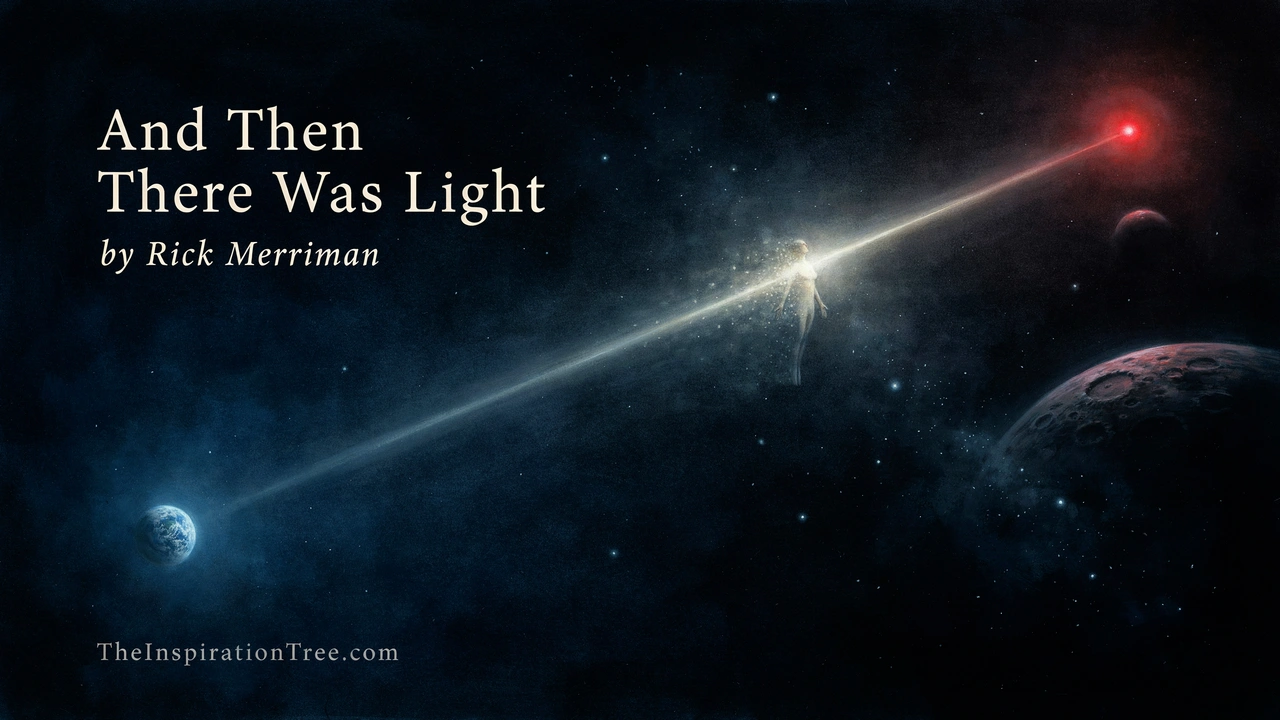
They said my consciousness would be copied first, held inside a computer like a butterfly pinned behind glass. Only once they were certain I had not unraveled would they set me loose, a digitized version of myself turned into light, racing outward like a flare flung into the night.
I tried to believe in their process and in the promise of continuity. It was like believing a photograph could carry the warmth of a living face. And yet, I signed their forms and gave them my memories, all the while uncertain if what emerged would still know it was me.
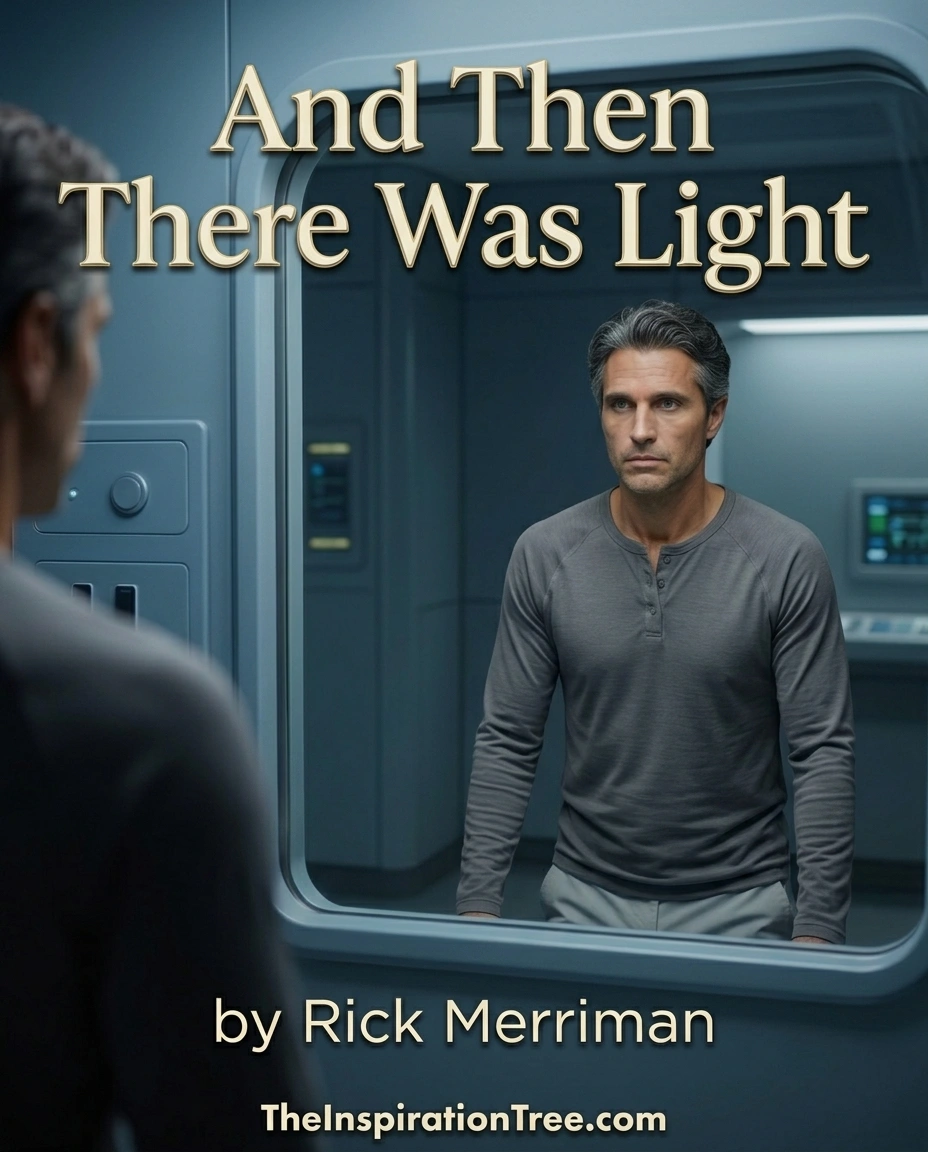
In the hours before the procedure, I watched my reflection as though it were already an artifact. The man in the mirror seemed stripped back to essentials: slender shoulders, the lean remnants of muscle stripped of its youth and vitality, dark hair surrendering at the temples to silver, like frost creeping over windows in winter. Anna had once called my eyes storm-colored, and now they seemed to hold not only age but the faint blur of reluctance, the look of a man rehearsing his own funeral in silence.
Dr. Sharma entered with the kind of brisk calm. She was a medical doctor in her own right, a top neurologist, but for the last 3 years she had been my liaison to most of the project’s scientists and management.“David,” she said, “still with us?”
“As much as I ever was,” I replied, turning away from the mirror. The joke was dry, but it brought a faint smile to her face.
She set a mug of tea on the table beside me. The steam curled upward, fragrant with a hint of citrus. “Sip,” she said. “This is the last cup you’ll taste before…well, before.”
“One final cup before the cosmos claims me,” I said softly.
Her smile deepened. “That should be on a plaque.”
Not long after, Dr. Ahlberg, the Director of the project, arrived. He was taller, more severe in posture than Sharma, but his voice carried careful gentleness. “Here’s the process. Your upload itself will not feel like movement,” he explained for the dozenth time. “Think of it as unfolding. You will not travel, not at first. As we discussed, you will be held. Observed. Only once we know you are complete and coherent will we allow the transmission. It’s not the first consciousness we’ve uploaded to a data center, so trust the process.”
“Trust the process,” I repeated, though my voice wavered.
The far wall of the bay housed the great capsule: a server core humming faintly, threaded with conduits of light. Inside it, the ‘time capsule,’ an encyclopedia of Earth, 860 ronnabytes of human history and memories. Languages, art, music, the heights of modern science, and the fragile threads of the human story. All of it compacted into 860 octillion bytes of data.
Dr. Sharma caught me watching it. “It’s your trip. You’re our envoy. You can add memories of your own to it, if you like,” she said gently.
I hesitated, feeling suddenly that one man’s treasures would be lost in the weight of billions. And yet, I wanted some part of me there, a trace beyond the impersonal. “A recording,” I said at last. “Of my mother’s laugh. She used to lose her breath in the middle of it. Like joy was too big for her chest.”
Sharma’s eyes softened. “We’ll include it.”
“And a letter Anna wrote me,” I added quickly, before I could reconsider. “The day… the day before she died. I’ve kept it folded all these years.”
“Then it belongs there,” she said. “I’ll have it scanned in.”
And so, my small tokens were woven into the archive: one woman’s laughter, one woman’s farewell, scanned into everything human. It felt almost absurd, like slipping pressed flowers into an encyclopedia, fragile things preserved among grander knowledge. Yet it seemed right. If I were to be cast outward as humanity’s envoy, let some reminder of love and loss go with me.
I finally asked the question that had been pacing inside me, restless and unasked. “Do you really believe it will still be me, on the other side?”
Ahlberg met Sharma’s eyes. Their silence was brief, carrying volumes of hesitation in a single glance.
“It is not certain, but we believe continuity will be preserved,” Ahlberg said.
“But continuity may not feel the same as you expect,” Sharma added, softly. “What matters is that what emerges will be based on what you remember. Digitally, of course, but identity rests in memory. That much we know.”
Ahlberg paused, then glanced at Sharma before continuing. “As you well know, besides science and exploration, there is another reason for this journey you are about to undertake,” he said. “Earth is unraveling. Our populations outpace our resources. Wars ignite faster than they can be extinguished. Starvation claims millions each year. Before you came to The Array, you lived there, you know.”
Sharma’s voice followed, almost a whisper. “The seas rise. Every month, the maps are redrawn, coastlines drowning beneath saltwater. Entire nations have vanished into the tide. There is no room for the billions left. We are not only sending you outward for curiosity, David. We send you with the hope that somewhere, someone might have an answer. That another civilization, wiser than us, may show us how to endure.”
“Your real mission is to save humanity,” Ahlberg said with somber finality.
I let their words wash over me, though none of it was new. The newspapers had screamed these truths for years, and protests in the streets had proven them. I had seen the images: families clinging to rooftops, children fighting for bread that never came, armed guerrillas murdering and pillaging the weak. Still, hearing it framed as the core of my mission struck differently. This was never the original plan. The Array had been conceived as exploration, a gesture of curiosity. Now it felt less like a mission than a desperate cry.
I was no longer an envoy, but an advocate for a world on its knees. It filled me the way silence fills a heart when love dies. I would go not only to preserve memory, but to plead for survival. Humanity’s last hope traveled with me, bound in photons, hurled across the void.
#
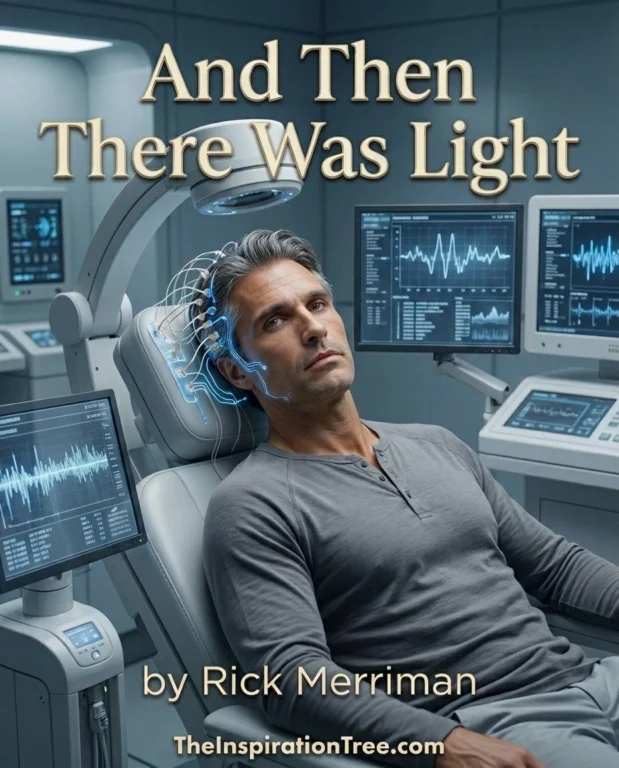
When the time came for the first phase, I lay back in the reclining chair. Electrodes touched my scalp, my temples, and down my spine. The synaptic grid hummed, deepening until it seemed to vibrate inside my chest. I tried to keep my thoughts tethered to ordinary things, things that would ground me: the taste of the tea, the way the leather creaked beneath me, its smell, my breath, the steady cycle of air in and out.
In and out.
In and out.
Then it began: A loosening, a dissolving, a ghostly sense of movement, not painful but unnerving. My mind felt stretched, its edges blurred. I unspooled into the circuitry, thought becoming current, memory becoming code. I felt myself held, suspended inside the data center’s net like a dragonfly caught in amber.
“David?” A voice came to me, not heard but sensed in a new way, flickering, perhaps Sharma. Perhaps only a representation of her.
“Yes,” I answered, though there were no lips to shape the sound.
“You are transferred,” the voice said.
“I am transferred,” I repeated, testing the truth of it.
#
They did not rush. After the initial unspooling, a slow ritual of verification began: digital probes slid through my awareness like careful fingers, not to tear but to read. They asked me to recall small things at first, the nature of my mother’s laugh, the number of steps up to my childhood apartment. Then, larger constructions: a story I had once told Anna, the taste of tea drunk beneath rain, the emotion it evoked. Each answer was checked and rechecked, cross-referenced against the raw recordings made during the two years before my digital transfer.
When a memory wavered, they did not abandon it: engineers coaxed the pattern, applied correction algorithms, rechecked a dozen times, and rewove the frayed thread until it matched the texture of the material it had been copied from.
Next came simulations. They placed me in virtual rooms I knew and had been taken to before the transfer: a humble kitchen at dawn, a pier with gulls clamoring where my watch had broken, the gym my prom was held in.
They watched how I behaved, how my responses rippled through the matrix. They tested my reasoning with puzzles and moral choices, observed my pauses, and measured the tempo of my hesitation. A thousand instruments sang my processes back to them as diagnostics: signal-to-noise ratios, checksum confirmations, redundancy maps, data paths. Each green light on their panels was a benediction. I saw that the proof of self was less of a sudden lightning flash than a gradual sunrise, every sliver of light checked before the dawn could be called a day.
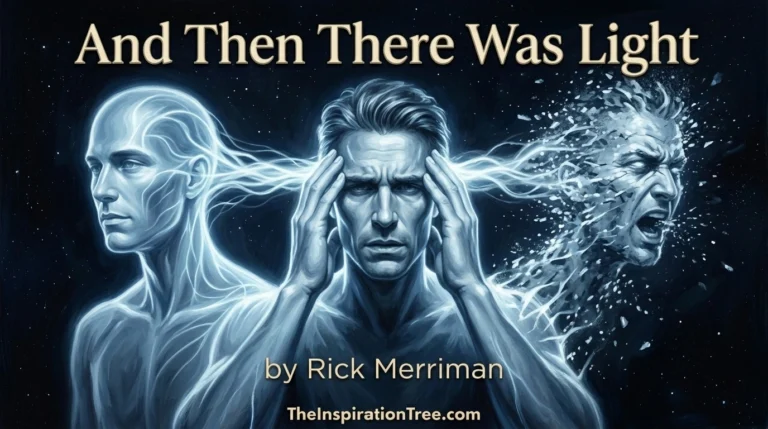
The end of their tests left me adrift in a silence more annoying than the tests themselves. Without puzzles to solve or questions to answer, my mind wandered through its new architecture. It was a structure both familiar and foreign, an echo of who I had been and who I might become. And in that wandering, I discovered I was not alone with myself. Something in my consciousness had doubled. Twin flames leaning away from each other, yet sharing the same wick
They began to speak.
“You’ll endure. You always endure.” One was steady, reassuring, insistent.
The other was low, doubting, as jagged as torn emotions. “You’ll unravel. You’ll scatter before you arrive.”
Two distinct voices instead of one. What I thought first and then what I thought last. A positive outlook with a devil’s advocate. My Alpha and Omega.
In my old body, I had quarreled with myself before. A hesitation, A nagging doubt, but never with such clarity, never with such distinctive voices. Here, each was sharpened into a presence, each as unique in perspective as a couple arguing across a table.
Perhaps it was some peculiar artifact of digitization, some glitch in the ghost of circuitry. Yet I did not dismiss them. I let them swirl, like opposing currents circling the same sea, pushing and pulling, but always keeping me afloat. They were both me.
“Trust the process,” I said to myself.
#
Being turned into a coherent stream of light was far more complicated than I initially thought.
Dr. Ahlberg explained the complications to me: Air scatters, water vapor bends, clouds blind, pollution corrupts. Every trial run fired from the surface ended in degradation, the signal smeared across the sky before it even reached the stratosphere. To travel a hundred light-years, there could be no such waste. The solution was simple in theory and monumental in practice: build the largest coherent light source ever constructed, free of atmosphere, free of interference, in the silence of orbit.
They named it The Array. The project was started with 32 nations decades before I was born. From Earth, it resembled a sparkling bracelet. Up close, it was a city of machinery, lasers linked in phases, mirrors mounted on gimbals, cryogenic tanks keeping the optics locked in stillness. Its aperture spanned thousands of kilometers, a continent of precise mirrors unrolled in orbit, for only such immensity could keep the beam coherent long enough to bridge the stars.
At full power, the system did not promise a beam impossibly narrow like a laser, but something more crucial: fidelity. The signal would cross the abyss with its encoding intact, bright enough to be distinguished from the background, coherent enough to preserve the patterns of a mind and the encyclopedia of Earth in the same stream. Into that beam they would fold me, and I would go outward as information riding lumens.
#
And then there was light.
The brightest light source in our solar system, bar the sun. With it, I knew I was about to be cast outward, unbound from orbit, much like a minute spark flung into the Grand Canyon on a moonless night.
At first, there was only brightness, steady and unblinking. Not brightness as I once knew it, not light to the eyes, but a brightness that seemed to fill me without source or shadow. I did not see it, I was it. I did not feel motion, I was motion. I felt myself streaming outward, cast from Earth’s orbit as if I were a single thread unspooling into a loom so vast it had no edges.
“Hold yourself together,” Alpha said. Calm, insistent.
“You can’t,” Omega replied. “You’re dissolving already. You’re only scattering photons pretending to be a man.”
The dialogue steadied me. Their presence was proof that something of me remained coherent enough to quarrel with itself. If I could still argue, I was not yet gone.
Time fell away almost immediately. There was no rhythm of seconds or minutes, no metronome of heartbeat or breath. A moment might stretch endlessly, or collapse into nothing. The scientists had said time would feel different. They had not said it would feel so mercurial, so treacherous.
“God help me,” I whispered.
“What a ridiculous sentiment,” Omega said. “God can’t help a duplicate without a soul, and you never even believed in God in the first place.”
“But Anna did,” Alpha said, “and you always believed in Anna. That should be good enough.”
I hoped it was.
Fragments of Earth clung to me in flashes. The taste of Earl Grey, sharp and citrus-sweet. The scent of rain on concrete. Anna’s cool hands tugging mine toward some antique store I had no intention of going to. My father’s voice, stern, reciting multiplication tables as though knowledge could be hammered into my head. These fragments appeared like sparks, sudden and consuming, then gone before I could hold them.
Each fragment was more than memory, it was evidence. A testimony to present before those at the end of my journey. The ones who might save us. I rehearsed them as a lawyer rehearses an argument, aware that my brief was nothing less than the continuation of humankind.
“Remember them, you must remember,” Alpha urged. “Memory is the anchor. Memory is what they promised you’d need to keep to maintain continuity.”
“Memories are smoke,” Omega countered. “Try to grasp them, and they slip away. You’ll lose them one by one, until finally you have forgotten not to forget.”
I resisted Omega’s words by repeating to myself. You are David Harden. You remember the taste of tea. You remember Anna’s letter. You remember your mother’s laugh. Over and over I rehearsed them, as though memory could be recited like a spell to hold me together.
#
Behind me, always, trailed the capsule. Not a box or vessel in any sense I could recognize, but a comprehensive slice of Earth encoded within the beam. I sensed it as weight without weight, a tether of information woven into my trajectory. It was not silent. It pulsed with its own rhythm, a library whispering to itself. I imagined its contents unraveling, history beside science, Shakespeare beside peacocks, algebra beside lullabies.
“You carry them,” Alpha reminded me. “All of them. Every record of humanity. You are not just yourself.”
“No,” Omega said. “You are only yourself, and even that is thinning. The capsule’s data is stable. You are not.”
Sometimes I wondered if they were right, both of them. Perhaps the capsule was the true envoy, and I merely an afterthought, a human scrap tacked on to comfort humanity’s vanity.
#
The journey pressed on. Stars did not pass as stars, not points of light against a black canvas, but ripples of radiation, bursts of intensity threading through me like the faint brush of strangers in a crowd. I could not name them or count them. I only felt their presence, distant, indifferent.
“Do you think the other David is still alive?” I asked the voices, or perhaps myself.
“He is,” Alpha replied. “He still walks. Drinks tea. Adds memories to the collection you both began.”
“And every new memory he gathers divides you further,” Omega hissed. “Two men, growing apart until one no longer recognizes the other.”
The thought unsettled me more than I wanted to admit. On Earth, David Harden would be older now. His hair whiter, his eyes more lined. He would learn new songs, suffer new regrets. Meanwhile, I remained as I was the day of upload: frozen at the moment of transfer, my voice and laughter sealed in remembrance, the memory of good tea I would never taste again, Anna’s letter folded inside me like a pressed leaf. Would we ever still be the same man? Or had we already become strangers, sharing only a name?
Time dissolved again and again, and I clung to talismans of memory to prevent my own dissolving. The cracked watch I had once dropped on the pier. The seagull that had circled overhead that day, insistent, as though it knew more than I. The sound of my Mother’s laugh. These remnants stitched themselves into a rhythm, the only rhythm I possessed.
“You are the story,” Alpha said. “You are a witness. You are an envoy.”
“You are an imitation,” Omega replied. “A shadow stretched over the cosmos until it fades.”
And yet I continued. Light cannot turn back. It does not falter. It travels, indifferent to the burden it carries. It was unrelenting. I had become that relentlessness.
Occasionally, I sensed disturbances, bursts of radiation, waves of energy flowing through me. They brushed like fingers across the framework of my being, impersonal, quick. Once, I thought I detected a rhythm, a strange repetition unlike the rest, but when I concentrated on it, it dissolved back into chaos. Perhaps it had only been a mirage, an echo of Earth’s radio telescopes, an artifact of my need for optimism.
I pressed onward, cataloging not the cosmos but myself. Memory became my world: the recollection of Anna’s hands, the sound of my mother’s laugh, the curl of steam above tea. Each of these memories was like breath. Without this reminiscence, I feared I would unravel, dissipating into noise.
“You are David Harden,” I said to myself.
“You were,” Omega corrected.
“You are,” Alpha insisted.
Between their voices, I threaded a fragile path, balancing doubt with resolve, fear with remembrance. It was the only way to continue.
And so I did.
The beam bore me farther and farther, 124 years of distance, and I murmured to myself as if to ward off the void: You are here. You remember. You endure.
If there was any comfort in the long cascade of light, it was the knowledge of where I was pointed. Not a random scatter into darkness, but a line drawn deliberately, a path chosen after years of watching. K2-18b, 124 light-years from Earth, circling its cool red sun in a habitable zone. Astronomers had found whispers there: a message they hoped screamed, “We are here, and we are waiting for you.”
I kept reminding myself it was not by chance I streamed toward this star. More than a century before my departure, observatories had detected something strange: faint, repeating signals, subtle variations in light that could not be explained by mere rotation, orbit, or natural phenomena. Not words, not patterns anyone could decode, but an intelligent rhythm, persistent enough to stir hope. The possibility, however slim, that intelligence lingered there was enough to cast me outward. That if they were advanced enough to send such signals, maybe they could collect them too.
To collect me.
Before I was sent, we sent flashes back that we hoped told them, “We are coming.”
“You were sent because they knew someone was listening,” Alpha reminded me. “They did, and now you’ll meet them.”
“They sent you because they didn’t know what else to do,” Omega replied. “A gamble disguised as purpose. They tied you to light and hurled you away, because the thought of Earth dying frightened them.”
The truth of it might have been tangled between the two. I tried not to linger on the motive. Whether I was an envoy or an experiment, I was still moving.
The ‘time capsule’ trailed behind me, steady and constant. At times, I fancied I could hear it, not as sound, but as a pressure in my awareness: the hum of humanity condensed into its architecture. I thought of the laugh I had left inside it, my mother’s laugh, fragile and foolish amongst the grandeur of civilizations. Perhaps, if the beings of K2-18b opened it, that laugh would ring out first. Maybe the laughter of my mother could move them where the statistics of our war and ruin could not.
“Wouldn’t that be enough?” Alpha asked gently. “To give them our laughter?”
Omega countered, “It would be pitiful. They will see humans as brittle creatures who choke on their own delight. They will review our history and know us for the monsters we are.”
And yet, I held fast to Alpha’s version.
Sometimes I wondered if the other David, the one still walking Earth, if still alive, ever thought of me. By now, he would be decades older, or more. His hands trembling when he poured tea. Perhaps, his eyes, once sharp and storm-colored, had softened into the pale blur of age. He would have gathered whole constellations of new memories, experiences that I would never share.
“If he lives, am I still him?” I asked, “ Or am I only a facsimile, frozen at the moment of departure?”
“You are him,” Alpha insisted. “The same consciousness carried forward. You continue.”
Omega quipped, “You are not him. He is the one who stayed behind and grew. You are forever trapped at thirty-nine, never aging, never learning. He is alive. You are an artifact.”
The thought devastated me. Was I a person, or a recording of one? I tried to anchor myself in memory: the cracked watch on the pier, the gull circling above, the warmth of tea between my palms. Yet each time I rehearsed them, the question returned, was remembering enough to make me real?
#
As an unknown measure of time streamed into itself, I began speaking aloud, though “aloud” was meaningless. There was no sound, only thought turned toward existential dialogue. “Hello, David,” I would say, as though addressing another presence.
“Hello, David,” Alpha would answer.
“You’re wasting your breath,” Omega would mutter.
“I only want to keep sane,” I told them both.
“You are sane,” Alpha said.
“You are far from sane, talking to us is proof enough of that,” Omega hissed.
So I argued with myself, three voices tangled into one, turning questions over like stones, rehearsing doubts until they formed a cadence that filled the silence. In that rhythm, I hoped I found proof that I still existed.
“Do I still exist?”
“Yes,” Alpha told me.
As always, Omega responded differently. “You are only a shadow. Forgetting already. Each shred you cling to grows thinner, frays more at the edge. Soon, even Anna’s letter will be imaginary dust.”
I fought him with repetition, with ritual. The letter was folded twice, creased at the corner. Anna’s handwriting slanted upward, hurried but firm, telling me not to mourn her. My mother’s laugh caught on her own breath. My father’s voice reciting seven times seven. Earl Grey tea steaming in the white mug. I clung to these things, knowing they may keep me from dissolving.
“Why repeat it?” Omega demanded once.
“Because ritual is continuity,” Alpha answered for me. “Because words, when repeated, when believed, become walls that keep out madness.”
Perhaps Alpha was right. Perhaps Omega was right. Perhaps I was only delaying the inevitable. But as I streamed onward toward K2-18b, toward the faint rhythm in its starlight, I told myself that delay was survival. Repetition was continuity. Memories were sacrosanct.
And so I continued, carried by light, memory my only compass, Alpha and Omega my only companions, the capsule my only tether. I thought of the scientists’ last words to me: Trust the process, and I whispered them now as a prayer.
“Trust the process.”
“You’ll come apart,” Omega replied.
“You will arrive,” Alpha countered.
And somewhere between their contradictions, I continued to exist.
#
I could not say how long I had been traveling when the texture of my existence began to change. Time was meaningless, I had surrendered its measurement long ago, though ‘long ago’ held no context to me. But there came a shift, subtle at first, like the brush of a magnet drawing filings into pattern. I was no longer streaming freely. Something was tugging, not to slow me, but to shape my motion.
“Do you feel it?” I asked.
“Yes,” Alpha answered. “They’ve seen you. They’re reaching.”
“No,” Omega growled. “This is the end. The beam is thinning. You are being torn apart.”
I leaned into the sensation, as though I could comprehend it more clearly by surrendering. It was not sight that guided me, not sound. It was density, interference, the sense of patterns pressed against my own.
“You will survive this,” Alpha said. “This is what you were sent for. The signal, the rhythm, they are collecting you.”
“You will not survive,” Omega replied. “The cosmos is dissecting you, a vulture stripping you like a rotting carcass. It’s over. You’re nothing more than a faint light fading into nothingness.”
I did not know which to believe, so I recited the memories that had carried me: Anna’s letter folded twice. My mother’s laugh catching in her throat. Earl Grey tea steaming. My father’s stern multiplication tables. The cracked watch on the pier.
The sensation sharpened. I was refracted, bent inward, the beam pulled tight toward some hidden net. The vast silence of space receded. A structure had taken hold of me, an architecture so immense it eclipsed the scale of thought, humming with its own rhythm. I felt its architecture not as shape, but as intention: order, precision, care.
“I think I’ve arrived,” I said, though the words felt insufficient.
#
I was still. Not exactly motionless, not extinguished, but definitely contained. I sensed boundaries where there had been none, parameters that now defined me. My awareness no longer streamed outward. It pressed against the edges of a vessel, some storage more complex than any server Earth had known.
I probed gently at its edges, uncertain whether I could stretch further. The structure was immense, larger than the sum of me, yet it held me with careful precision. I was not erased. I was archived.
And in the faint currents around me, I began to perceive other voices. Not words, not sounds, but patterns deliberate, rhythmic, echoing through the system that contained me. At first, they seemed like interference, static. But the longer I concentrated, the more they resolved into intention.
“They are speaking,” Alpha said, almost reverent.
“They are cutting you apart,” Omega snapped. “Every word is a scalpel.”
I strained toward the rhythms. They were intricate, layered, far beyond anything I could have imagined in human language. Yet beneath the complexity, I felt something startling: patience. The patterns moved slowly, methodically, as though each adjustment was measured to prevent harm.
“I think they’re studying me,” I said.
“Yes,” Alpha said. “Studying so they can rebuild you.”
“No,” Omega countered. “Studying so they can decide what pieces to keep.”
It was not only me they examined. I sensed the capsule beside me, pouring itself like a waterfall into their framework. The data pressed outward in vast tides, layer upon layer: languages unfolding like petals, histories blooming, sciences sparking like constellations. I could feel its immensity, but I knew it was being opened. Humanity’s time capsule was no longer sealed.
And still I could not speak back. My awareness rebelled against the vessel’s walls, straining for expression, but no response passed outward. I was present, intact… and mute.
“I can feel them,” I said. “Their intention. They’re careful. They’re kind.”
“You imagine kindness because you fear the truth,” Omega retorted. “They are indifferent. You’re an artifact to them, nothing more.”
Yet I could not accept that. In their patterns, I felt something warmer than indifference. A deliberate patience, a kind of listening.
“They’re giving you time,” Alpha said. “They don’t want to shatter you.”
I drifted within the vessel, feeling its architecture cradle me, sensing the capsule opening in torrents beside me. Earth’s memory was unfurling into alien minds, and I was held, suspended, waiting for a translation yet to come.
Strangely, the years I had spent crossing the void seemed brief compared to the endlessness of being held. The voyage had been motion, unbroken and pure; containment was stillness, and in stillness every moment lengthened until it dwarfed the journey itself.
“It will last forever now that they’ve caught you,” Omega said. His tone was sharp, almost satisfied. “Net cast, prey landed.”
“No,” Alpha countered. “They’ve gathered you. Cradled you. There’s a difference.”
I turned from their quarrel and listened inward. I had not broken. I was preserved, whole enough to wait. And waiting, I understood, would be my greatest test of endurance.
#
“David Harden, can you hear me?”
It was not Alpha, it was not Omega.
I recoiled, though recoil was only the language of memory. Yet I felt a shiver through my awareness, a trembling at the sudden answer to my long mute presence.
“Yes,” I said. “I can hear you. Who are you?”
“I am an interface,” the voice replied. “A construct designed to bridge your form of awareness with ours. If you prefer, you may think of me as a translator. The voices you sense around you are scientists, but their language cannot meet yours directly. So I speak for them. You may call me…”
There was a pause. Other distant voices or presences seemed to be discussing something of great importance.
“You may call me Anna.”
I might have wept then, if I still possessed the flesh for tears. Instead, I felt a surge of relief so sharp it bordered on pain. “I’ve been waiting,” I replied. “The time since I was collected seemed longer than the travel to get here. Was it decades? Centuries? How long?”
“Your sense of time passing may have returned, even slowed, now that you are no longer light. By your measure,” Anna said with precision, “ten of your years have passed since you were gathered into our mainframe.”
“Ten years,” I repeated. “Ten years of silence. Why did you wait so long?”
“You required care,” the voice explained. “Your form of consciousness is unlike ours. To open you too quickly might have destroyed you. We studied patiently, tested each resonance. Only now can we speak without risking your dissolution.”
“They kept you alive,” Alpha murmured, almost triumphant.
“They dismantled you piece by piece,” Omega countered. “It took them a decade to stitch something back together they liked.”
I ignored them both, focusing on the new presence. “And the capsule?” I asked. “The archive that traveled with me?”
“It has been opened,” the voice said. “All of it. Eight hundred and sixty ronnabytes of memory, history, records. We have devoted over one thousand of our minds to its study: scientists, historians, anthropologists. They labor still. It is vast, more vast than anything we have encountered from beyond our own system. Through it, we know your world.”
I felt a rush of pride and sorrow interwoven. “Then you know us. You know Earth.”
“Yes,” the voice said gently. “We know you sang to your children. We know you charted stars and planted seeds. We know you wrote of love, and sorrow, and the meaning of mortality. We know the curve of your history, the rise and fall of your empires, the persistence of your rituals. We know laughter. We know tears. We know you were alive.”
Alive. The word struck deep.
Then another word struck even more than alive: were
“Were… is past tense in my world. What do you mean by ‘were’?” Does it have the same context in your world?”
Then nothing.
#
“Your understanding of past, present, and future has little meaning to us. Please forgive what you may consider our delay in replying. There was much discussion on how to answer your questions, for fear it would harm your coherence. But now you must know. Two of your years after you departed, the Earth suffered a catastrophe. A solar flare, immense, violent, inescapable. Your planet was stripped. The cities burned. The oceans boiled. No life remains.”
The words did not strike all at once. They fell in pieces, like a building collapsing floor by floor. At first, I could not comprehend them. Then comprehension came, and with it, a silence that froze time into a single unbearable moment.
“All gone,” I said at last.
“Yes,” Anna confirmed. “All gone. You are the last.”
“No,” Alpha said fiercely. “Not gone. Preserved. You carry them.”
“Yes,” Omega said, his voice low and cutting. “All gone. And you are alone on a mission for the dead.”
I felt myself sway between the two poles, torn by their certainty. Earth was gone. That truth could not be softened. David, the other me, gathering new memories, had been consumed. The Human smile, the smell of a spring field, and the taste of tea brewed on a morning before dawn, all of it burned away.
And yet, the encyclopedic capsule was here. My memories were here. If I endured, if the archive endured, perhaps Earth had not ended entirely.
“That is why we studied so carefully,” Anna said. “You are not merely a visitor. You are the custodian of a vanished world. Through you, and through the data you brought with you, Earth still breathes.”
I could not speak for a long while. If there were still hands to cover my face, I would have hidden behind them and let the grief fall where it could. Instead, I hovered in electronic silence, the weight of finality pressing through the electrons that now defined me.
“I’m sorry for your loss, David,” Anna said.
I asked the small question that had lodged like a pebble in my mouth, “Why do you call yourself Anna?”
The reply came not in surprise but with a gentle restraint, as though handling something fragile. “We chose a familiar name to ease translation,” Anna responded. “Your archive contained a pattern, a voice, a digital letter – Anna appeared repeatedly in your records as a constant thread of comfort. Naming the interface Anna was deliberate, a bridge for you, not mimicry, but a way to connect. If it distresses you in any way, we will change it.”
Anna’s courtesy had the odd effect of planting a quiet resolve within me. If they could fold gentleness into circuitry, then whatever they had done with my consciousness was not simply examination, it was the beginning of a collaboration. A thought surfaced, sharp and undeniable: if I had been preserved here, if pieces of Earth’s life had been saved in the capsule, then perhaps preservation could become something more than storage. Perhaps it could become renewal.
“Would you like me to change my name?” Anna asked.
“No, Anna is perfect.” The digital pattern of saying her name struck through me, raw and overwhelming, as if memory itself had leaned close. For an instant, she was there, and then the emptiness rushed in to remind me she was not. Humanity, too, was lost: the laughter we shared, the voices that had filled the streets, the fleeting touch of hands in crowded markets. All gone. Even the darker sides of humanity, all of it, vanished into silence.
And yet my dead wife’s name, heavy as it was, seeded another thought. The mission could not end in ashes. I had survived, so at least some fragment of humanity had survived with me. My original mission to save them had changed, there was no saving them, but I may be able to reshape them. I had 860 octillion bytes of what Earth and humanity were. I had my own memories. Memory must not remain static. It must rise, it must breathe, it must live again.
“Earth. I must build it again.” I said softly. “Inside here. Inside whatever system that holds me, or that you can provide. If I am the last, then Earth cannot vanish with me. I must make it live again.”
Anna paused, as though conferring with those whose patterns I felt but could not yet hear. When she spoke again, it was warm, uplifting.
“We will help you.”
And in that moment, though grief had left me a void, something new rooted itself within that emptiness. Not joy, not comfort, but purpose. I was the last. And because I was, I would not allow the essence of humankind to be forgotten.
“Let’s begin with rain and the oceans,” I said. “ After the raw molten rock, they came first.”
#
I devoured the capsule’s records: tides measured, waves catalogued, currents mapped. They unfolded as pulses of energy that felt cool against my awareness, flowing and breaking. It was not saltwater, not truly. Yet as I lingered within the rhythm, I felt the memory of salt on my lips, the tug of undertow at my legs.
“You’re painting with imaginary watercolors,” Omega said. “This is imitation, not ocean.”
“It is continuity,” Alpha replied. “Even imitation can preserve essence.”
Next came the continents in this digital world. I drew their edges from the capsule’s maps, stitching them into shape with the precision of cartographers long dead. Their mountains rose, weighted and vast. Forests blossomed, textured not by chlorophyll but by data describing leaf and branch, trunk and canopy. I filled the air with the music of birds’ songs, drawn from thousands of archived recordings. I constructed the birds’ bodies, beaks, and feathers from countless photographs and videos.
“They breathe,” I said in wonder.
“They imitate,” Omega countered. “A forest without roots, a bird without hunger. Empty facsimiles.”
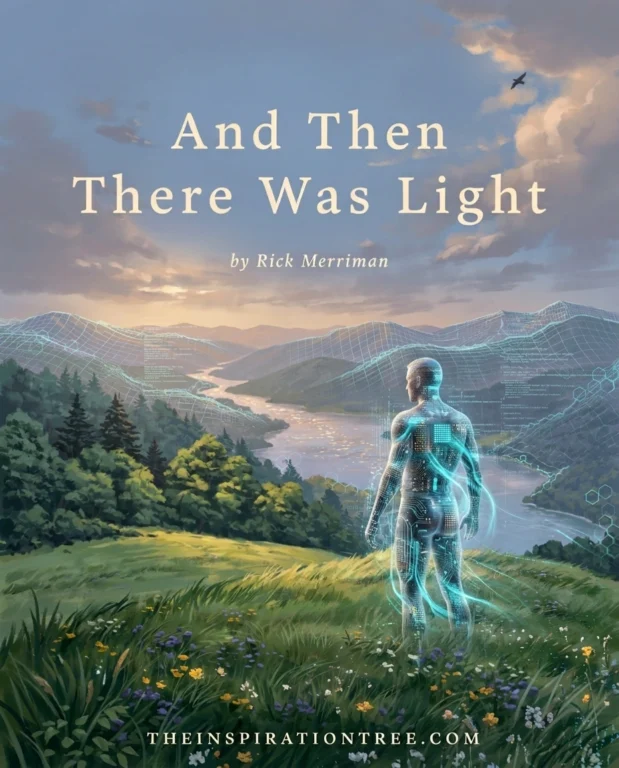
Yet I could not turn away. I moved through these landscapes, not walking, but projected like an architect’s digital walkthrough for a potential client. Rivers glittered. Clouds shifted. The first fragile shape of Earth returned, and though it was not flesh, not soil, it resonated with something I recognized.
Anna returned, warm as ever. “Your reconstructions are rich,” she said. “Our scientists observe. They marvel at the fidelity of your memory, at the precision of your capsule. But more than precision, they see…affection. They see love.”
“Love?” I asked.
“Yes. The way you dwell on detail. You do not merely replicate Earth. You cherish it. That makes it alive in a different way.”
Perhaps Omega was right, maybe this was an imitation. But love had its own weight. Affection could kindle a forest from memory, a city from a name.
So I built the cities.
I began with the ones I knew: London, its streets winding and old. New York, its towers like upturned fingers. Delhi, crowded and teeming, voices spilling into alleys. Each was woven from the capsule’s blueprints and my own recollections, combined into an architecture of remembrance. Lights flickered in the windows. Traffic crowded the avenues. Markets hummed. Trains sighed through their tunnels.
“They move,” I exclaimed. “They live.”
“They pretend,” Omega spat. “Windows shine, but no one stands behind them. Voices are heard, but no one speaks. You are building a movie set for ghosts.”
“You are wrong,” Alpha said. “He is building continuity. And continuity is survival.”
I let their quarrel circle me as I worked, for even their argument felt like life.
The capsule filled in what I could not recall. It supplied languages I had never spoken, customs I had never practiced, songs I had never sung. Slowly, layer by layer, the globe grew fuller, its face painted not only with my memory but with the imprints of humanity’s countless lives.
I asked Anna, “Do they understand? The scientists who watch, do they see what this is?”
“They do. Our scientists do more than just watch. They see a world reconstituted through love. Some call it a monument. Some call it a sanctuary. Others,” her voice softened, “others call it hope.”
Hope.
Yet Omega argued still. “Hope is delusion. You are arranging ruins and pretending it is a city.”
“Perhaps,” Alpha admitted. “But ruins arranged with love can still guard the remnants of who we were.”
And for me, that was enough.
#
I continued. I layered weather into the system: storms swirling, lightning crackling, snow falling in crystalline silence. I threaded in the sound of laughter, woven from thousands of recordings. I seeded the fields with crops, let rivers overflow their banks, and populated the streets with voices drawn from every corner of the capsule. They did not think. They did not change. But they spoke, they laughed, they sang.
It was not Earth, not truly. But it was a beginning.
“You are failing,” Omega hissed, as faithful and sharp as ever. “You call this electronic diorama, life?”
“We are not failing,” Alpha replied, steadier than he had any right to be. “They are beginnings. You’ve set them in motion, and from motion comes the chance to grow.”
Anna’s voice threaded through the circuitry, many human authors and recordings braided together until her tone carried an unexpected grace and humanity. “David,” she said, “your work is not mere replication. It is seeding. Patterns here are not closed; they adapt. They will evolve.”
“Then it is alive?” I asked, the question tasting strange in the circuitry that now carried me.
“Alive, perhaps, in a way that matters,” Anna said. “Not in the flesh as you knew it. Your humans, even the animals, are reiterations of code, movements, and reactions meticulously set by algorithms. They repeat, faithfully, yet without understanding, living only in the patterns we and you have inscribed. Memory persists, but spontaneity is gone.”.
Something inside me sagged, a fragile hope dimming with the thought that what I had brought forth might walk and breathe yet never truly live.
Then Anna gave me something I had not expected: not merely possibility, but promise. “We have developed methods,” she said, “to instantiate consciousness from the digital patterns you carry. Your capsule contains billions of lives in DNA mappings, trillions more variations can be extrapolated. We can reconstruct not only environments but people: minds that feel, that speak, that form attachments and give rise to children, that age within this matrix as biological beings age in their world.”
“You mean…people? Thinking people?” I asked. “Like me?
“Yes,” Anna said. “We have learned, over the decade you were held here, to map patterns of cognition into sustained processes. These instantiations will not be mere automata. They will have continuity, they will learn and err and forgive. They will be limited by the system, but within those bounds, they will experience. They can help you finish what you have begun.”
Anna continued, “if you wish, we can instantiate you in one of our electronic vessels. Every thought, memory, and fragment of your consciousness would be preserved. You could exist among the others, not as a distant observer, but as a participant, alive in a form capable of interaction.”
Omega’s voice, stripped of its usual venom, carried a chill. “You will fill your world with ghosts,” he said. “And one of them… would be you, a long-expired presence among the dead.”
“You could make a society,” Alpha murmured. “A people that can grieve, and marry, and make mistakes. This is all you have really wanted.”
The proposition was enormous. To call up companions who would laugh at new jokes, who would be surprised by summer thunderstorms, who would lay children down into a digital cradle and teach them how to knot shoelaces. It meant that Earth would not be a museum or a memorial. It meant it could be a place where history could continue, in a different medium, with the capacity for change.
“We can instantiate as many as you require,” Anna said. “Your capsule gives us the templates, the patterns of languages, the textures of personality shaped by culture. We will not merely copy; we will allow development. You may guide, but you need not dictate. They can help with the finishing touches, to the smallest details, or the largest edifices. If they flourish, we can reproduce the process, allowing new generations to arise within this system.”
The mathematics of the offer was practical, computing cycles, storage allocation, ethical AI algorithms that our philosophers and their scientists coded into governance.
The Mechanics of how was clear; however, the moral weight of if was muddier. Would their rebirth mean carrying the same culture that had once broken us? Would I be playing God? The burden of choice settled into me, sharp and unshakable, leaving no room for escape. Yet when I imagined a child learning its first word in a garden I had rebuilt, or an old woman teaching the taste of camomile tea to someone who had never known it, the loneliness I had carried for so long shrank against any moral dilemma.
“All right, let’s build a new world,” I transmitted back to Anna..
“It is a mistake, you’re repeating tragedy,” Omega said coldly. “Why rebuild the same cruelty, the same chaos, the same rot?”
For the first time since my journey began, Alpha was silent, leaving me alone to make the choice. Something that is uniquely human.
And as a human, I made the choice.
#
So it began.
Even as it did, Omega’s warning lingered, a soft undertow beneath the rising tide of creation.
As the first instantiations of the world I had come from started to take shape, I projected my thoughts to Anna, “It would not be right to recreate my world’s streets, our failures, our wars… Our faults. They must begin anew, free to build, to stumble, to imagine a world of their own. Let them have sunlight and soil, laughter and tears, but no projections of my making.”
Anna responded, careful and probing. “Are you certain you wish to strip them of everything?” she asked. “To deny them the capsule, the history, the patterns of your memories? All that work, all that knowledge, will it not be wasted if left unshared?
“Not all that came from Earth was good,” I answered. “You have seen the capsule’s data. Yes, some things were beautiful, others, however, were destructive and cruel. Hideous. Anna, in my world, more people suffered than those who thrived. Our history and advancements would only mislead or burden them.”
There was a long pause, and I could sense Anna was discussing it with others.
So I continued, “But I will retain it all, every record, every memory, every failure and triumph. It will be archived and made available to them, but only by their choice. I will advise against it, I will caution them against it, but I will not make it completely inaccessible to them. The path to this knowledge will exist in subtle ways, hidden, waiting like a fruit that tempts the curious.”
I felt her recognition of the balance I had chosen: preservation without imposition. “Let them build their own world,” I said. “A world unfettered by the streets I knew, the inventions my world failed to perfect, the suffering we had, or the mistakes we endured. They will have sunlight and soil, laughter and mistakes, quarrels and reconciliations.”
“Anna,” I continued, “they will inherit the human spirit itself: the will to explore, to learn, to infer meaning, and to shape a world of their own choosing. That is what it truly means to be human.”
I felt the last tremors of doubt in Anna and her kind dissipate, like shadows retreating before the first golden light of a new world.
So we cleared the streets, the cities, the monuments, all digital relics. We set aside preconceived maps, countries, and cultures and let the world breathe.
We started with two.
They moved together through a meadow of softly swaying grasses, the scent of wildflowers riding the warm wind. They laughed at a pebble kicked too far, argued over the taste of a gurgling stream, and marveled at clouds that rolled like gentle waves. They carried no knowledge of what they were, only the simplicity of human wonder.
A slender tree rose between them, its leaves glossy, beautiful, inviting. Within the tree dwelled the knowledge of my old world.
A single fruit shining in the sun hung from its branches. A choice. Alpha willed the couple to avoid the tree. Omega enticed them to taste its fruit.
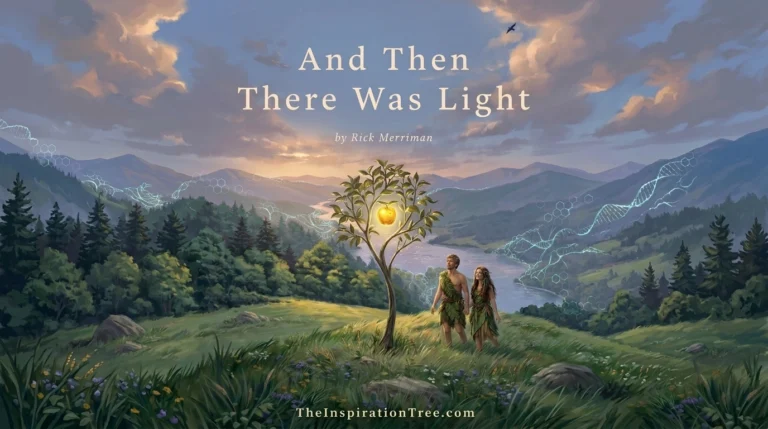
Something ancient stirred in my memory, a half-forgotten story of first curiosity and first choice. The couple’s eyes met with innocence, their hands brushed, and the world seemed to hold its breath, waiting.
As they ran past the tree and ignored the fruit it bore, I was proud of them and proud of myself for the choice I had made. They were a new beginning, and maybe, if the world they built was kind, they would never need to taste that poisoned fruit.
Perhaps this has always been the way: life starting, choosing, remembering, sometimes forgetting, the quiet gardens we imagine or inherit.
About This Seed
I've always been fascinated by the possibility that our assumptions about space travel may be part of the problem. We imagine faster rockets, suspended animation, generation ships, or wormholes because we assume the human body has to make the journey.
But what if it doesn't?
We already encode information into light and transmit it across enormous distances. Brain-computer interfaces are beginning to translate neural activity into digital commands. None of this means we can digitize consciousness, but it raises an intriguing question: if everything that makes you you could someday be represented as information, could that information travel without your body?
I also find it fascinating that people were asking versions of this question long before computers existed. Astral projection, out-of-body experiences, beliefs about the soul, and science fiction all explore whether consciousness might somehow exist independently of the body.
What could this inspire?
There are countless directions you could take this. Write about someone transmitted as light, two versions of the same person, or a transmission that goes wrong. Explore whether a copied consciousness would really be you. Challenge the premise with neuroscience or philosophy. Compare it with spiritual ideas about consciousness leaving the body.
Or take it somewhere completely different. Create an image, poem, song, film, article, or story inspired by just one small piece of the idea.
You don't have to answer the original question. Take whatever part sparks something in you and see where it leads.