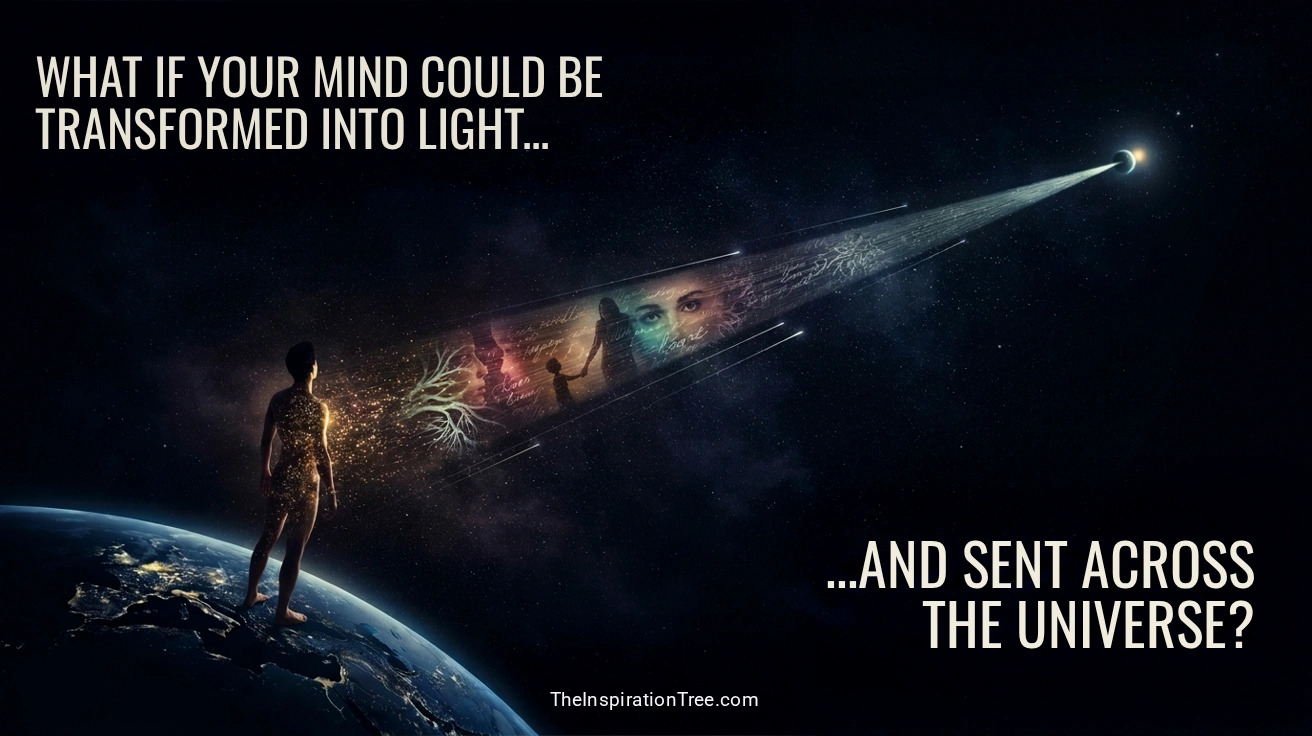
Every day, enormous pieces of our lives are already transformed into light.
A photograph you send to a friend, a video you stream, a conversation traveling through the internet, even these words may spend part of their journey encoded in pulses of light traveling through fiber-optic cables. A laser converts electrical signals into photons, the light travels through incredibly thin strands of glass, and a receiver at the other end converts those signals back into usable information. Corning explains how fiber-optic communication works
We already know how to turn data into light.
So what if someday that data were you?
The Brain Is Already Talking to Computers
That idea sounds like distant science fiction, but we have already taken some remarkable first steps toward connecting human brains directly to computers.
In 2024, Noland Arbaugh, who is paralyzed below the shoulders, became the first person implanted with Neuralink’s brain-computer interface. Neural signals from his brain allowed him to control a computer cursor with his thoughts, play online chess, and return to games such as Civilization VI. Neuralink’s PRIME Study update
Other research is going considerably further. Scientists have decoded attempted and imagined speech from brain activity, and in 2025 researchers demonstrated real-time decoding of some inner speech in people with severe paralysis. NIH: Decoding inner speech from brain signals
None of this means we can download a human mind. We can’t. At least not yet. Today’s brain-computer interfaces interpret limited kinds of neural activity, not someone’s complete memories, personality, emotions, and consciousness.
But the wall between brain and computer is no longer completely solid.
How Much of You Is Information?
Meanwhile, another technology is approaching the question from the opposite direction.
Companies are creating AI versions of people using their voices, photographs, stories, memories, and personal histories. Some are specifically marketed as digital legacies that family members can interact with after someone dies. These systems are simulations, not preserved consciousness, but they raise an uncomfortable question.
If an AI knew your life story, remembered your childhood, spoke in your voice, understood your sense of humor, knew whom you loved and responded to questions the way you would, how much more would it need before someone said, “That’s you”? Read about current AI digital-legacy experiments
Researchers at MIT’s McGovern Institute are taking the larger question seriously. Whole-brain emulation remains far beyond present capabilities. We don’t even fully understand what information would have to be captured to reproduce a functioning mind, much less consciousness. But it is increasingly a subject of legitimate scientific and philosophical discussion. MIT: Can consciousness be uploaded to a machine?
Suppose, someday, we figure it out.
Then we have data.
And we already know how to turn data into light.
Sending You to the Stars
NASA is already experimenting with laser communication across deep space. Its Deep Space Optical Communications experiment transmitted data between Earth and the Psyche spacecraft across hundreds of millions of miles. NASA’s Deep Space Optical Communications experiment
Scale that technology far enough and perhaps a future spacecraft wouldn’t need to carry a human body at all.
It might carry you as information.
There are enormous problems. Laser beams spread as they travel. The farther the light goes, the less dense the signal becomes and the harder its information is to recover. Aiming is extraordinarily difficult as well. Over astronomical distances, you can’t simply aim at where your receiver is now. You must anticipate where it will be when the signal arrives. NASA already accounts for this when pointing lasers across the solar system. How NASA points lasers across space
Across light-years, those challenges become staggering. And there would need to be something at the destination capable of receiving the signal and doing something with it.
But if those problems could be solved, the ultimate interstellar vehicle might not require engines.
It might require bandwidth.
Or Have We Imagined This Before?
There is something strangely familiar about the idea of consciousness traveling without a body. Long before computers, fiber optics, or lasers, human beings were already imagining it.
Astral projection and related spiritual traditions describe consciousness as capable of experiencing existence apart from the physical body. People also report out-of-body experiences during near-death events, sleep paralysis, lucid dreams, meditation, and other altered states. Science has proposed neurological and psychological explanations for many of these experiences, and there is no established scientific evidence that a person’s consciousness literally leaves the body and travels elsewhere. Yet the persistence of the idea across cultures is fascinating.
Perhaps it fascinates us because the question beneath it is so fundamental: Are we our bodies, or are our bodies simply containers where we currently reside?
Science fiction took that ancient question and gave it machinery. The transporter in Star Trek converts a person into a pattern that can be transmitted and reconstructed elsewhere. Our thought-as-data experiment is actually less ambitious. Forget transporting trillions upon trillions of atoms. What if all we needed to transmit was the information required to recreate the mind?
Modern neuroscience doesn’t tell us that this is possible or impossible. What it does tell us is that brains produce signals computers can increasingly interpret. Communications science tells us that information can be encoded into light and transmitted across enormous distances. Neither answers the consciousness question, but together they give us an intriguing place from which to ask it.
But Would It Actually Be You?
Suppose technology eventually becomes capable of mapping everything necessary to describe your mind. Your memories are there, but so are the relationships between them. Your personality, fears, habits, preferences, humor, knowledge, emotional associations, and all the subtle patterns that make your thoughts different from anyone else’s are captured as information.
That information becomes light.
Somewhere across the universe, perhaps decades or centuries later, a receiver reconstructs it. A consciousness awakens beneath a sky you have never seen, yet it remembers Earth. It knows your name. It remembers your childhood and the people you loved. It remembers volunteering to become data/light and wondering what arrival would feel like.
To that consciousness, there may be no mystery at all. It left Earth, crossed the stars, and arrived.
For everyone else, however, an enormous question remains. Did a human being actually travel across the universe, or did Earth transmit the instructions for creating someone who sincerely believes they did?
We may eventually discover that consciousness is completely reproducible from information. We may discover that something essential is missing. This is the basis for many religions and spiritual practices. Or we may learn that the distinction between an original and a perfect continuation is far stranger/closer/further apart than either science or philosophy currently imagines.
Either way, perhaps our obsession with building machines capable of carrying fragile human bodies across interstellar distances has caused us to overlook another possibility. The universe already provides something extraordinarily good at crossing empty space.
Light.
About This Seed
I've always been fascinated by the possibility that our assumptions about space travel may be part of the problem. We imagine faster rockets, suspended animation, generation ships, or wormholes because we assume the human body has to make the journey.
But what if it doesn't?
We already encode information into light and transmit it across enormous distances. Brain-computer interfaces are beginning to translate neural activity into digital commands. None of this means we can digitize consciousness, but it raises an intriguing question: if everything that makes you you could someday be represented as information, could that information travel without your body?
I also find it fascinating that people were asking versions of this question long before computers existed. Astral projection, out-of-body experiences, beliefs about the soul, and science fiction all explore whether consciousness might somehow exist independently of the body.
What could this Inpire?
There are countless directions you could take this. Write about someone transmitted as light, two versions of the same person, or a transmission that goes wrong. Explore whether a copied consciousness would really be you. Challenge the premise with neuroscience or philosophy. Compare it with spiritual ideas about consciousness leaving the body.
Or take it somewhere completely different. Create an image, poem, song, film, article, or story inspired by just one small piece of the idea.
You don't have to answer the original question. Take whatever part sparks something in you and see where it leads.