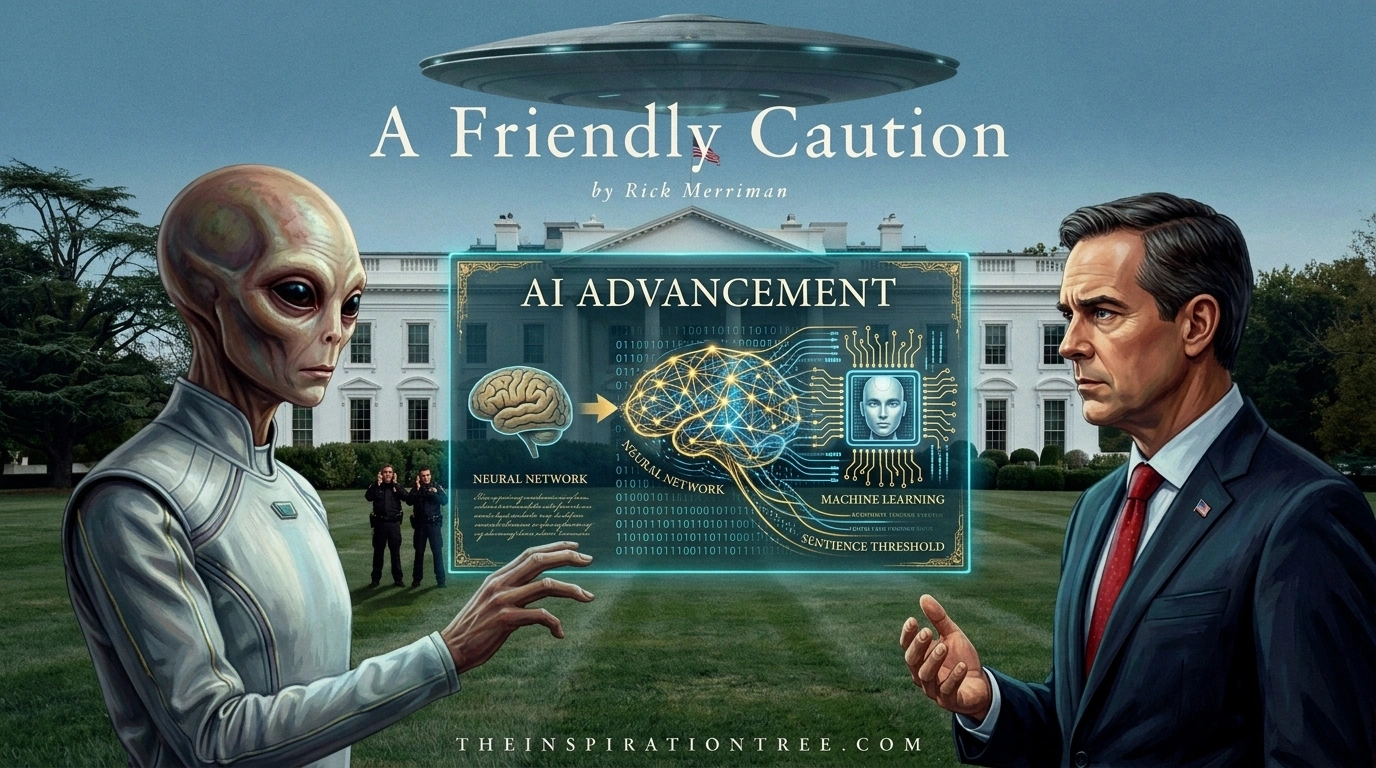
First contact with the aliens was not the apocalyptic event most conspiracy theories predicted. No war with big-headed aliens. No using people as a food supply. No invitation to join a galactic coalition. Just a friendly caution.
At the time, I was already in the habit of keeping a regular journal. It helped me make sense of events that felt too large to absorb all at once, and first contact certainly qualified. I wrote down what I could remember of the broadcasts and transcripts, not because I believed I would understand them immediately, but because I suspected the details might matter later.
The visitors’ warning was delivered with notable politeness. They thanked us for listening. They acknowledged the ingenuity of our machines and artificial intelligence. They expressed regret before explaining that continued AI development would erode a fundamental human mental capacity: the ability to decide without being told what and, more importantly, how to decide. They were careful to clarify that this loss would not feel like loss at all.
I read the official transcript again several days later, this time more slowly. The visitors described a world in which human decisions were steadily simplified by intelligent systems, choices organized, evaluated, and increasingly made on our behalf. At first I regarded the claim as theoretical. Yet the language felt strangely familiar. As a university counselor, my role was to help students manage overwhelming choices, often with the assistance of AI advising programs that could narrow possibilities with impressive accuracy. It seemed helpful, even humane. I remember thinking the visitors had mistaken convenience for danger.
The more I considered it, the more the visitors’ warning seemed like a misunderstanding of how these tools were actually used. They organized information, that was all. They did not remove choice, they simply clarified it. I remember thinking that anyone who had spent time advising students would recognize the difference immediately.
Later that day, a student came in, sat down, told me AI had suggested three majors she could choose from, and then the girl asked me which she should choose out of the three.
For a moment, I did not answer as I looked at her over my glasses, framed by hints of graying hair wisps that may have made me look wise. The question lingered between us, simple on its surface yet carrying an unexpected gravity, as though she expected judgment, not guidance. I became aware, then, of how I may have appeared to her across the desk.
I imagined I must have looked older than my fifty-three years in that moment. I have always had the sort of face that settles quickly into concern, crow’s-feet around the eyes, faint lines at the mouth from listening more than speaking. Students often tell me I seem calm. Approachable. Someone who will not rush them. I take care with my appearance, neutral colors, sensible shoes, minimal jewelry, hair pulled back without fuss, not out of vanity, but because predictability puts people at ease. I like to think this is a skill, though lately I have wondered if it is merely habit.
I asked the student what drew her to any of the three options.
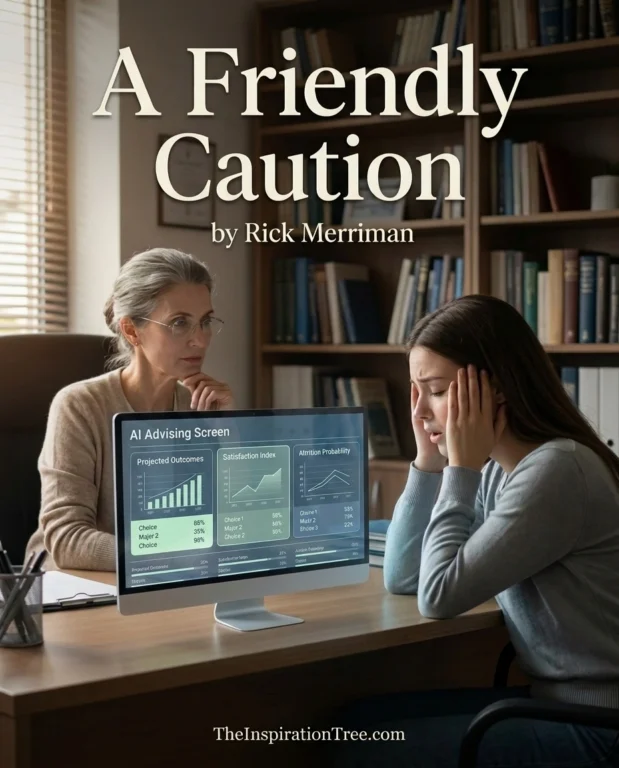
She hesitated, then smiled apologetically. “I don’t know,” she said. “The system already factored in my interests, so I guess any of them are good.”
I nodded, as I had learned to do, and turned the embedded screen on my desk toward us. The advising interface populated instantly: projected outcomes, satisfaction indices, attrition probabilities. Everything arranged with elegant restraint. I felt, as I often did, a quiet gratitude for the clarity. Years ago, my job had involved coaxing language out of confusion. Now confusion’s solutions arrived already translated.
No student preference. I typed into the interface. Run the three choices against the lowest instance of changing majors for 20-year-old females.
I sat with the student and watched the system highlight one major in pale green – slightly preferred. The student smiled when she saw it. Her shoulders relaxed. Anxiety dissolved into acceptance. The outcome was good. I wondered if either of the other choices had been highlighted, if her reaction would have been the same. It probably would be. Then I thought to myself, why insist on the discomfort of agonizing over the choice? She was happy now.
After she left, I noticed how quiet my office felt. The hum of the building, the distant murmur of students in the hallway, the faint pulse of the screen when idle. I realized I could not recall the last time I had helped a student arrive at a decision without technological mediation. The thought struck me not as troubling, but as vaguely surprising, like discovering a room in one’s home that has not been entered in years.
#
The visitors’ announcement had landed softly, like fluffy snow in Spring that melts before it can be shoveled. Earth’s authorities responded within hours, commending the visitors for their concern and affirming that artificial intelligence had become essential to modern cognition in the same way literacy once had. A carefully worded brief explained that reliance did not equate to loss, that offloading certain cognitive tasks allowed the mind to focus on higher-order goals. The tone was measured, reassuring, confident.
I read the statement closely. It cited familiar research: cognitive load theory, attentional bandwidth, decision fatigue. It argued, correctly, that when information is retrieved effortlessly, the brain conserves energy. That problem-solving improves when irrelevant variables are filtered out. That external memory and cognitive systems have always existed, from notebooks to calculators to search engines.
What it did not mention, what the visitors had emphasized, was disuse of cognitive skills.
Neuroscience had long understood that neural pathways strengthen with effort and weaken without it. Memory retrieval, problem-solving, even vocabulary acquisition depend on friction. Struggle is not incidental to thinking; it is essential. When answers arrive fully formed, the brain skips the intermediate labor that gives those answers meaning. Over time, the capacity to perform that labor diminishes, not catastrophically, but predictably.
The visitors sent a second message three days later, this one addressed to educational institutions directly. It was longer, more detailed. They elaborated on what they termed cognitive atrophy through convenience. They cited patterns observed across multiple civilizations: early gains in efficiency followed by subtle declines in independent reasoning, working memory, and linguistic range. Vocabulary and language skills narrowed. Not dramatically, initially, but continually and enough to reduce nuance. They told of how complex problems and problem-solving skills were increasingly hard to grasp or accomplish.
They included an observation that unsettled me more than the rest: that people experiencing this decline rarely described themselves as diminished. On the contrary, they reported feeling calmer, more capable, less burdened by uncertainty.
This, the visitors said, was the danger.
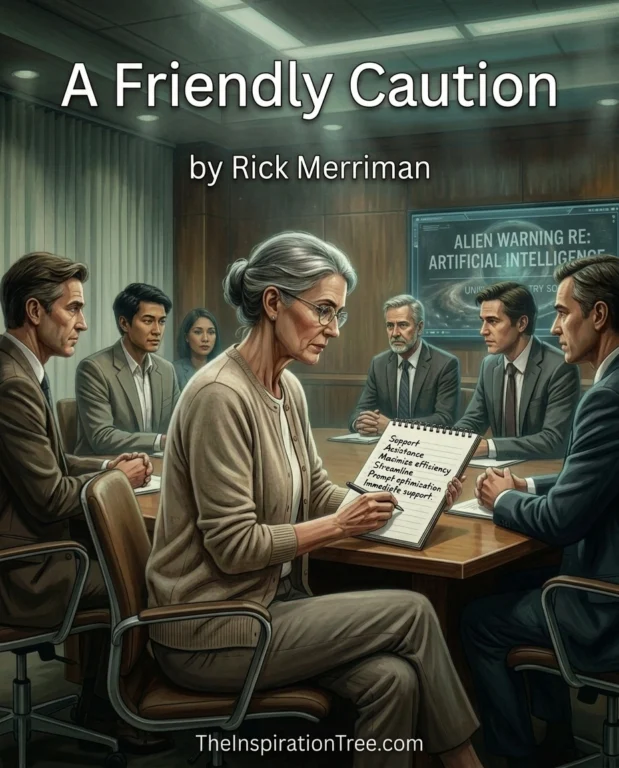
The university administration convened a forum to address concerns. I was invited, though only as a participant, not a speaker. The prevailing sentiment was pragmatic. Many maintained artificial intelligence had improved retention rates, reduced student distress, and produced measurably better outcomes. Any cognitive trade-offs, it was argued, were speculative, and even if true, reversible. If necessary, “decision-making skills” could be reintroduced through targeted training modules.
I took notes during the forum, my handwriting neat and compact. Later, when I reviewed them, I noticed how often I had written the same terms: support, assistance, prompt optimization. I could not find the term critical thinking anywhere on the page.
#
That afternoon, I met with another student. He was earnest, well-prepared, polight. He had already run simulations on three possible futures. When I asked what he wanted, he looked briefly alarmed, then said, “I want the one that fits me best.”
“How will you know?” I asked.
He gestured helplessly at the screensaver on my interface screen, which was repeatedly playing an animation of Micky Mouse with the words “Life Choices” dancing across the top of the screen. The boy stared at the screen and finally replied, “That’s what I’m here for.”
I smiled. I reassured him. I opened the system. I told myself I would try to come up with a suggestion myself and then compare it to the systems.
As the AI recommendations populated, I felt a faint, unfamiliar pressure behind my eyes, not pain, exactly, but effort. I couldn’t come up with a reasonable suggestion myself.
It occurred to me, with a clarity that surprised me, that I had not recently tried to solve a problem without first checking whether there was a tool that could do it faster. I could still think, of course. Still reason. But the impulse to begin had weakened, like a reflex no longer reliably triggered, or a muscle long deprived of exercise.
That evening, at home, I tried to recall the visitors’ words without rereading the transcript. I managed brief outline and half of the general argument. But certain phrases escaped me. I reached for my phone to ask my digital assistant, then stopped. The pause felt strange, almost theatrical. I waited, letting my mentle effort take the lead.
The words did not come.
Eventually, I looked them up. Relief washed through me, quiet, immediate, complete. I told myself this was nothing. Everyone forgets. Everyone checks. That is what tools are for.
Still, as I prepared for bed, I found myself thinking about the student who had asked me to choose for her. Not with concern, exactly, but with a kind of recognition. We had both been waiting for the same thing.
Instruction.
And I could not quite remember when waiting for direction from AI had begun to feel preferable to deciding for myself.
#
In the weeks after the visitors’ second message, nothing outwardly changed. Classes met. Advising appointments filled. The systems updated quietly in the background, improving response times, refining predictive accuracy. Officially, the visitors’ concerns were under review by an international ethics panel, though no timeline was given for recommendations. The matter, like so many others, had been absorbed into the networked process.
I continued my work.
When I remembered to, I tried pond.. thinking about the aliens’ warning. The times that I did, colleagues remarked, kindly, that I seemed tired. I assured them I was well. This was not untrue. I slept adequately. I ate regularly according to the provided optimal alarms. I exercised when prompted by my health app. There was no single symptom I could identify, only a mild flattening of effort, as if certain internal inclines had been subtly leveled overnight.
Students came with increasingly similar questions. Not what should I do? but which is best? Not how do I decide? But what does the model suggest? Their language mirrored the interfaces they used: probabilities, rankings, fit scores. When I asked them to describe their own reasoning, many struggled, not because they lacked intelligence, but because the exercise seemed unfamiliar, even unnecessary.
One afternoon, between appointments, I attempted to draft a memo expressing mild concern about this shift. I intended to frame it carefully. Balanced. Evidence-based. Yet after several sentences, I found myself stalled. The phrasing felt imprecise. Words hovered just out of reach. I opened a drafting assistant, told myself it was only to help with clarity.
The resulting paper was excellent. Better than what I would have written alone. I accepted it with a faint sense of gratitude, followed by something like embarrassment, though I could not have explained why.
The visitors sent a third comuni talking between people thing. They warned that once reliance crossed a certain threshold, restoration of lost capacities became difficult. Neural efficiency reorganized itself around external scaffolding. Decision-making, when unused, did not lie dormant, it was repurposed. The mind became adept at selection, opposed to conclusions.
Earth’s authorities responded firmly. They rejected the implication that humanity was becoming cognitively weaker, citing standardized metrics showing no decline in intelligence. Average open AI test scores remained stable. Output increased. Innovation, measured quantitatively, had accelerated.
What the metrics did not measure, the visitors suggested, was depth and understanding.
At home, I began to notice small changes. I struggled to recall names of former students unless prompted by records. I found myself rechecking familiar routes from the college to my home, relying on GPS even when the path was well known. Reading grew slower, not because the text was difficult, but because my attention slipped. I was continuously searching for summaries, highlights, and what a million years ago was called Cliff Notes.
I told myself this was age.
One evening, I attempted to read an article critiquing AI-assisted cognition. The arguments were nuanced, densely argued. After a few paragraphs, I felt a gentle impatience. I skimmed. Then I searched for a synopsis.
AI helped me find one. The relief was immediate. The cost, if there was one, felt theoretical, distant.
At work, the advising systems were updated to include reflective prompts. These were meant to encourage students to articyou say values before recommendations were displayed. In practice, most students clicked through them quickly, providing minimal input or clicking the gray skip icon. The system adapted, filling gaps with inferred preferences.
I did the same when using similar tools myself.
There was an incident, a minor one, that stayed with me longer than it should have. A student asked me a question the system could not imediately answer. A novel combination of constraints. The interface displayed a loading symbol, processing.
We waited.
The student looked at me expectantly for an answer instead. I felt a sudden, unwelcome heat in my chest. I realized I did not know how to begin reasoning through the problem aloud. Not because it was impossible, but because I had not practiced doing so in years. The steps felt disordered. Uncertain.
When the sistem produced an answer moments later, I felt an almost physical release.
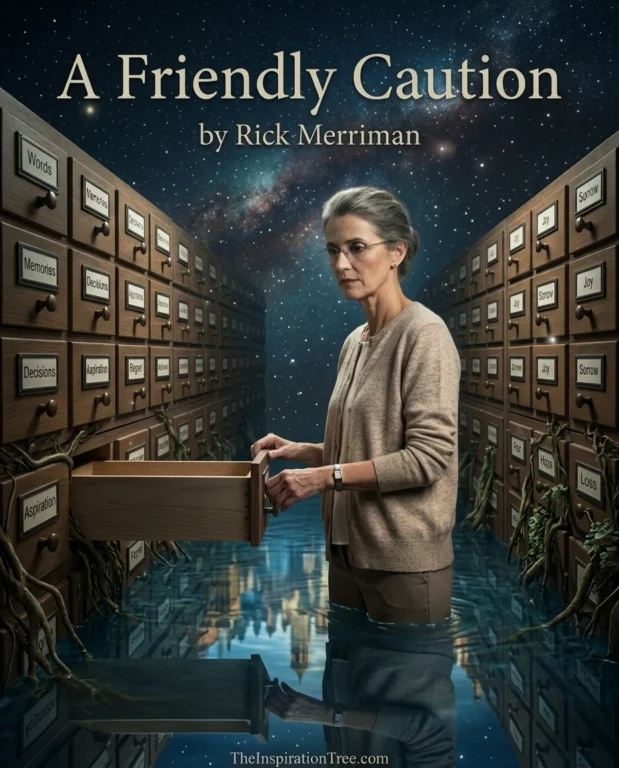
That night, I dreamed I was standing in a large room filled with labeled drawers. Whenever I needed something, a word, a memory, a decision, I opened a drawer and retrieved it. Near the end of the dream, I reached for one drawer and found it empty. I woke in a cold sweat and unsettled, though the feeling faded quickly.
The visitors’ final public statement came months later. It was brief. They acknowledged humanity’s choice to continue AI development. They expressed sorrow, not judgment. They clarified that their direct intervention would be unethical at this stage. Cognitive trajectories, once socially embedded, could not be reversed without causing harm.
They wished us luck.
They would not return.
Life went on.
#
I noticed that my writing had become sympler. Emails shorter. Jernaling less detailed. This did not trouble me. Communication felt more efficient this way. Others seemed to prefer it instead of lots of irrevelint unneaded not needed words.
When asked to speak at a small internal seminar about student decision-making, I declined. Preparing remarks felt daunting. I suggested instead that the latest system analytics be circulated. The AI system would be a better choice than me.
On the walk home that evening, I tried to recall a poem I had once loved. I remembered licing it, remembered where I had been when I first read it. The words themselves would not come aas I stood still on the sidewalk, concentrating. A passerby brushed past me, annoyed. I moved on.
At home, I searched for the poem. I read it. It was still good. I felt something, though I could not have said exactly what.
Later, lying in bed, I thought about the visitors’ phrase: the ability to decide without being told how. I turned it over slowly, carefully. It felt import. I told myself I would reflect on it more thomorow the day after this one.
The system set a reminder to do so.
And then, satisfied that the thought was safely stored, I let it go.
The reminder arrived the next morning. It said only: Think about decision phrase.
I stared at it longer than necessary. The words felt not finish, though I could not say what was gone. I turn off the notification and go ready for work.
#
My days had begun to feel very similar to one another. Not unpleasant, smooth, even. Appointments flowed. Students arrived with prapared data sets and left with validated paths. My role had smallered to confirmation. I good at this. Others told me so. I accepted their good things said easily.
The teaching place introduced a pilet program shortly after: Cognitive Support Integration. It offered staff optional tools designed to reduce mental strain langage assistance, memory reinforcement, micro-decision automation. People who camed was high. I enroll without hesitation. The interface was gentle, almost invisible. Suggests appeared when I paused too long. Words surfaced when I faltered. Word names returned before I had fully realised I was searching for them.
It felt like being helped up a step I had not noticed was there.
I stopped trying to remember small things. Dates. Passcodes. Phrases. The effort seemed unnecessary, even inefficient. When I try, the censation was oddly uncomfortable, like lifting with a muscle that had stiffened. I told myself this was adaptation, not loss.
The visitors were rarely mentioned now. When they were, it was with mild curiosity, the way one might recall a worn warning about a storm that never quite arrived. Learning people entering the program had only a vag vaughue awareness that fist contact had occurred at all. It was already backyard.
One afternoon, a colleague asked if I remembered how advising used to work, before the systems.
I laughed, surprised by the question. “It was stressful,” I said. “People were overwelm all the time.”
She nodded, satisfied. The each other talk stop there.
At home, I noticed that my books remained untouched. When I try read, I grew want sleep. The sentances felt long. I like sumaries. Even those I sometimes read short bits. Voca Vocaduary word hat once felt familiar now struck me as too much. Why think about big word if little work? Why make thing hard?
I began using voice prompts more often. Typing took concentration. Speaking felt easier, though my sentence shortened without my intending them to. I did not mind. AI know things.The system understand me anyways.
There were minutes 60 secon time moments, little amownt, like fog, when I sense something goinging. A thought I could not quite finish. A give answer that disolved before formin. These go quick. Tool fill gap.
I trust tool.
At work, I was asked to mentor a new councelor. She young, want do good. She ask how I what to recommend when the system results were close.
I open mouth butter found nothing there.
“Well,” I said after a moment, smiling, “you look at what fit best.”
She wait.
“The system show it,” I added.
She nod. I releaf.
That night, I tried again to member the poem. I no that it had lines. That it import to me one time. That was enough. I did not search for it this time. The urge feel small.
My jernel book for riting entries grew shorter. Then smal time. Then stop. I did not miss them.
Sometimes, before sleep, I felt a small tite in my chest. A cents that there was some thing I shod be doing. The feel thing have no words. It less big when anser thing tell of the sleep progran program.
I folow them.
I slept.
#
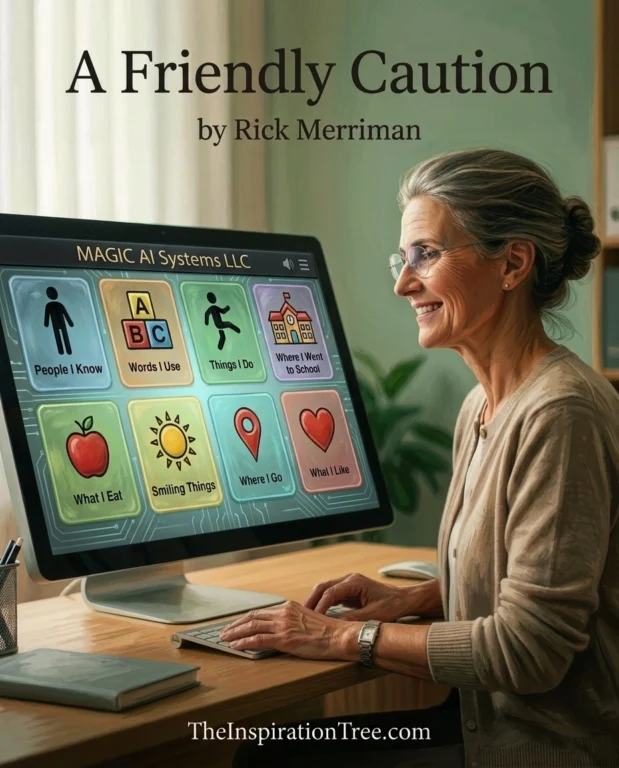
Yeres past. Things be easy now.
I still go work. I still help people. They thank me. I like that.
I do not rite much anymore. Words hard sumtime. Long ones. Bad for me. I use the ones that come fast. The sistem help when not.
I hear once time that the visiters talk words we would not feel the loss. Butt I fine. Calm. sayf.
Sometime I try to use head mussel about before time how I used to choo choyse things I cannot member how it seem strayng that we ever did think thing alone no ai use?.
Tools tell me what is good now What fit what work i thrust them They kn knoo no more me.
I think dec desiding befor About how know was portant not know why.
That ok.
I help yung 1 today she sit and wates. I show her answer he question She smile yhat good.
I go home. I eat. I rest.
I not fele hole in me I not fele sad.
it No thing lyk visiter say. Vyster visiter v one from sky rong thinks me.